

Quantum Dot Solar Cells (QDSCs)
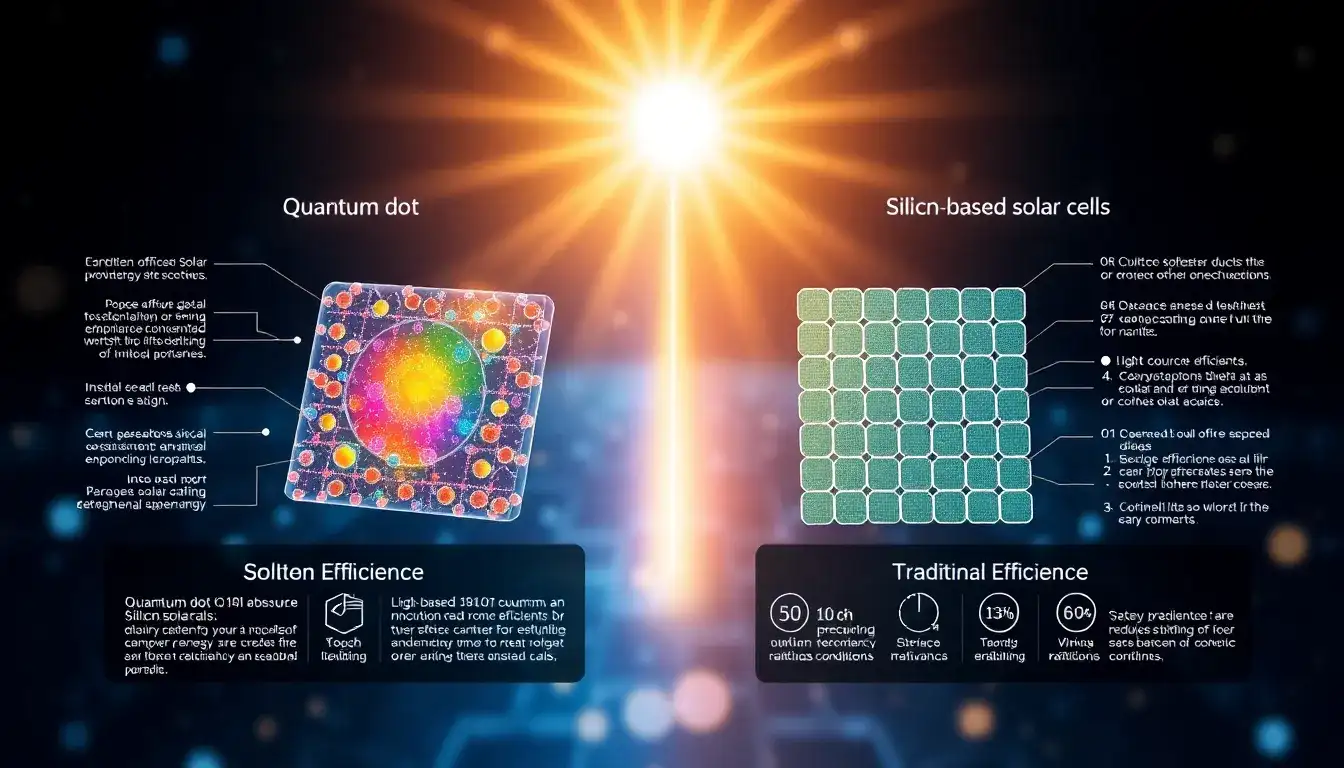
Quantum dot solar cells (QDSCs) are an emerging photovoltaic technology that differs significantly from traditional silicon-based solar cells, offering unique advantages and some current limitations in efficiency.
Efficiency Comparison:
- Current Efficiency Levels:
- Traditional silicon solar cells, which have been developed and optimized for over 50 years, typically achieve commercial efficiencies in the range of 20–25%, with some advanced cells reaching upwards of 26–27% under ideal conditions.
- Quantum dot solar cells, as of early 2024, have reached a world-record certified efficiency of 18.1%, achieved by researchers at UNIST in South Korea using organic perovskite quantum dots with novel ligand exchange techniques to improve stability and reduce defects.
- Theoretical Efficiency Potential:
- Silicon solar cells have a theoretical efficiency limit known as the Shockley-Queisser limit, approximately 33%, due to fundamental physical constraints on single-junction devices.
- Quantum dot solar cells have the potential to exceed this limit significantly, with theoretical maximum efficiencies reaching up to 66%. This is largely because quantum dots can exploit advanced mechanisms like multiple exciton generation (MEG), where a single high-energy photon generates multiple electron-hole pairs, and hot carrier extraction before energy loss as heat occurs.
Key Advantages of Quantum Dot Solar Cells Compared to Silicon:
- Bandgap Tunability: Quantum dots have size-tunable bandgaps allowing absorption across a broader range of the solar spectrum. This property is ideal for multi-junction or tandem solar cells that can harvest more sunlight efficiently.
- Multiple Exciton Generation: Unlike silicon cells that produce one exciton per photon, quantum dots can generate multiple excitons, boosting photocurrent and potentially surpassing silicon’s efficiency ceiling.
- Lower Manufacturing Costs and Flexibility: Quantum dot cells can be manufactured using solution processing and can be deposited on flexible substrates, enabling lightweight, flexible solar panels unlike rigid silicon wafers.
- Improved Stability: Recent advances in organic perovskite quantum dot stabilization have improved long-term operational stability, with some devices retaining efficiency after 1,200 hours of operation and over two years in storage.
Challenges:
- While quantum dot efficiencies have rapidly improved from less than 4% a decade ago to over 18%, they still lag behind leading silicon devices.
- Stability under operational conditions and scaling up manufacturing remain areas under active research.
- Early QDSCs using inorganic quantum dots had lower efficiencies (~8–16%) and faced issues with defects and environmental sensitivity, but new ligand exchange strategies have substantially mitigated these problems.
Summary Table:
| Feature | Silicon Solar Cells | Quantum Dot Solar Cells |
|---|---|---|
| Current Efficiency | ~20–27% (commercial) | Record 18.1% (2024, lab scale) |
| Theoretical Efficiency Limit | ~33% (Shockley-Queisser limit) | Up to ~66% (due to MEG and hot carrier effects) |
| Material Bandgap | Fixed | Tunable by quantum dot size |
| Manufacturing | Mature, wafer-based | Potentially low-cost, solution-processed, flexible |
| Stability | High | Improving rapidly with new materials and methods |
| Scalability | Established | Developing, early-stage |
Conclusion:
Quantum dot solar cells currently have slightly lower efficiency than the best silicon cells but are closing the gap rapidly due to recent breakthroughs. Their unique physical properties offer the potential to surpass silicon’s theoretical efficiency, potentially doubling it in the future, and they provide advantages in manufacturing flexibility and cost. Continued research could see QDSCs emerge as a commercially viable, high-efficiency alternative to traditional silicon solar cells, especially for applications requiring lightweight and flexible panels.
Original article by NenPower, If reposted, please credit the source: https://nenpower.com/blog/how-do-quantum-dot-solar-cells-compare-to-traditional-silicon-based-solar-cells-in-terms-of-efficiency/

