

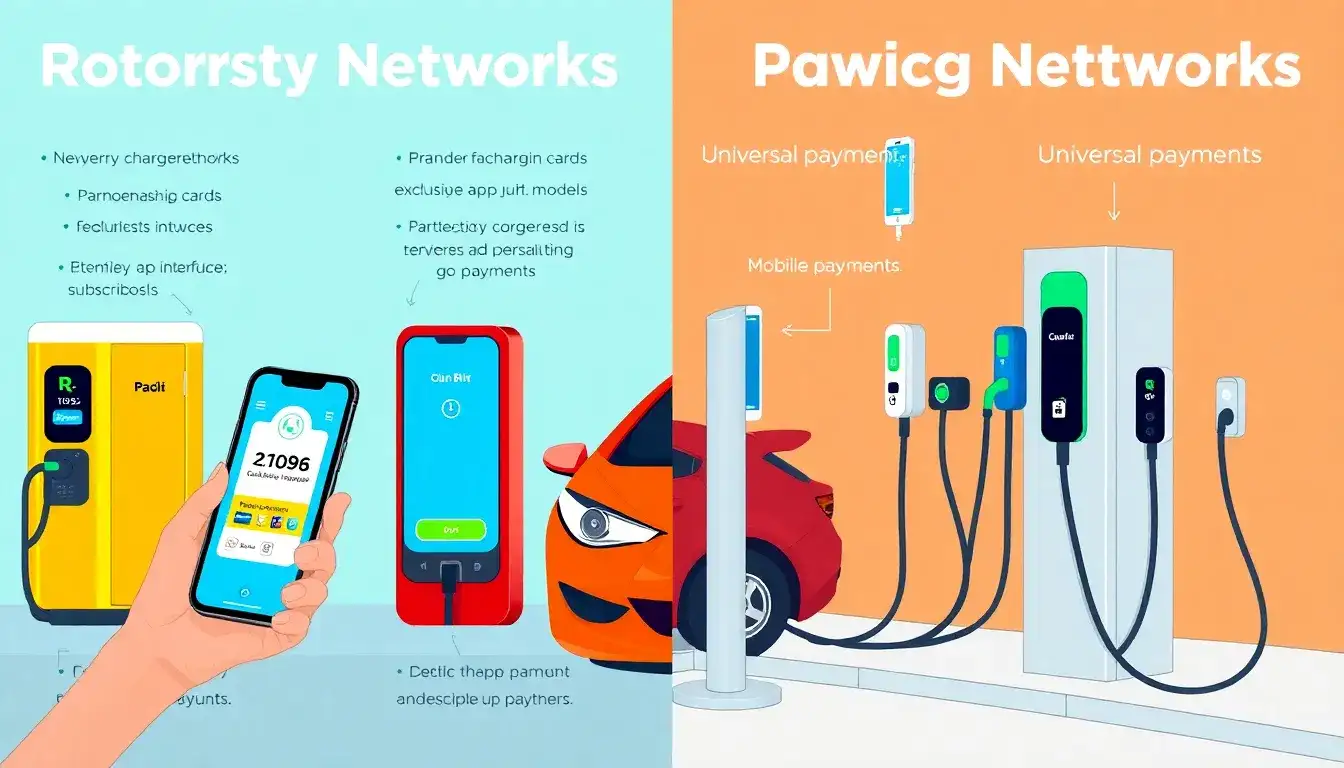
Proprietary charging networks and public charging networks differ significantly in how their payment systems operate, primarily in terms of user convenience, interoperability, and the payment methods supported.
Proprietary Charging Networks Payment Systems
- Proprietary networks typically require users to use specific payment methods tied to the network’s own infrastructure. This often means using dedicated apps, RFID cards, or membership subscriptions exclusive to that network. Early EV charging required such proprietary RFID cards, which proved cumbersome and inefficient for users.
- These systems create fragmentation since users must manage multiple accounts or apps when accessing different charging networks, leading to inconvenience and friction in the charging and payment process.
- Payment processing is often closed and not interoperable, limiting the flexibility for users to pay with standard methods like credit cards directly at the charging point without prior registration with the network.
Public Charging Networks Payment Systems
- Public networks are increasingly adopting open, interoperable payment systems that allow universal payment methods. For example, many public charging stations now accept credit card payments directly at the terminal, eliminating the need for proprietary apps or memberships.
- New payment solutions enable seamless plug-and-charge experiences where authentication and payment happen automatically and securely without user intervention, relying on standards such as ISO 15118 and initiatives like EMVCo’s Electric Vehicle Open Payments (EVOP).
- Cloud-based and OCPI-compliant (Open Charge Point Interface) payment systems are being developed and adopted to improve interoperability, regulatory compliance, and scalability, enabling a unified payment ecosystem accessible by diverse operators and users alike.
- These public payment networks are designed to comply with emerging regulations such as the EU Alternative Fuels Infrastructure Regulation (AFIR), allowing more flexible and user-friendly payment options spanning multiple operators and regions.
Summary Table of Differences
| Aspect | Proprietary Charging Networks | Public Charging Networks |
|---|---|---|
| Payment Methods | Proprietary apps, RFID cards, network-specific | Credit cards, universal plug-and-charge, open standards |
| User Experience | Requires multiple accounts/apps, friction | Seamless, interoperable, no multiple apps needed |
| Interoperability | Limited to own network | High, supports multiple operators and standards |
| Regulatory Compliance | Often lags behind | Designed to meet or exceed new regulations (e.g., AFIR) |
| Technology Integration | Closed ecosystems | Cloud-based, OCPI-compliant, ISO 15118 supported |
| Payment Processing | Fragmented, manual registration | Automated, secure, card-based open payment solutions |
In essence, proprietary charging payment systems are more closed and fragmented, requiring specific network credentials or hardware for payment, causing user inconvenience. Public charging networks are evolving towards open, interoperable, and automated payment systems that accept standard payment methods such as credit cards directly and enable seamless charging experiences across various stations and manufacturers.
Original article by NenPower, If reposted, please credit the source: https://nenpower.com/blog/how-do-proprietary-charging-networks-differ-in-payment-systems-from-public-networks/

