

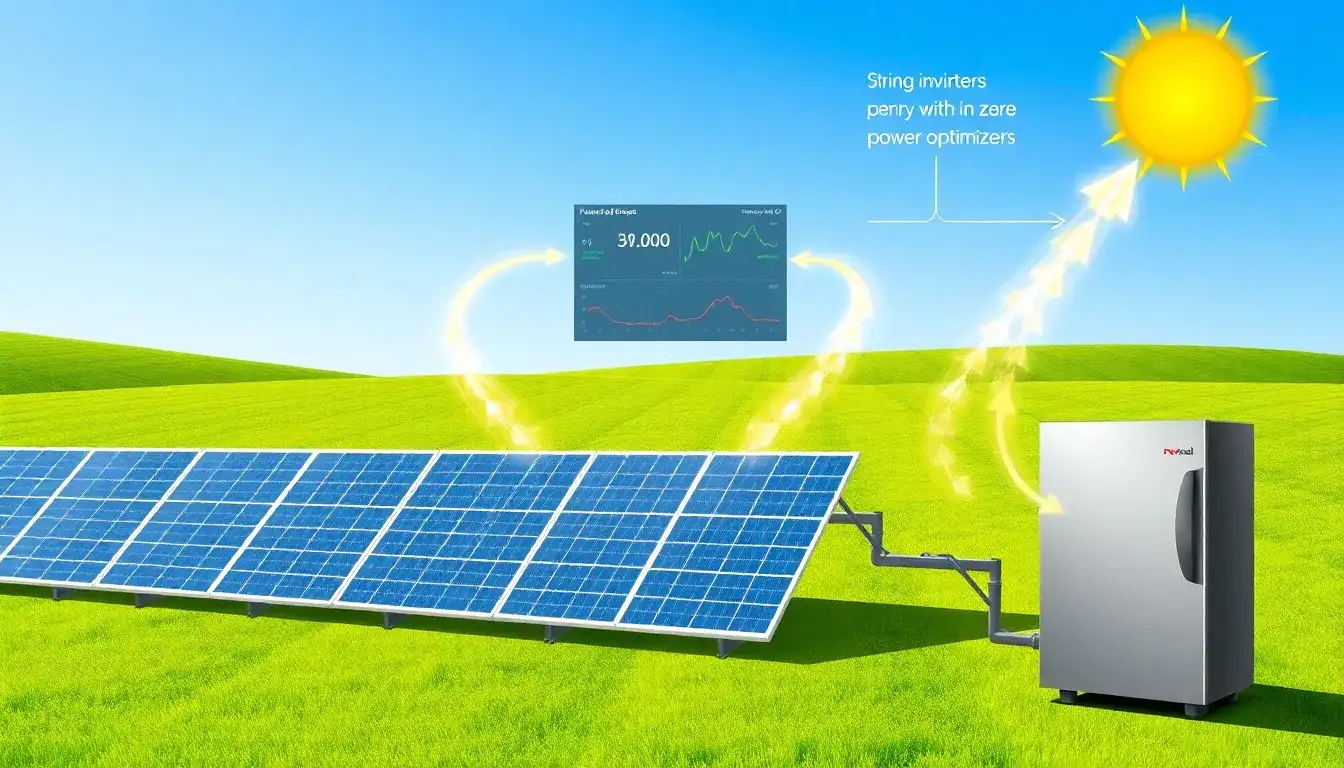
Power optimizers significantly enhance the efficiency of traditional string inverter solar systems by enabling panel-level power optimization, which overcomes key limitations of standard string inverters.
How Power Optimizers Affect String Inverter Efficiency
Traditional String Inverters and Their Limitations
- Standard string inverters connect multiple solar panels in series (“strings”) and convert the combined DC output into AC at a single central location.
- The output of the entire string is limited by the weakest panel in that string. If one panel underperforms due to shading, soiling, or damage, it reduces the power generated by all panels in the string.
- String inverters optimize power output only at the string level, not at the individual panel level, which can lower overall system efficiency especially in complex roof setups or partial shading.
Role of Power Optimizers
- Power optimizers are small electronics attached to each solar panel. They perform maximum power point tracking (MPPT) individually for each panel, allowing each one to operate at its peak output regardless of the performance of other panels.
- Instead of converting DC to AC at the panel, power optimizers condition and regulate the DC electricity, sending the optimized DC power to the centralized string inverter for conversion to AC.
Efficiency Improvements
- By eliminating the “weakest link” problem of string inverters, power optimizers can increase system energy yield notably, especially where panels are shaded or face multiple directions.
- Efficiency gains with power optimizers compared to traditional string inverters are generally around 5% under partial shading, with some cases reporting up to 25% more power in shady conditions.
- In full direct sun, power optimizers produce about 2% more power than string inverters alone.
- While microinverters provide slightly higher efficiency gains due to full DC-to-AC conversion at each panel, power optimizers offer a cost-effective compromise by combining panel-level optimization with a centralized inverter.
Additional Benefits Related to Efficiency
- Power optimizers facilitate module-level monitoring, allowing detection and troubleshooting of underperforming panels, which helps maintain overall system efficiency.
- They support compatibility with DC-coupled battery systems, improving overall system energy management and efficiency by avoiding unnecessary DC to AC to DC conversions.
Summary Comparison
| Feature | String Inverter Only | String Inverter + Power Optimizers | Microinverters |
|---|---|---|---|
| Panel-level optimization | No | Yes | Yes |
| Efficiency gain in shading | Limited by weakest panel | 5-25% more efficient than string inverter | Slightly higher than optimizers |
| Cost | Lowest | Moderate (about 10% more than string inverter) | Highest |
| Monitoring | String level only | Panel-level monitoring | Panel-level monitoring |
| Battery compatibility | Limited | Good (DC-coupled batteries possible) | Good |
| System complexity handling | Poor with shading/multi-orientation | Good | Excellent |
Conclusion
Power optimizers greatly improve the efficiency and flexibility of string inverter solar systems by enabling panel-level power tracking and optimization. They allow systems to mitigate losses caused by shading, panel mismatch, or varying orientations, resulting in up to 25% more energy production in less-than-ideal conditions compared to traditional string inverters alone, all while retaining the cost and reliability benefits of centralized string inverter technology.
Original article by NenPower, If reposted, please credit the source: https://nenpower.com/blog/how-do-power-optimizers-affect-the-efficiency-of-string-inverters/

