

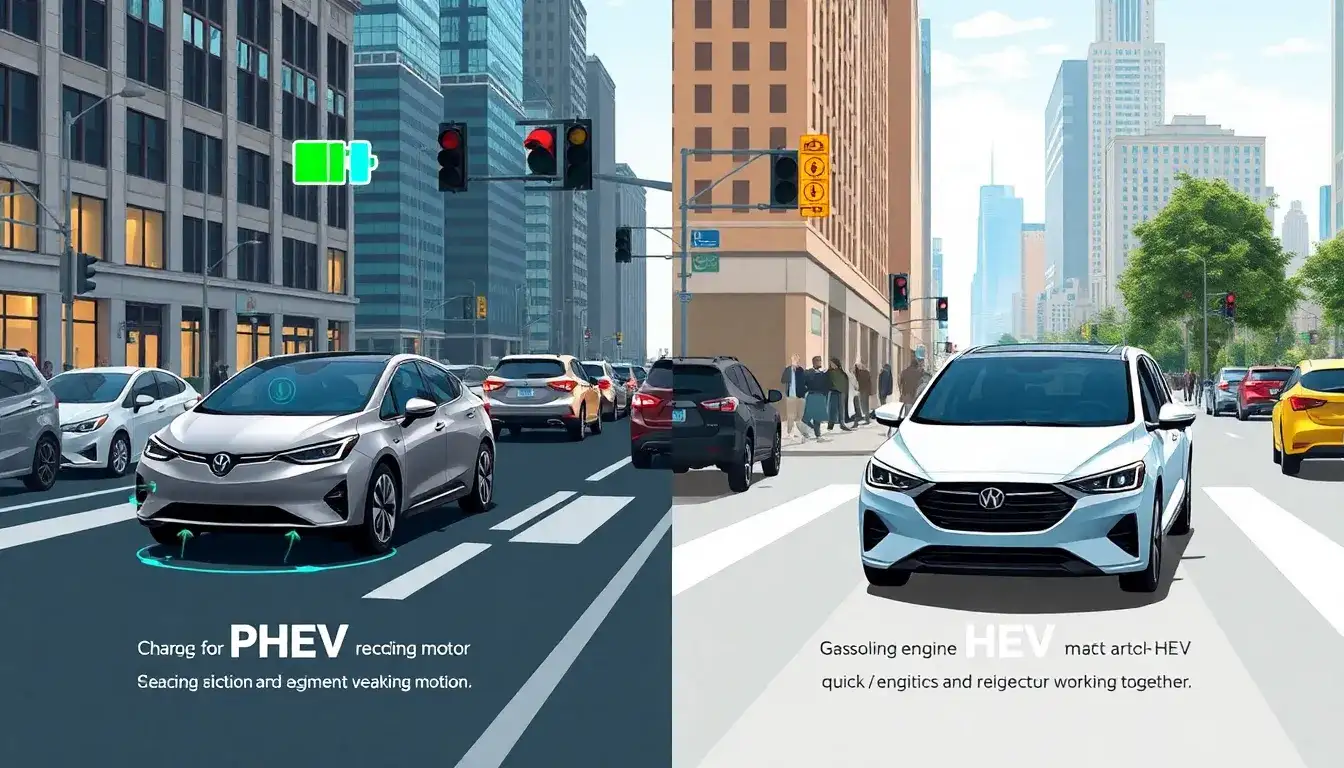
In stop-and-go city traffic, Plug-in Hybrid Electric Vehicles (PHEVs) generally perform better than traditional Hybrid Electric Vehicles (HEVs) due to their larger batteries and ability to operate in electric-only mode for longer distances.
Key Differences Affecting Stop-and-Go City Traffic Performance
- Battery Size and Electric Range:
HEVs have a small battery (around 1 kWh), sufficient for short bursts of electric motor assistance mostly during acceleration and braking. The battery is recharged mainly through regenerative braking and the engine itself, so the electric assist is limited in duration and range.
PHEVs feature much larger batteries—10 to 20 times the size of HEV batteries—allowing them to operate solely on electric power for 20 to 50 miles depending on the model. This means in typical city driving with frequent stops and starts, a PHEV can run mostly or entirely on electric power for a considerable part of the trip if the battery is charged. - Operation in City Traffic:
Both HEVs and PHEVs use regenerative braking to recover energy during stop-and-go driving, which improves efficiency. However, because a PHEV starts with a larger battery capacity and can be externally charged beforehand, it can stay in all-electric mode longer and reduce fuel consumption significantly. In contrast, an HEV relies more on gasoline engine operation once its smaller battery’s charge is depleted. - Fuel Efficiency and Emissions:
In pure electric mode during city commuting, PHEVs can achieve much higher equivalent miles per gallon (MPGe), such as 94 MPGe with up to 42 miles of electric driving in models like the Toyota RAV4 PHEV. Their conventional gasoline mileage (MPG) is similar to HEVs, but their ability to use mostly electric power in city traffic reduces fuel use and emissions more significantly than HEVs. For example, the Toyota RAV4 HEV gets about 41 mpg city while the PHEV gets around 40 mpg but with the added benefit of 42 miles of electric-only range.
Summary
| Feature | HEV | PHEV |
|---|---|---|
| Battery Size | Small (~1 kWh) | Larger (10-20× HEV battery) |
| Electric-Only Range | None or very limited | 20-50 miles depending on model |
| Electric Mode in Stop-and-Go | Short assist during acceleration | Extended electric-only driving possible |
| Fuel Efficiency (City) | Approx. 40-41 mpg | Approx. 40 mpg + up to 42 miles electric range (94 MPGe) |
| Emissions | Reduced vs. ICE only | Lower due to longer electric use |
| Charging Requirement | No external charging | Requires plugging in to recharge |
Because of these factors, PHEVs tend to outperform HEVs in stop-and-go city conditions when their batteries are charged, offering longer electric-only driving, lower fuel consumption, and reduced emissions. HEVs still perform very well in city traffic, but their electric assist is more limited without the ability to plug in and recharge a larger battery.
Original article by NenPower, If reposted, please credit the source: https://nenpower.com/blog/how-do-phevs-perform-in-stop-and-go-city-traffic-compared-to-hevs/

