

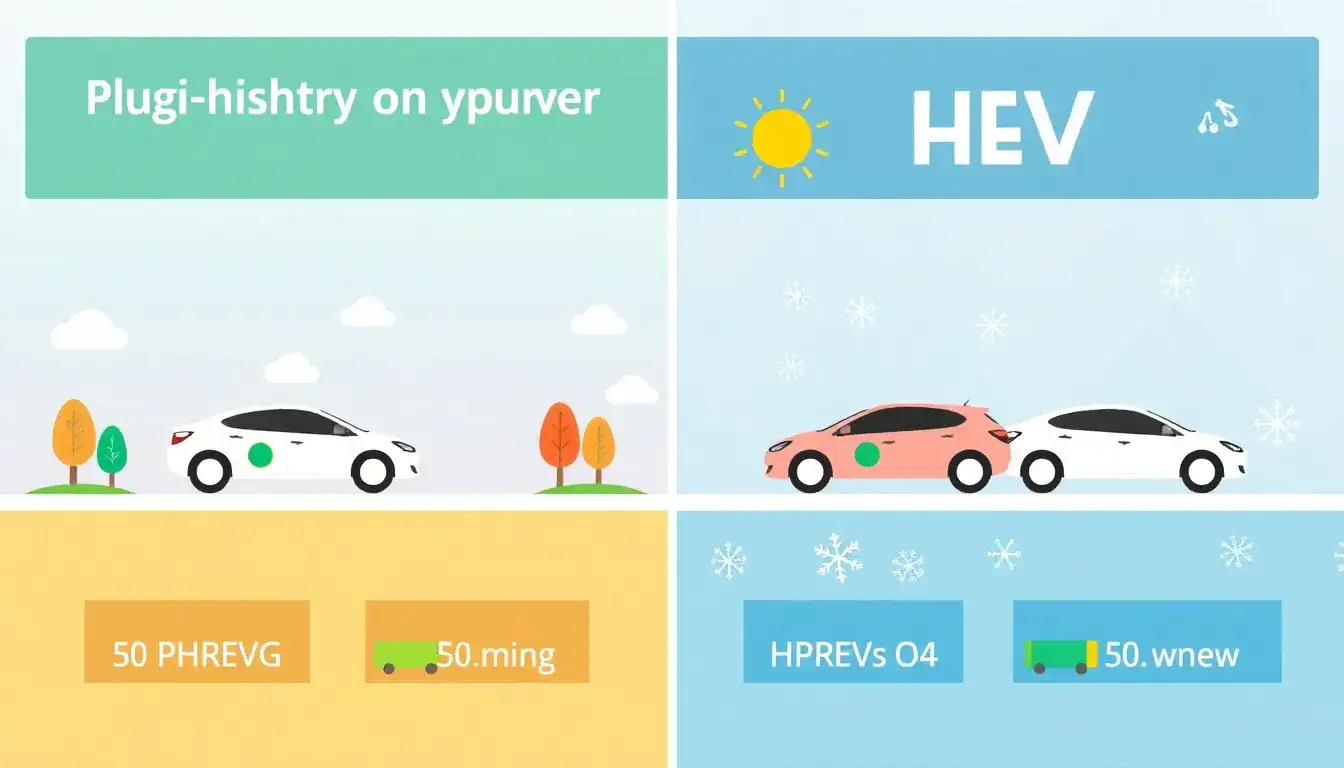
Plug-in hybrid electric vehicles (PHEVs) and hybrid electric vehicles (HEVs) differ in their emissions profiles, and this difference is influenced by factors including seasonal conditions, though detailed seasonal emissions comparisons are less often explicitly documented in the search results. However, based on the lifecycle emissions and usage patterns reported, we can infer how emissions might vary with seasons.
Emissions Comparison Between PHEVs and HEVs
- General Emissions Performance: PHEVs generally reduce greenhouse gas emissions more significantly than HEVs. PHEVs reduce lifetime emissions by about 46% on average in the US when compared to conventional internal combustion engine vehicles (ICEVs), slightly outperforming battery electric vehicles (BEVs) in some scenarios due to their smaller battery size and hybrid technology. HEVs also reduce emissions compared to ICEVs but not as much as PHEVs.
- Lifecycle Perspective: The emissions advantage of PHEVs over HEVs is consistent across various electricity grid emissions intensities, with PHEVs reducing more emissions mainly because they can operate in electric-only mode for a portion of miles (typically assumed around 30-40% of miles on electricity).
Seasonal Impact on Emissions
- Winter and Cold Weather Effects: While the search results do not explicitly provide seasonal emission data, it is well established that colder temperatures affect electric vehicle efficiency, including PHEVs, due to increased energy use for cabin heating and battery thermal management. In winter, PHEVs may rely more on the internal combustion engine if the battery’s electric range is reduced by the cold, increasing fuel use and tailpipe emissions.
- HEVs’ Seasonal Emissions: HEVs, which rely on the engine and regenerative braking without significant battery-only driving, may have more stable emissions throughout seasons as their electric assist is integrated continuously. However, cold starts and increased engine idling in cold weather can increase emissions in HEVs as well.
- PHEVs vs HEVs in Winter: In colder seasons, PHEVs may see a relative decrease in their electric driving share, leading to higher gasoline consumption and thus higher emissions compared to warmer months. HEVs might experience smaller relative seasonal variations since their hybrid system continuously assists the engine without depending heavily on electric-only mode.
Summary
- PHEVs generally have lower emissions than HEVs and ICEVs over their lifecycle, primarily because of the ability to drive a significant portion on electric power.
- Seasonal effects, particularly cold weather, likely reduce the electric driving range and increase fuel consumption for PHEVs, diminishing their emissions advantage in winter relative to HEVs.
- HEVs maintain more consistent emissions across seasons but typically have higher emissions than PHEVs in general.
Therefore, while PHEVs outperform HEVs in emissions overall, their relative advantage may be seasonally reduced in colder months due to decreased electric operation and increased fuel use. HEVs tend to have steadier emissions year-round but at a higher baseline level than PHEVs. Specific quantified seasonal emission data would require detailed empirical studies not present in the search results.
Original article by NenPower, If reposted, please credit the source: https://nenpower.com/blog/how-do-phevs-and-hevs-compare-in-terms-of-emissions-during-different-seasons/

