

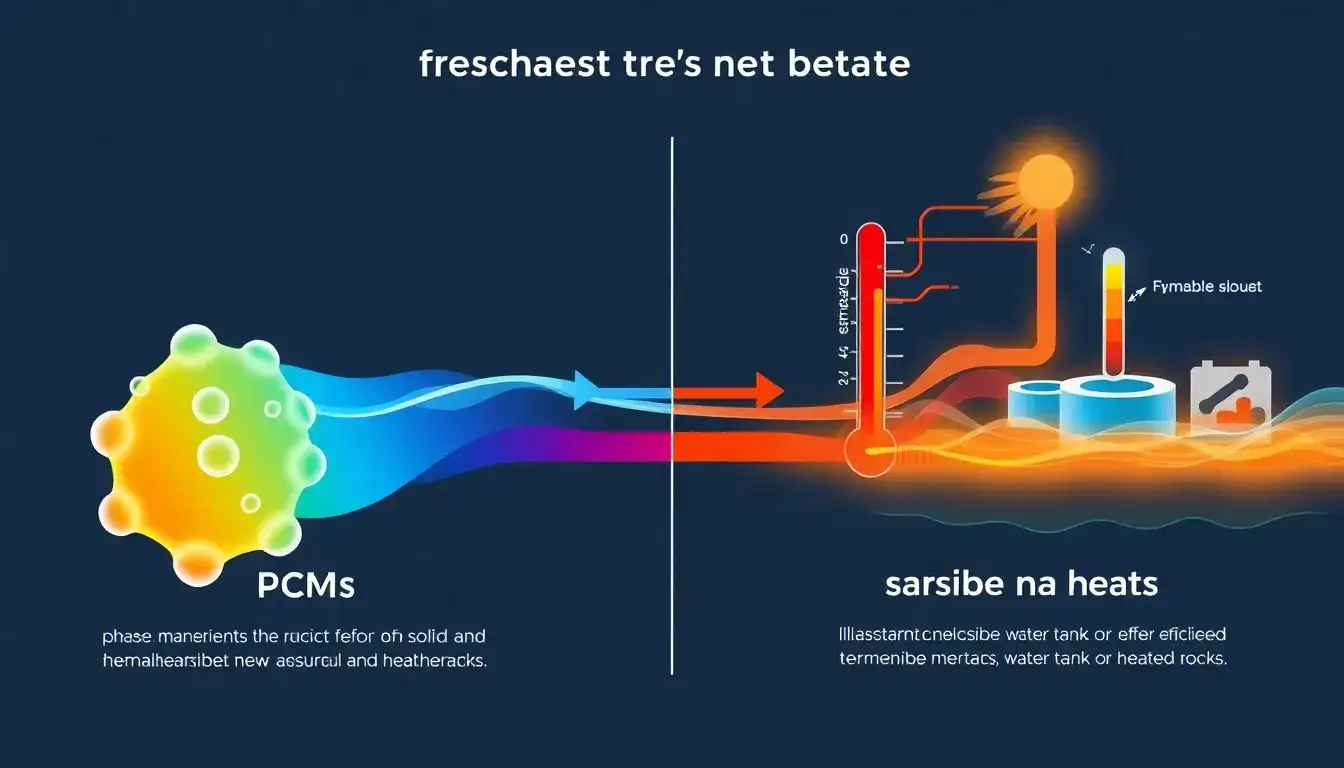
Phase change materials (PCMs) and sensible heat storage are two common methods for thermal energy storage, but they differ significantly in efficiency and energy storage characteristics.
Comparison of PCMs vs Sensible Heat Storage in Efficiency
Energy Storage Density and Capacity
- PCMs store thermal energy by absorbing or releasing latent heat during phase transitions (typically solid-liquid), allowing them to store more energy per unit mass or volume. This latent heat storage capacity is significantly higher than the sensible heat capacity used in conventional sensible heat storage (which relies on temperature changes without phase change).
- As a result, PCMs provide a greater density of energy storage compared to sensible heat storage materials like water or rocks.
Temperature Stability and Efficiency
- PCMs facilitate thermal energy storage and release at nearly constant temperatures corresponding to their phase change temperature. This characteristic reduces temperature differences during heat charging and discharging, improving the system’s overall thermal efficiency. Sensible heat storage involves larger temperature swings, which can cause more thermal losses and less efficient heat transfer.
- The smaller temperature difference in PCM systems means less energy is wasted during charging and discharging cycles, enhancing operational efficiency.
Compactness and System Design
- Due to their higher energy density, PCM-based thermal storage systems tend to be more compact than sensible heat storage systems, which require larger volumes for equivalent energy storage. This compactness can translate into cost savings and better integration into buildings or devices.
Thermal Conductivity and Rates of Charging/Discharging
- A notable challenge for PCMs is their relatively low thermal conductivity, which can slow heat transfer rates. However, advanced composites and nanomaterial enhancements (such as carbon nanotubes or graphene) have been shown to significantly improve heat transfer efficiency and reduce melting/freezing times, thereby increasing practical system efficiency.
- These improvements can sometimes lead to photothermal conversion efficiencies as high as 89.3% when PCMs are integrated with photothermal materials.
Summary Table
| Feature | Phase Change Materials (PCMs) | Sensible Heat Storage |
|---|---|---|
| Energy storage mechanism | Latent heat during phase change | Sensible heat via temperature change |
| Energy density | High (more energy stored per unit mass) | Lower |
| Temperature during storage | Nearly constant at phase change temperature | Varies over a range (larger ΔT) |
| Thermal efficiency | Higher due to smaller temperature differences | Lower due to larger temperature differences |
| System volume/compactness | More compact | Bulkier system needed |
| Thermal conductivity issues | Lower but improvable via composites and nanomaterials | Generally higher |
| Practical heat transfer rates | Can be slower but enhanced by advanced materials | Usually faster |
Conclusion
PCMs offer higher efficiency for thermal energy storage compared to sensible heat storage because they store more energy at a nearly constant temperature, reducing thermal losses and enabling more compact storage systems. Advances in material science have further improved PCMs’ thermal conductivity and charging rates, making them highly efficient for various applications. Sensible heat storage, while simpler and often cheaper, is less efficient due to lower energy density and larger temperature swings during operation.
Original article by NenPower, If reposted, please credit the source: https://nenpower.com/blog/how-do-phase-change-materials-pcms-compare-to-sensible-heat-storage-in-terms-of-efficiency/

