

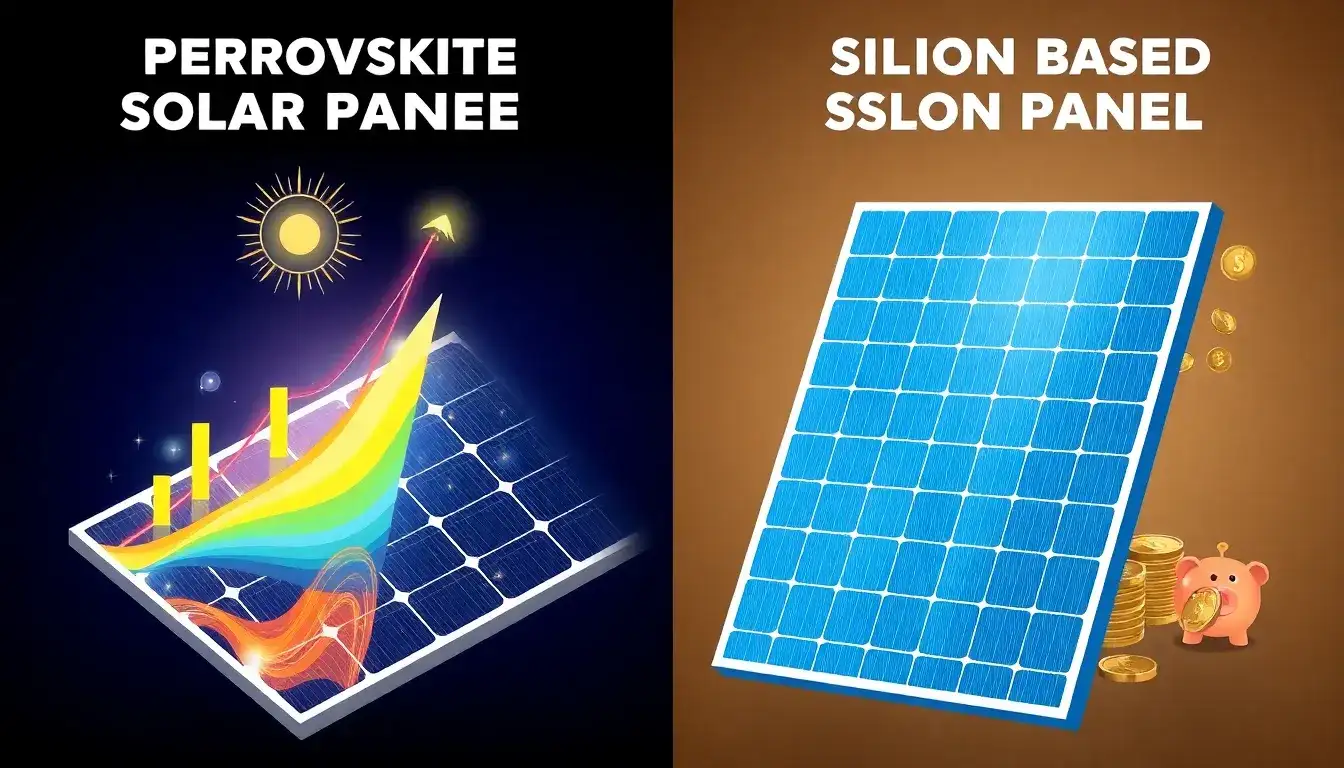
Perovskite solar panels differ from traditional silicon-based panels in both efficiency and cost primarily due to their material properties and manufacturing processes.
Efficiency Differences
- Light Absorption: Perovskite materials absorb light more efficiently than crystalline silicon. They can be tuned to capture regions of the solar spectrum that silicon cannot, which enhances their potential for higher overall power conversion efficiency (PCE).
- Efficiency Records: Traditional crystalline silicon solar cells have a theoretical efficiency limit around 29%, with commercial cells often slightly lower. Perovskite solar cells have achieved experimentally recorded efficiencies as high as 29.15%, surpassing many silicon-based technologies and representing one of the highest efficiencies among thin-film solar technologies.
- Thin Film Advantage: Perovskite cells are extremely thin (0.2-0.4 μm), which allows for potentially more flexible and lightweight solar panels compared to the rigid silicon panels.
Cost Differences
- Material and Manufacturing: Silicon solar cells require highly pure silicon and must be fabricated under high temperatures and vacuum conditions, which make the process costly and energy-intensive.
- Perovskite Manufacturing: Perovskite solar cells can be produced more cheaply and flexibly, often with simpler and lower-temperature processes. Their ability to be fabricated into thin, flexible films suggests potential for roll-to-roll manufacturing that could further reduce costs.
- Durability and Lifespan: A significant current drawback for perovskite panels is their shorter lifespan—typically around 2.5 years (30 months) in the best cases—compared to silicon panels that can last 25-30 years, which affects overall cost-effectiveness and practical deployment.
Summary Table
| Feature | Perovskite Solar Panels | Silicon-based Solar Panels |
|---|---|---|
| Power Conversion Efficiency | Up to ~29.15% (records), potentially tunable across spectrum | ~29% theoretical max, slightly lower commercial efficiency |
| Light Absorption | Superior, can be tuned to capture more spectrum | Limited to certain wavelengths |
| Material Purity and Tolerance | More tolerant to defects and impurities | Needs very high purity and defect-free silicon |
| Manufacturing Process | Lower temperature, simpler, potential roll-to-roll production | High temperature, vacuum conditions, energy-intensive |
| Flexibility | Flexible, thin film | Rigid, bulky panels |
| Durability/Lifespan | Shorter lifespan (~2.5 years) | Long lifespan (25-30 years) |
| Cost | Lower material and manufacturing cost, but current instability limits longevity cost-effectiveness | Higher upfront manufacturing cost, but mature and reliable |
In conclusion, perovskite solar panels promise higher efficiency potential and a significantly lower production cost due to easier and more flexible manufacturing processes. However, their current limitation is durability and operational lifespan, which is much shorter than traditional silicon-based panels. Silicon solar cells remain the industry standard for reliability and longevity but come with higher production costs and less spectral absorption capacity.
Original article by NenPower, If reposted, please credit the source: https://nenpower.com/blog/how-do-perovskite-solar-panels-differ-from-traditional-silicon-based-panels-in-terms-of-efficiency-and-cost/

