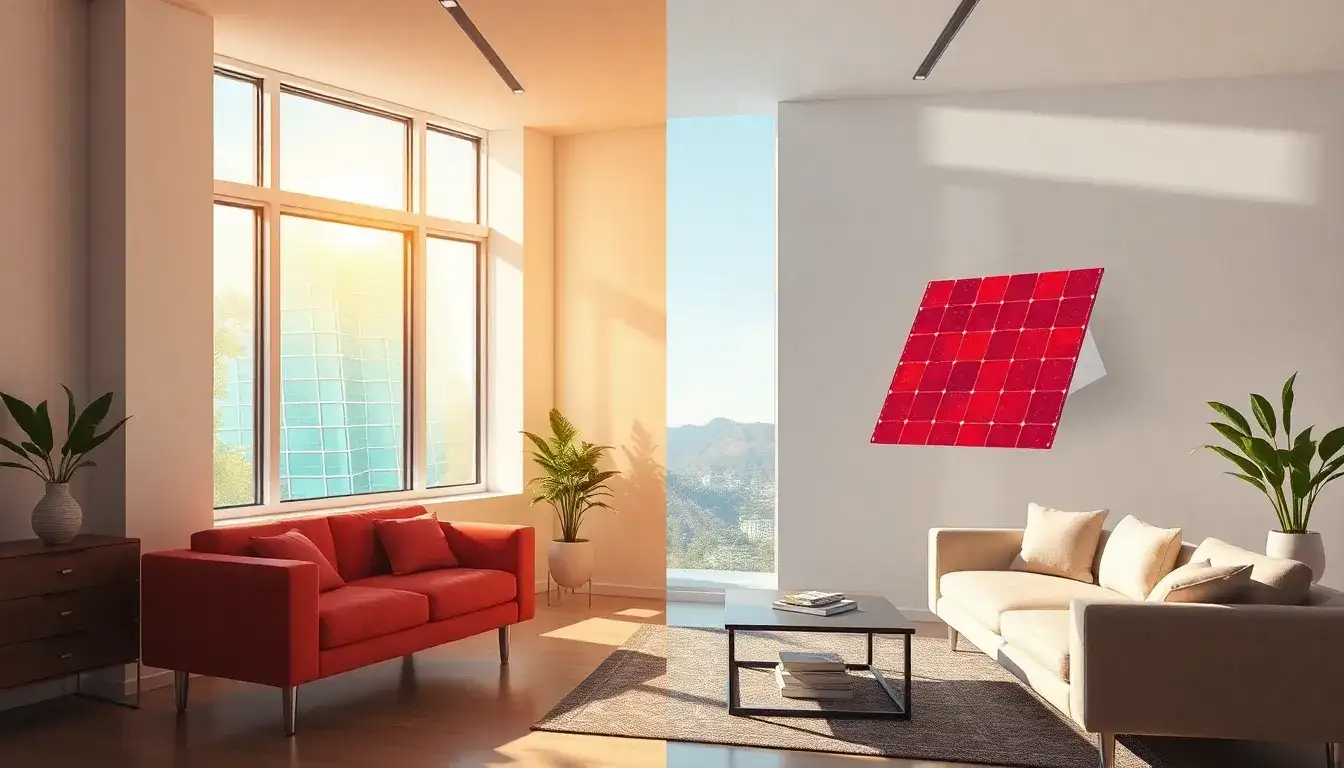
Perovskite solar panels show significant advantages over traditional solar panels specifically for indoor applications, largely due to their superior indoor power conversion efficiency, tunable properties, and cost-effective fabrication.
Efficiency Comparison
- Perovskite solar cells (PSCs) have demonstrated indoor power conversion efficiencies exceeding 40%, with one advanced design achieving up to 42% efficiency under typical indoor lighting of 1,000 lux from a 3,000 K LED source. This performance is driven by improvements in defect passivation and the use of self-assembled monolayers that enhance the perovskite crystal growth and optoelectronic properties.
- In contrast, traditional silicon-based solar panels typically exhibit much lower efficiencies indoors because they are optimized for high-intensity sunlight rather than the lower-intensity and different spectral distribution of indoor lighting. Their efficiency indoors is generally well below that of perovskite cells under comparable conditions.
Material and Application Advantages
- Perovskite materials offer better bandgap adjustability, allowing optimization for indoor light spectra, which often differ from sunlight. This adaptability translates into more efficient energy harvesting indoors than traditional solar panels, which have fixed bandgaps.
- PSCs can be fabricated on flexible substrates and at lower costs, enabling easier integration into indoor environments and IoT devices, where flexible, lightweight, and small-area solar cells are critical.
- The improved optoelectronic properties and ability to tailor device structures position perovskite solar cells as a superior choice for powering indoor electronics, especially in emerging markets like IoT monitoring systems that require reliable indoor energy harvesting solutions.
Summary
| Feature | Perovskite Solar Panels | Traditional Solar Panels |
|---|---|---|
| Indoor Power Conversion Efficiency | >40% (up to 42% reported) | Significantly lower (<40%) |
| Bandgap Tunability | High, optimized for indoor lighting spectra | Fixed, optimized for sunlight |
| Substrate Flexibility | Compatible with flexible and lightweight substrates | Mostly rigid and heavier |
| Cost and Fabrication | Lower cost, easier fabrication, scalable | Higher cost, complex fabrication |
| Suitability for IoT and Indoor Use | Excellent, tailored for low-light indoor scenarios | Generally less suitable for indoor low light |
In conclusion, perovskite solar panels outperform traditional solar panels in indoor applications due to their higher indoor efficiencies, material tunability, cost advantages, and better integration potential for indoor electronics and IoT devices.
Original article by NenPower, If reposted, please credit the source: https://nenpower.com/blog/how-do-perovskite-solar-panels-compare-to-traditional-solar-panels-in-indoor-applications/