

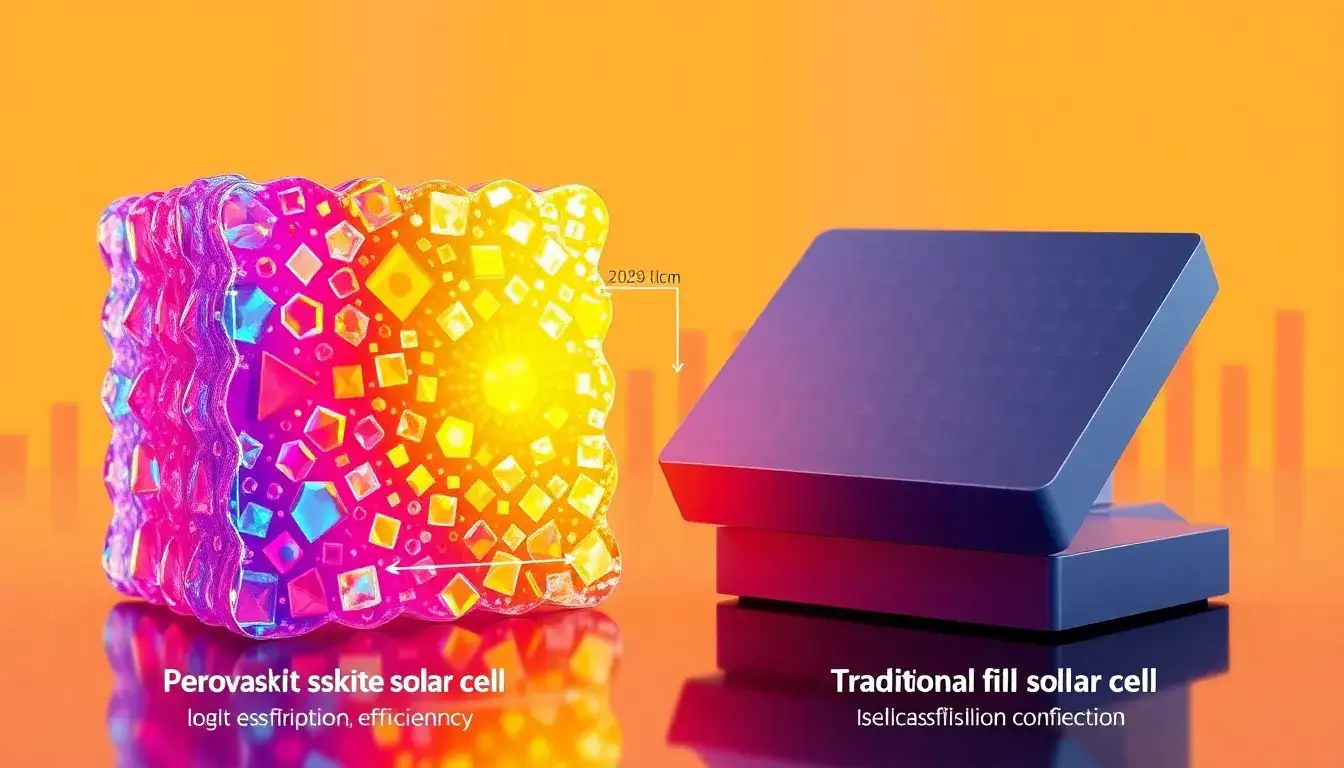
Perovskite solar cells demonstrate higher laboratory efficiencies than traditional silicon solar cells when used in tandem architectures, though commercialization challenges remain. Here’s the comparison:
Efficiency Comparisons
- Single-junction perovskite cells
Recent lab records reach 25.7%–26.3% efficiency, surpassing monocrystalline silicon cells (typically 22%–24% in labs). However, achieving >25% efficiency remains uncommon. - Perovskite-silicon tandem cells
These combine perovskite and silicon layers, achieving 29.8%–34% efficiency in labs, exceeding the practical limit of standalone silicon (~27% lab record). - Commercial silicon cells
Mass-produced silicon modules average 15%–22% efficiency, while perovskite PV is not yet manufactured at scale.
Key Differences
| Feature | Perovskite Solar Cells | Silicon Solar Cells |
|---|---|---|
| Lab Efficiency | Up to 26.3% (single-junction), 34% (tandem) | ~27% (single-junction lab record) |
| Commercial Efficiency | Not yet mass-produced | 15%–22% (modules) |
| Stability | Improved (retains 90% efficiency after 1,100 hours in recent tests) | Decades-long proven stability |
| Manufacturing | Low-temperature solution processing possible | High-energy, high-cost processes |
Recent advances, such as protective coatings that triple operational stability, suggest perovskite technologies are closing gaps with silicon while offering superior efficiency potential in multi-junction architectures. However, durability and scalable production remain unresolved.
Original article by NenPower, If reposted, please credit the source: https://nenpower.com/blog/how-do-perovskite-solar-cells-compare-to-traditional-silicon-solar-cells-in-terms-of-efficiency/

