

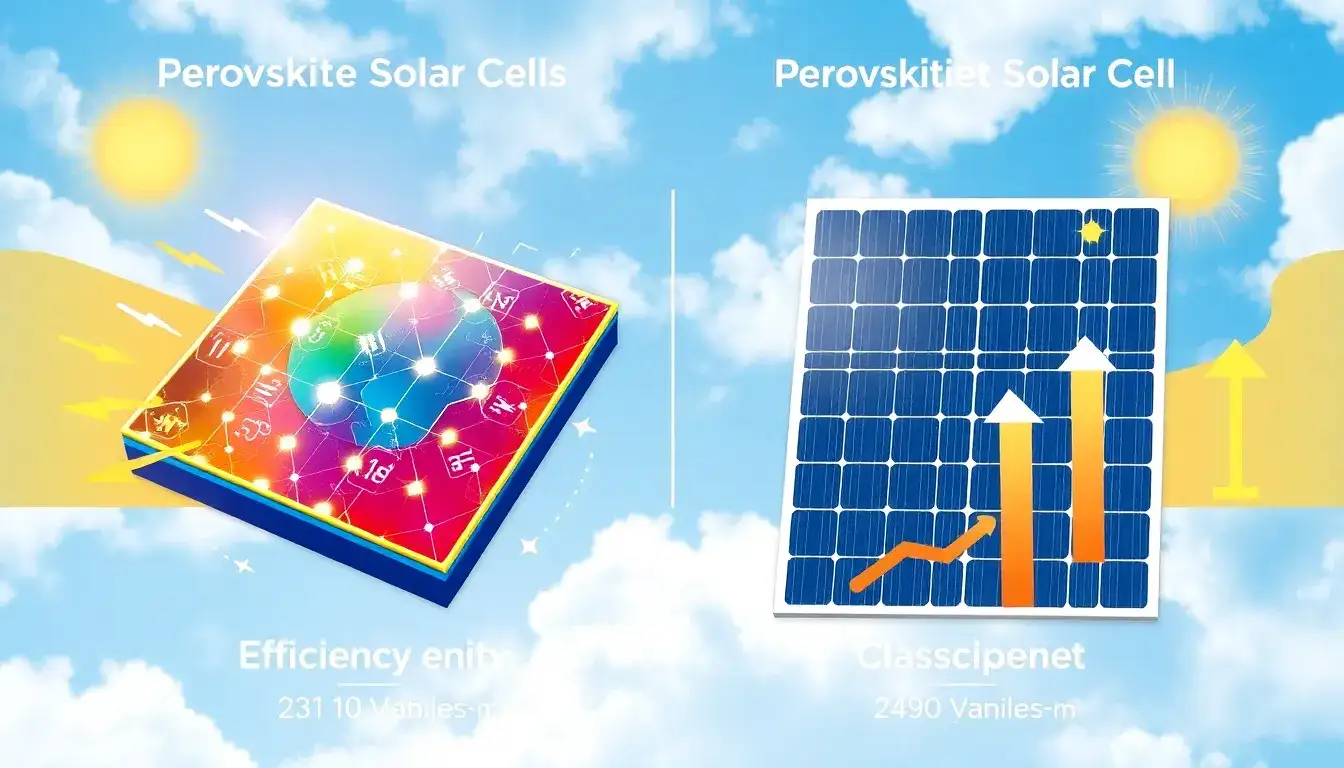
Perovskite solar cells (PSCs) have rapidly advanced in efficiency, now rivaling and even exceeding traditional silicon solar cells in certain configurations, particularly in tandem architectures.
Efficiency Comparison
- Single-junction efficiency:
- Laboratory-scale perovskite solar cells have achieved efficiencies of about 25.7% as of 2021 in single-junction designs.
- Traditional crystalline silicon solar cells typically have efficiencies around 20% to 22%, with commercial high-performance silicon cells reaching up to about 26-27%.
- Tandem cell efficiency:
- Perovskite-on-silicon tandem solar cells have reached efficiencies close to 34%, surpassing the practical efficiency limits of single-junction silicon cells.
- A certified perovskite-on-silicon tandem cell recently achieved 29.52% efficiency, demonstrating the ability of perovskite layers to boost silicon cell performance.
Key Advantages of Perovskite Cells that Impact Efficiency
- Perovskite materials have a high absorption coefficient, enabling ultrathin active layers (~500 nm) to absorb a wide range of the solar spectrum effectively, which helps achieve high efficiency even with thin films.
- The bandgap of perovskite materials is tunable by adjusting their chemical composition, allowing better spectral matching and optimization when paired with silicon in tandem cells.
- Perovskite cells exhibit excellent charge carrier properties such as long diffusion lengths and low exciton binding energy, improving electron-hole separation and collection efficiencies.
Other Considerations
- Stability and durability remain challenges for perovskite solar cells compared to silicon, which has a long-established track record of reliability. However, recent advances like protective coatings have significantly improved perovskite cell lifetimes without compromising efficiency (e.g., a protective amidinium-based layer tripled stability and maintained 26.3% efficiency).
- Perovskite cells potentially offer lower manufacturing costs due to low-temperature processing and simpler fabrication methods such as ink printing, which may help offset current challenges in scale-up.
Summary
| Feature | Perovskite Solar Cells | Traditional Silicon Solar Cells |
|---|---|---|
| Typical single-junction efficiency | ~25.7% (lab scale) | ~20-22% (commercial) |
| Tandem cell efficiency | Up to ~34% (perovskite-silicon tandem) | ~26-27% (single-junction performance limit) |
| Absorber layer thickness | Ultrathin (~500 nm) | Thicker (tens to hundreds of microns) |
| Material tunability | Bandgap tunable for spectral matching | Fixed silicon bandgap |
| Stability | Improving rapidly, shorter lifetime currently | Industry-standard long-term stability |
| Manufacturing cost potential | Potentially lower due to simpler, low-temp processes | Higher capital and energy costs |
Perovskite solar cells have made remarkable strides in efficiency, especially when combined with silicon in tandem cells, demonstrating a new path beyond the efficiency ceiling of traditional silicon technology. Although challenges remain with stability and commercial scale-up, ongoing research is rapidly closing these gaps. Therefore, perovskite solar cells currently offer higher theoretical and demonstrated efficiencies than silicon alone and promise cost-effective, high-performance solar energy technology in the near future.
Original article by NenPower, If reposted, please credit the source: https://nenpower.com/blog/how-do-perovskite-solar-cells-compare-to-traditional-silicon-cells-in-terms-of-efficiency/

