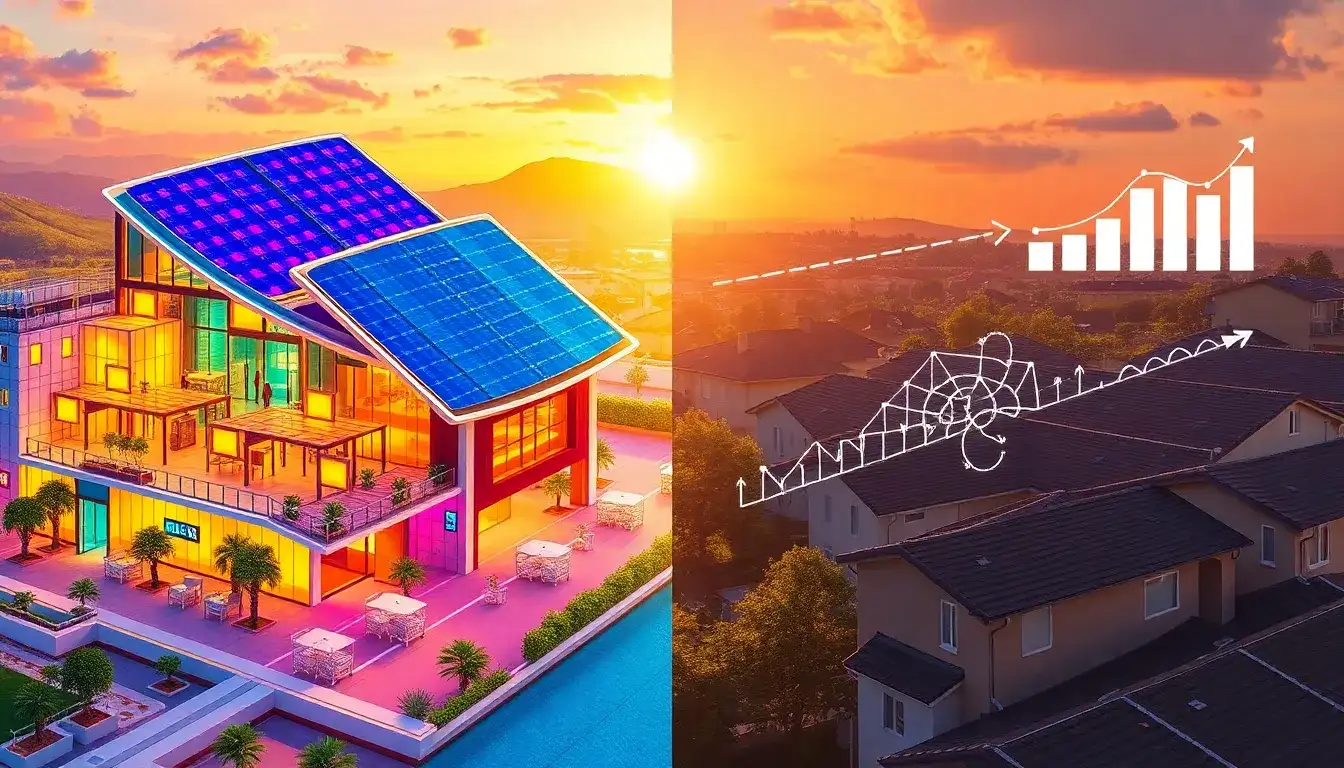
Perovskite solar cells and traditional silicon cells differ significantly in efficiency, cost, production, and durability, with each offering distinct advantages and challenges.
Efficiency
- Perovskites can achieve higher theoretical efficiencies (over 30% in lab settings) and better light absorption across a broader spectrum, including wavelengths silicon cannot utilize. Recent advances, such as metal or metamaterial substrates, have boosted perovskite efficiency by 250% in experimental setups.
- Silicon cells currently dominate with commercial efficiencies around 15-20% and a lab-record near 29%, but their performance declines in high temperatures.
Cost and Production
- Perovskites are cheaper to produce, requiring simpler processes (e.g., printing) at room temperature, without the need for ultra-pure materials or energy-intensive fabrication.
- Silicon cells demand high-purity crystalline silicon and expensive, high-temperature manufacturing under vacuum conditions.
Material Properties
- Perovskites tolerate defects well, enabling functional performance even with impurities. They can be tuned chemically for specific light absorption and fabricated into flexible, lightweight designs.
- Silicon requires near-perfect crystallinity, making defect-free production costly and limiting flexibility.
Stability and Durability
- Perovskites degrade rapidly due to moisture, heat, and light exposure, with lifetimes currently under a decade in optimal conditions. Lead content in most variants also raises environmental concerns.
- Silicon cells retain ~90% efficiency after 25 years, offering unmatched reliability in harsh climates.
Tandem Applications
Combining perovskite and silicon in tandem cells leverages their strengths: perovskites capture high-energy photons, while silicon absorbs low-energy ones. This approach has achieved record efficiencies (e.g., 33.9% by LONGi) and reduced environmental impact compared to silicon-only modules.
Key Tradeoffs
| Factor | Perovskite | Silicon |
|---|---|---|
| Efficiency | Higher potential (lab: ~30%+) | Mature tech (~15-20% commercial) |
| Cost | Lower production costs | High purity/material costs |
| Lifespan | Years (improving) | Decades |
| Flexibility | Lightweight, rollable designs possible | Rigid, heavy panels |
| Toxicity | Lead content concerns | Environmentally inert materials |
While perovskites promise transformative gains in efficiency and cost, silicon remains the practical choice for long-term, large-scale deployments due to its proven durability. Tandem cells and ongoing material research aim to bridge these gaps.
Original article by NenPower, If reposted, please credit the source: https://nenpower.com/blog/how-do-perovskite-solar-cells-compare-to-traditional-silicon-cells/