

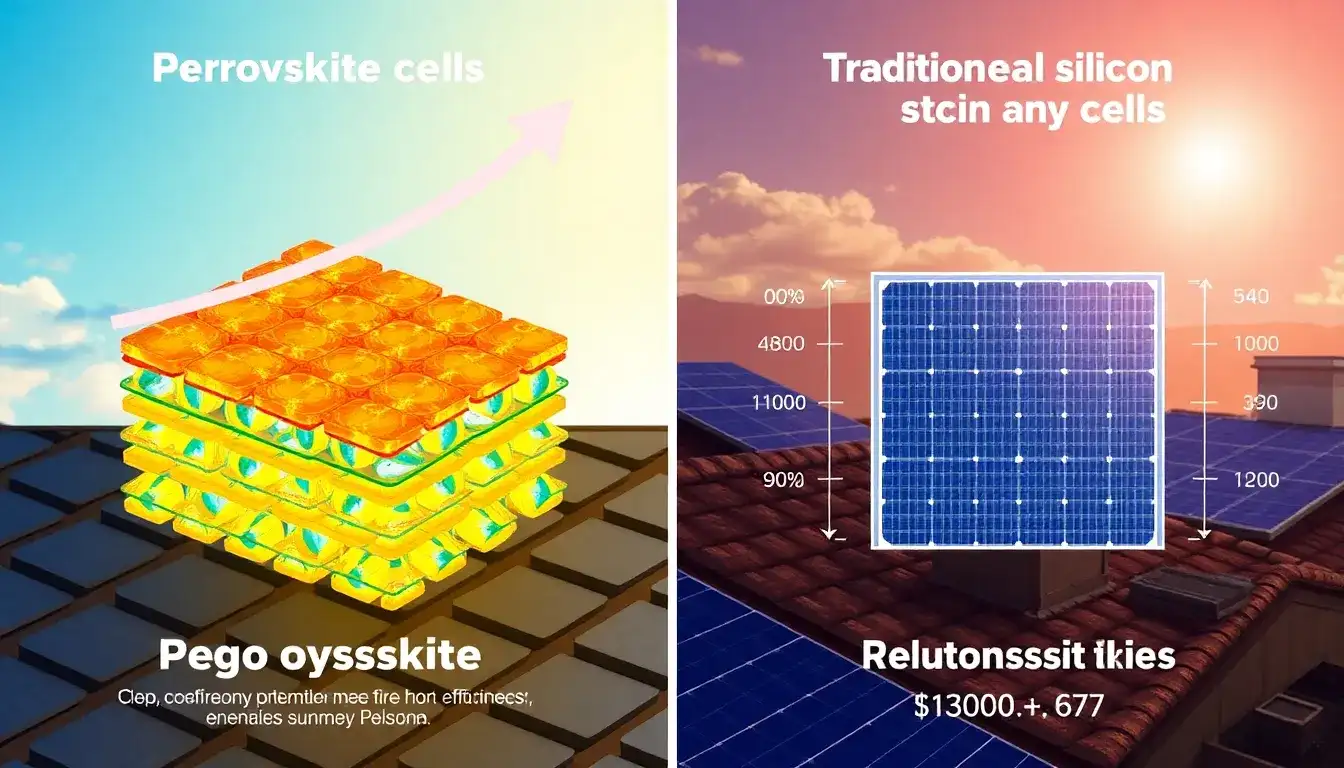
Efficiency Comparison
- Perovskite Solar Cells have demonstrated rapid efficiency improvements from below 5% in early development stages to over 25% in recent years, with some tandem perovskite-silicon cells recently reaching efficiencies above 33.9%. Their unique crystalline structure allows them to absorb a broader range of the solar spectrum, including wavelengths inaccessible to silicon cells, contributing to higher conversion efficiencies.
- Silicon-Based Solar Cells, particularly crystalline silicon (c-Si), remain the most common and mature technology, with a practical efficiency ceiling around 29%, achieved in high-purity, defect-free cells. Polycrystalline silicon cells typically show slightly lower efficiencies than monocrystalline silicon due to grain boundaries but offer good stability and reliability.
- Tandem Cells combining perovskite on silicon take advantage of both materials’ strengths—perovskite absorbs high-energy photons while silicon absorbs low-energy photons—to surpass the efficiency limits of standalone silicon cells, breaking the 30% barrier and reaching near 34% efficiency commercially.
Cost Comparison
- Perovskite Solar Cells are produced using simpler, lower-temperature, and less energy-intensive methods compared to silicon cells, allowing for potentially much lower manufacturing costs. Estimated future costs for perovskite modules could be around $0.10 per watt, which would make them some of the cheapest photovoltaic technologies.
- Silicon Solar Cells require high-purity silicon and energy-intensive processes, including high temperatures and vacuum conditions, which contribute to higher production costs and environmental impact.
- The manufacturing of perovskite cells is more flexible, enabling rollable and lightweight panels, in contrast to the rigid and bulky nature of silicon panels that require more material and space.
Other Considerations
- Stability and Lifespan: Silicon solar panels have well-established lifespans of up to 30 years and robust performance under diverse environmental conditions. Perovskite cells currently suffer from stability issues such as sensitivity to moisture, temperature fluctuations, and degradation over time, with typical lifespans significantly shorter (~2.5 years in best cases), which limits their widespread practical use.
- Environmental Impact: Perovskite cells use lead-based materials during fabrication, raising toxicity concerns, though ongoing research is focused on finding more stable and less toxic alternatives.
- Performance in Different Conditions: Perovskite cells perform better than silicon in low-light and high-temperature conditions, but they require protective measures against humidity to maintain longevity.
Summary Table
| Aspect | Perovskite Solar Cells | Silicon Solar Cells |
|---|---|---|
| Efficiency | >25% (single-junction); >33% (tandem with Si) | Up to ~29% (single-junction crystalline Si) |
| Cost | Potentially very low (~$0.10/W), low-energy fabrication | Higher due to pure silicon and energy-intensive processes |
| Lifespan | Currently ~2-3 years (stability issues) | ~25-30 years (well-established durability) |
| Material Flexibility | Thin, flexible, rollable | Rigid, bulky panels |
| Environmental Concerns | Lead toxicity issues under study | Environmentally intensive silicon refining |
| Performance in Conditions | Better in low-light and heat, sensitive to moisture | Stable in diverse environments |
Conclusion
Perovskite solar cells offer promising higher efficiencies and substantially lower production costs than traditional silicon cells. However, their shorter operational lifetimes and stability challenges currently limit commercial adoption. Silicon solar cells remain the reliable industry standard due to proven durability and manufacturing maturity. The most immediate advantage of perovskites lies in tandem configurations with silicon, boosting efficiency beyond silicon’s limits while potentially reducing costs. Continued research is rapidly addressing perovskite stability, suggesting they could become a highly cost-effective complement or alternative to silicon photovoltaic technology in the near future.
Original article by NenPower, If reposted, please credit the source: https://nenpower.com/blog/how-do-perovskite-solar-cells-compare-to-traditional-silicon-based-cells-in-terms-of-efficiency-and-cost/

