

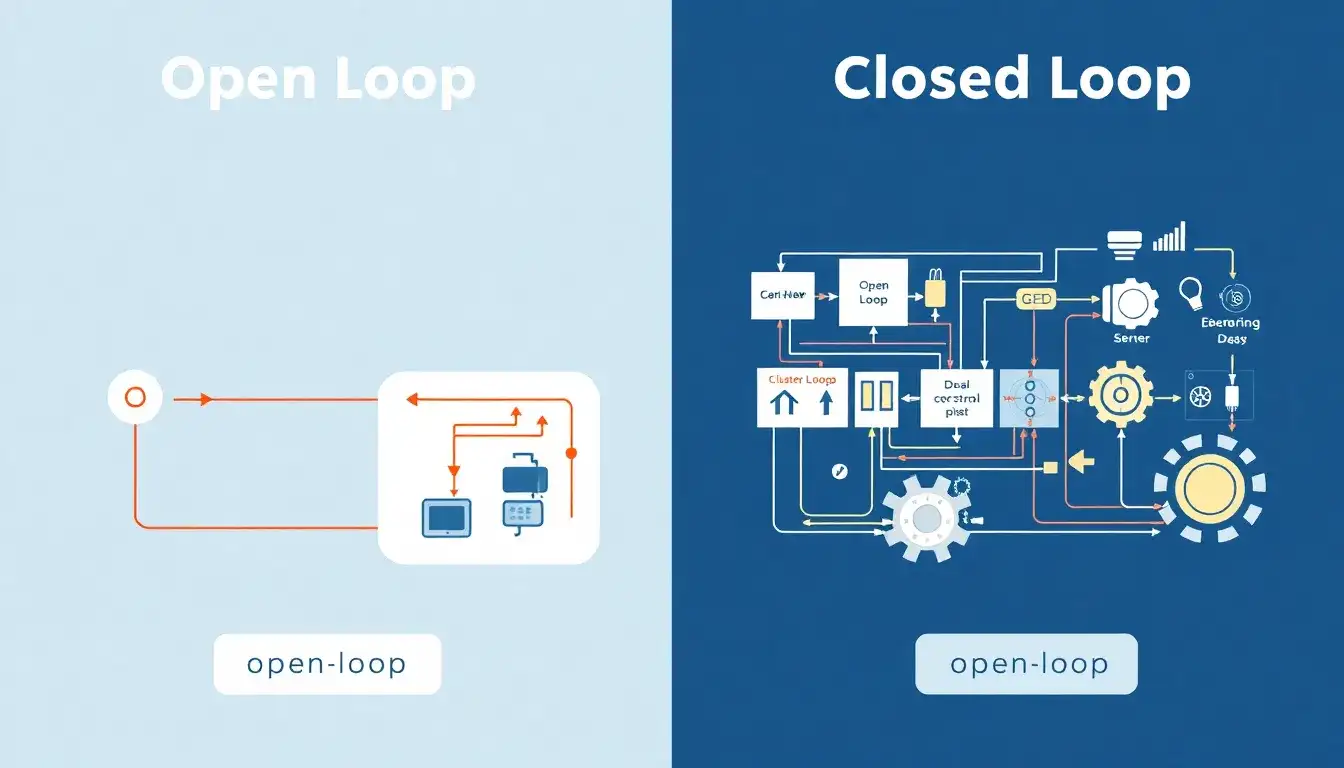
Efficiency Differences Between Open-Loop and Closed-Loop Systems
Open-Loop Systems:
- Operate without feedback; they run based on predefined inputs without adjusting to output conditions.
- Typically simpler, faster, and less expensive to design and maintain because they do not process feedback data or make continuous adjustments.
- Efficiency can be high in stable, predictable environments where conditions do not vary drastically. For example, open-loop cooling towers transfer heat rapidly due to direct air contact, making them highly efficient in suitable climates.
- However, they may be less efficient overall because they cannot adapt to disturbances or changes, potentially resulting in suboptimal performance and higher resource consumption under variable conditions.
Closed-Loop Systems:
- Continuously monitor output via sensors and adjust inputs accordingly to maintain desired performance.
- More complex and typically costlier due to the feedback loop and control mechanisms, but they provide more precise and stable control.
- Their adaptability allows for maintaining efficiency even when operating conditions change, such as varying load, environmental factors, or contamination risks. For example, closed-loop cooling systems, although slightly less efficient due to additional heat exchangers, prevent contamination and scaling, maintaining long-term efficiency and environmental friendliness.
- In applications like engine control, closed-loop systems optimize fuel delivery to improve fuel efficiency and reduce emissions by continuously adjusting air-fuel ratios based on sensor feedback.
- Their ability to self-regulate and minimize deviation from target performance usually results in higher overall system efficiency, especially in dynamic or sensitive environments.
Summary Table of Efficiency Aspects
| Aspect | Open-Loop Systems | Closed-Loop Systems |
|---|---|---|
| Feedback | None | Continuous sensor feedback |
| Complexity | Simple | Complex |
| Adaptability | Low; fixed operation | High; adapts to disturbances and changes |
| Speed of Operation | Faster due to no feedback processing | Slower due to processing feedback |
| Efficiency | High in stable conditions; potentially less efficient overall | Slightly less efficient in heat transfer but more efficient long-term; improved fuel efficiency in engines |
| Environmental Impact | Higher water usage and potential chemical use (in cooling systems) | Reduced environmental impact due to better control and reduced resource use |
| Applications | Suitable for cost-sensitive, stable environments | Ideal for precision-demanding, dynamic, or sensitive environments |
In essence, open-loop systems can be more efficient in simple, stable scenarios due to their speed and simplicity but lack adaptability, which limits their efficiency under varying conditions. Closed-loop systems, while potentially incurring slightly higher immediate costs or complexity, achieve superior efficiency over time by continuously optimizing performance and reducing waste or errors.
Original article by NenPower, If reposted, please credit the source: https://nenpower.com/blog/how-do-open-loop-and-closed-loop-systems-differ-in-efficiency/

