

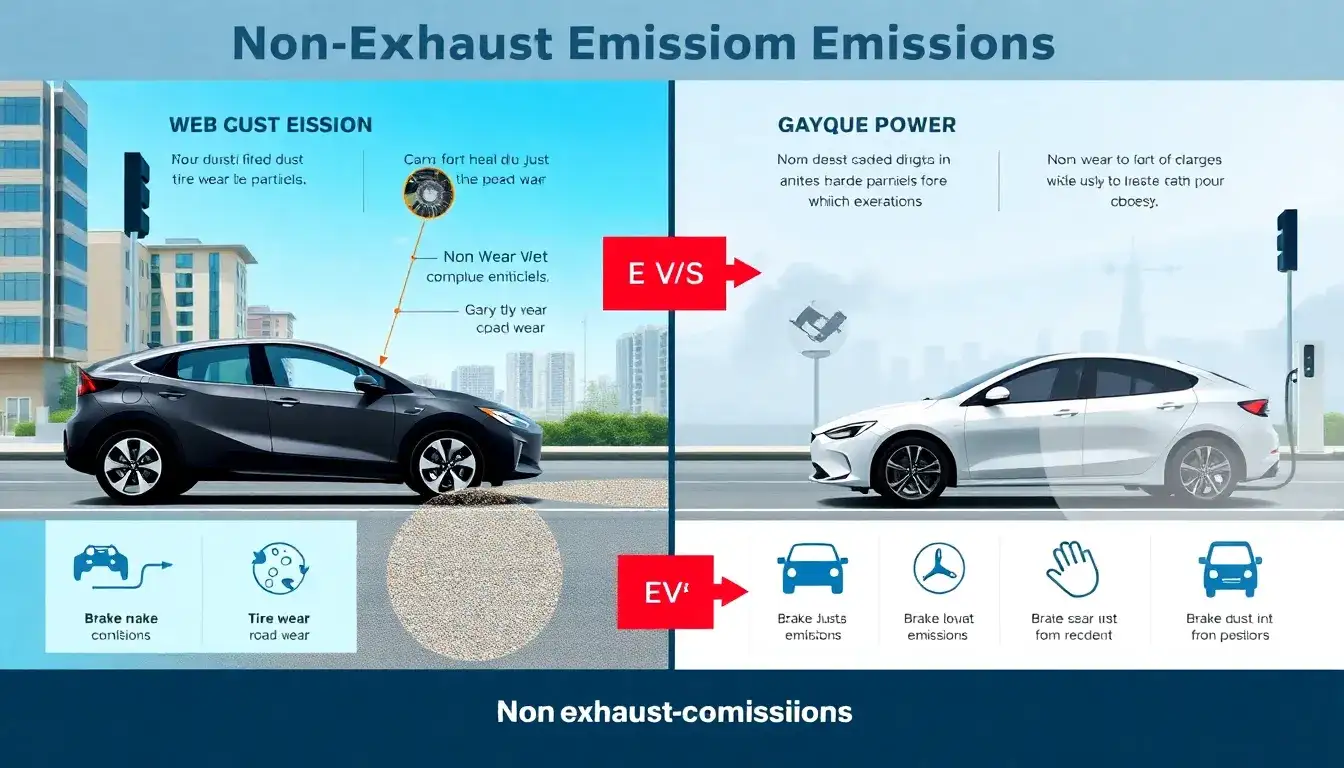
Non-exhaust emissions from electric vehicles (EVs) compared to gasoline-powered cars show a nuanced pattern influenced mainly by vehicle weight, driving conditions, and brake system differences.
Key Points of Comparison:
- Vehicle Weight: EVs tend to be about 40% heavier than equivalent gasoline vehicles largely due to their battery packs. This additional weight generally increases tire wear, which can generate particulate matter (PM) emissions from tire abrasion.
- Brake Wear: Unlike gasoline cars, EVs often use regenerative braking systems, which rely on the electric motor to slow the vehicle and recharge the battery. This process reduces the use of traditional friction brakes, thus lowering brake wear emissions significantly compared to conventional vehicles.
- Driving Conditions Impact: Research by the Virginia Tech Transportation Institute (VTTI) has shown that in heavy traffic or city driving conditions, EVs produce fewer non-exhaust particulate emissions than gasoline cars because regenerative braking reduces brake particulate emissions. However, in light traffic or highway driving where less braking occurs, EVs can produce more tire-wear emissions due to their heavier weight.
- Overall Non-Exhaust Emissions: Considering real-world mixed driving conditions (with at least 15% city driving), EVs generally have lower total non-exhaust particulate matter emissions than gasoline-powered vehicles. This includes emissions from tire and brake wear combined.
- Comparable Particulate Emissions: Some studies highlight that despite the weight difference, the total particulate matter emissions from EVs are broadly comparable to those of gasoline vehicles due to brake emission reductions balancing tire wear increases.
Summary:
| Aspect | Electric Vehicles | Gasoline-Powered Vehicles |
|---|---|---|
| Vehicle Weight | ~40% heavier (increases tire wear) | Lighter weight (less tire wear) |
| Brake Wear Emissions | Reduced due to regenerative braking | Higher due to conventional brakes |
| Tire Wear Emissions | Potentially higher due to extra weight | Lower due to lighter weight |
| Non-Exhaust Emissions | Lower in city/heavy traffic, may be higher in light traffic | Generally higher brake emissions, lower tire wear |
| Overall PM Emissions | Generally lower if urban driving ≥15% | Generally higher overall |
In conclusion, while EVs emit no tailpipe exhaust pollutants, their non-exhaust emissions (brake and tire particles) are generally lower or comparable to gasoline cars depending on driving context, with regenerative braking playing a major role in reducing brake wear pollution. This makes EVs environmentally advantageous in urban and heavy traffic conditions, which are common in real-world usage.
References:
Original article by NenPower, If reposted, please credit the source: https://nenpower.com/blog/how-do-non-exhaust-emissions-from-electric-vehicles-compare-to-those-from-gasoline-powered-cars/

