

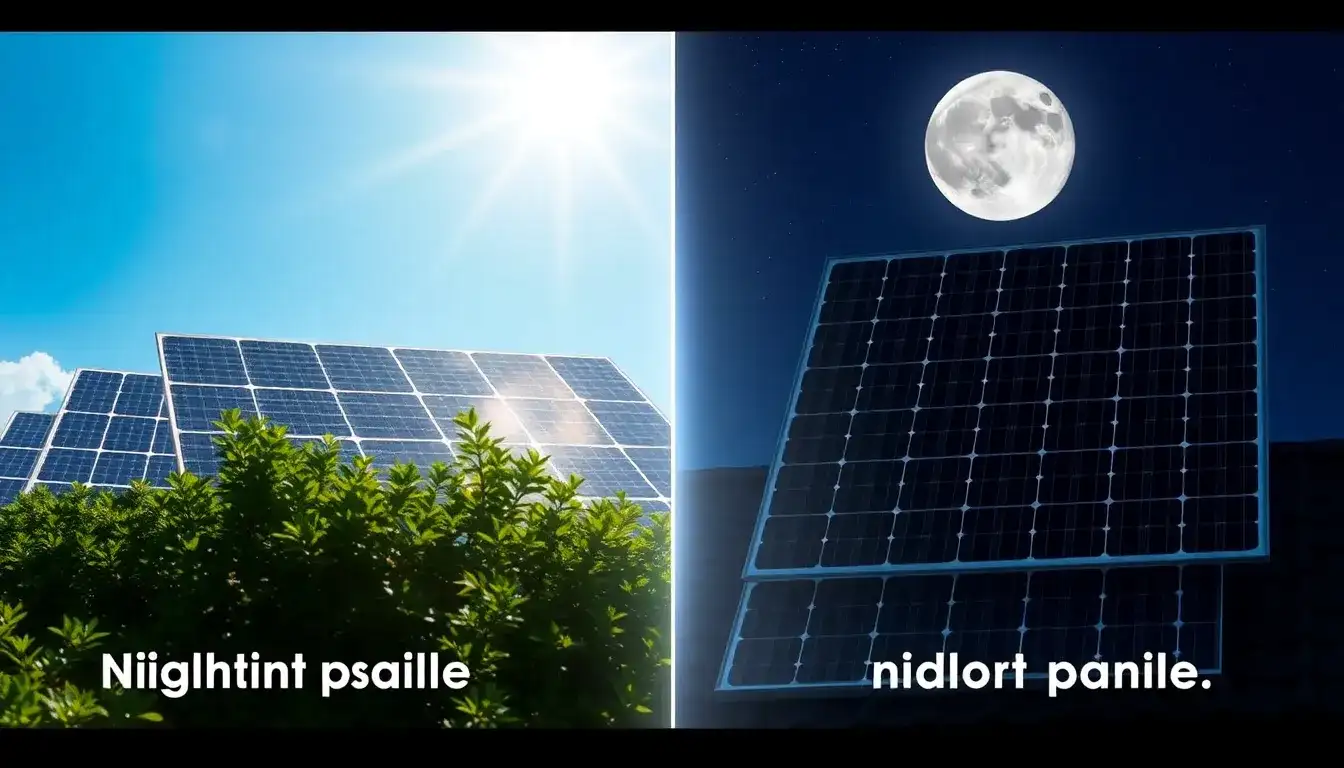
Comparison of Nighttime Solar Panels and Traditional Solar Panels
Nighttime solar panels and traditional solar panels operate on different principles and have distinct characteristics. Here’s a comparison of these technologies:
Operating Principle
- Traditional Solar Panels: These rely on photovoltaic (PV) cells to convert sunlight into electricity during the day. They depend entirely on sunlight and do not generate electricity at night.
- Nighttime Solar Panels: These exploit radiative cooling, a phenomenon where objects radiate heat into outer space, creating a temperature difference that can be harnessed by thermoelectric generators to produce electricity. This process allows for a small amount of electricity generation at night.
Energy Output
- Traditional Solar Panels: Typically generate around 200 watts per square meter during peak daylight hours.
- Nighttime Solar Panels: Currently produce approximately 50 milliwatts (0.05 watts) per square meter at night. Newer research has shown potential for up to 2.2 watts per square meter.
Applications
- Traditional Solar Panels: Effective for powering homes and businesses during daylight, especially when integrated with net metering and battery storage systems for nighttime use.
- Nighttime Solar Panels: More suited for low-power applications such as nighttime lighting, environmental sensors, and IoT devices. They offer a promising solution for off-grid energy needs, especially in areas with limited access to electricity.
Economic Viability
- Traditional Solar Panels: Well-established technology with significant commercial viability and economies of scale.
- Nighttime Solar Panels: While scientifically promising, the technology is still in its early stages, and its cost-effectiveness and large-scale viability remain uncertain.
In summary, traditional solar panels excel during daylight hours with high energy output, while nighttime solar panels provide a novel approach to generating electricity at night through radiative cooling, albeit with much lower output. Nighttime panels could complement traditional solar energy systems, especially in off-grid scenarios or for low-power applications.
Original article by NenPower, If reposted, please credit the source: https://nenpower.com/blog/how-do-nighttime-solar-panels-compare-to-traditional-solar-panels/

