

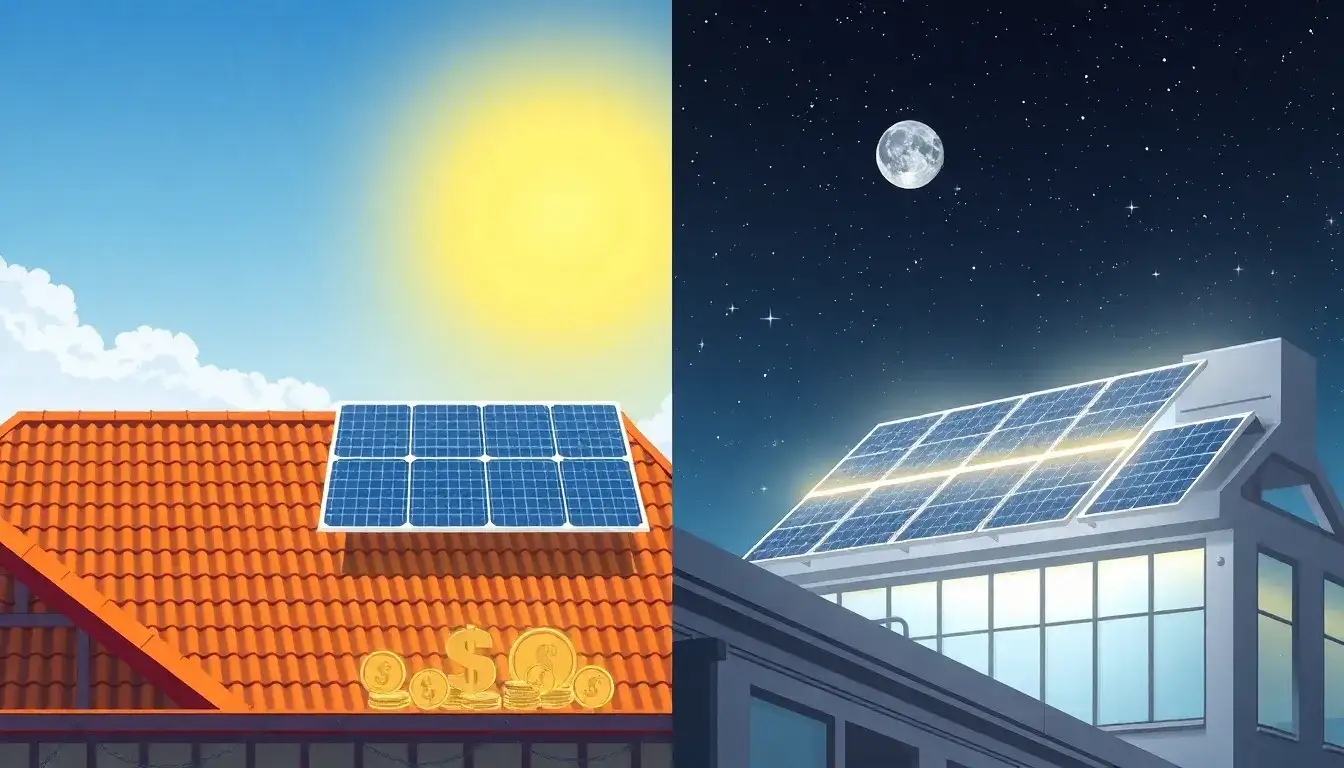
Nighttime Solar Panels vs. Traditional Solar Panels
Nighttime solar panels, which refer to modified or advanced solar technologies that can generate some electricity at night, are fundamentally different from traditional solar panels that only produce power during daylight. Here’s how they compare in cost and practicality:
Traditional Solar Panels Cost
- Traditional solar panels in 2025 typically cost about $1,200 per panel, though this can vary based on type, home size, installation, and labor costs.
- Solar systems often include additional expenses like inverters and battery storage for nighttime energy use, but the panels themselves remain the primary cost element.
- Standard solar panels do not produce electricity at night; instead, nighttime power is usually supplied via the grid or battery storage systems charged during the day.
Nightime Solar Panels Cost and Technology
- Nighttime solar panels are an emerging technology where researchers, such as those at Stanford, have modified conventional panels to generate small amounts of electricity at night by exploiting radiative cooling—a process where panels emit heat to the cold vacuum of space to generate energy.
- These panels currently produce very little energy at night (about 50 milliwatts per square meter), which is far below the output of daytime solar panels (around 200 watts per square meter).
- The modifications involve adding technology to existing panels, but this is still experimental and not commercially widespread.
- Prices for “solar panel night” products as listed on Alibaba show a wide range from approximately $0.10 to $0.26 per watt depending on order size, but these figures mainly reflect available products marketed under this category, which may not be equivalent to the experimental radiative cooling panels at Stanford.
Cost Comparison Summary
| Feature | Traditional Solar Panels | Nighttime Solar Panels (Experimental) |
|---|---|---|
| Price per panel | Around $1,200 per panel (typical) | Not yet standard; experimental components possibly add cost |
| Energy output | About 200 watts per square meter during day | About 0.05 watts per square meter at night, very low |
| Commercial availability | Widely available and established | Currently experimental / research phase |
| Practical use | Powers homes during day; batteries or grid for night | Potentially powers low-energy devices at night in future |
| Cost-effectiveness | Proven cost savings over time | Too early to be economically viable |
Conclusion
Currently, nighttime solar panels are an experimental technology that generates very small amounts of electricity at night and are not commercially available at scale. Traditional solar panels remain the practical, cost-effective option with well-understood pricing and installation costs. The added complexity and low output of nighttime panels mean they are unlikely to be cost-competitive with traditional solar panels or batteries for nighttime power in the near future. For now, traditional solar systems paired with batteries or grid connections remain the best solution for nighttime electricity needs.
Original article by NenPower, If reposted, please credit the source: https://nenpower.com/blog/how-do-nighttime-solar-panels-compare-in-cost-to-traditional-solar-panels/

