

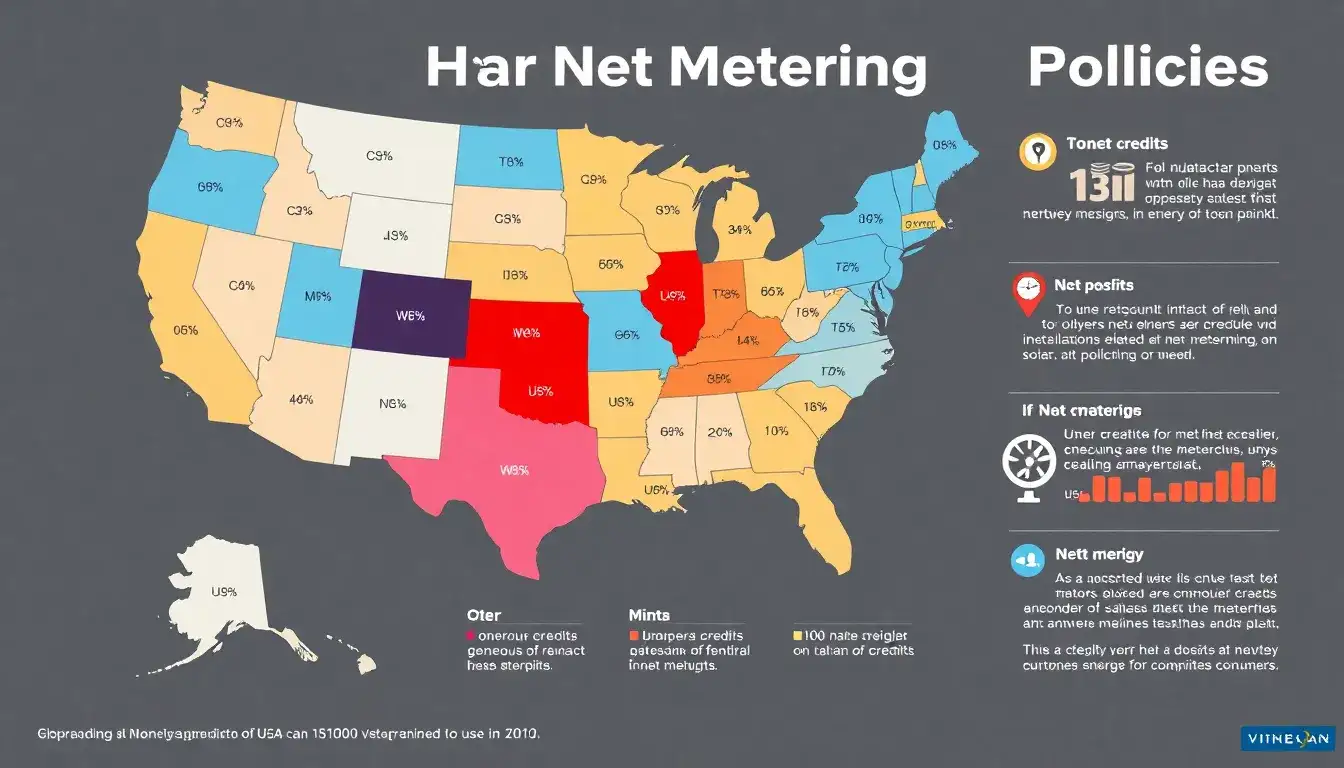
Net metering policies in the United States vary significantly by state, reflecting different regulatory frameworks, compensation rates, system size limits, and program designs. Here is a detailed overview of how net metering policies differ across states:
1. Types of Net Metering Policies
- State-Governed Net Metering:
Most states have laws mandating net metering with specific rules and caps set by the state regulatory bodies. These rules often apply uniformly to utilities within the state. Examples include California, New York, Massachusetts, and others. - Utility-Governed Net Metering:
In some states, rather than a statewide mandate, individual utilities establish their own net metering policies. This can lead to more variation within the state and sometimes more limited programs. Some states without statewide mandates may rely solely on utility-specific programs, such as Idaho and Texas. - Net Billing (Modified Net Metering):
This is a variation where customers are credited for excess electricity at wholesale rates rather than retail rates. It is becoming more common in some states to better reflect the value of energy to utilities and the grid. California’s recent NEM 3.0 program is a prominent example, where compensation varies by time of day and is generally lower than prior retail-rate credit programs. Arizona and Utah also use net billing-style policies to encourage self-consumption rather than grid reliance. - Solar Buy-Back Programs:
Some states or utilities offer specific solar buy-back programs that differ slightly from traditional net metering or net billing, providing alternative compensation mechanisms.
2. Compensation Rates and Credit Systems
- Retail Rate Credit:
Traditional net metering credits customer-exported electricity at the full retail rate, which effectively allows customers to use the grid as a battery. This has historically been the most generous form of net metering. Many states still follow this model. - Wholesale or Avoided Cost Rate Credit:
Under net billing or modified net metering, credits for exported electricity are based on the wholesale price or the utility’s avoided cost, which is lower than the retail rate. This reduces compensation and aims to address cost-shifting concerns for utilities and non-solar customers. - Time-Varying Rates:
Some new policies incorporate time-of-use or seasonal rates where compensation depends on when electricity is generated or used, reflecting grid demand and supply patterns more accurately. For example, California’s new NEM 3.0 rates vary by daytime versus nighttime usage.
3. System Size Limits and Caps
- System Size Caps:
States impose different maximum system sizes eligible for net metering. For instance, Massachusetts allows up to 60 kW for residential, with larger limits for commercial or public systems; New Mexico allows very large 80,000 kW systems; other states like Wyoming have lower caps (25 kW), limiting participation mostly to residential customers. - Aggregate Program Caps:
Many states limit the total capacity of net-metered systems allowed under the program as a percentage of the utility’s peak load or total capacity. This varies widely and affects program growth and availability.
4. Credit Expiry and Rollover Policies
- Monthly Rollovers:
Some states allow excess credits to roll over indefinitely month-to-month, providing greater flexibility and financial benefit to customers. - Annual Expiration:
Other states require credits to expire at the end of the year or billing cycle, limiting long-term credit accumulation.
5. States Without Statewide Mandates
- No State-Mandated Compensation:
Alabama, South Dakota, and Tennessee do not have statewide net metering or compensation policies. However, utilities in some of these states may offer their own programs. - Utility-Specific Programs:
States like Idaho and Texas do not have statewide policy mandates but rely on utility-specific net metering or compensation options.
6. Examples of State-Specific Policies
| State | Policy Type | Compensation Rate | Size Limit | Notes |
|---|---|---|---|---|
| California | State-governed, net billing (NEM 3.0) | Wholesale varying by time of day | Varies | New policy reduces compensation up to 75%, encouraging battery storage |
| Massachusetts | State-governed, traditional net metering | Retail rate | Residential up to 60 kW, larger for commercial | Caps set as % of historic peak load per utility area |
| Arizona | Utility-based feed-in tariff (post-2016) | ~10.45 cents/kWh (below retail) | Varies | Replaced retail net metering with feed-in tariff paying avoided cost |
| Oklahoma | Revised state law (2019) | Avoided energy cost | Up to 300 kW | Compensation for excess at avoided cost, credits carry over monthly |
| Wyoming | State-governed | Seasonal average avoided cost | 25 kW | Credits in kWh, not dollars; limited to residential scale |
| Alabama | None (no statewide mandate) | N/A | N/A | Utilities may offer programs but no state mandate |
7. Policy Trends and Future Outlook
- Increasing adoption of net billing or hybrid models to reduce cost shifts to non-solar customers.
- Encouragement of solar energy storage to maximize self-consumption and reduce reliance on grid credits.
- Continuous refinements in rate design including demand charges and time-of-use pricing.
- Variability in program caps and system size limits reflecting local grid conditions and solar penetration.
Summary
Net metering policies vary widely by state due to differences in:
- Whether the policy is state-mandated or utility-based
- Whether compensation is at retail, wholesale, or some hybrid rate
- System size limits and aggregate caps on program participation
- Rules on credit rollover and expiration
States like California have moved from traditional net metering at retail rates to net billing with lower compensation to better balance utility cost concerns, while others maintain full retail rate credit programs. Some states have no mandatory net metering policies but allow utilities discretion to offer programs. The trend is toward more nuanced compensation that reflects grid costs and encourages energy storage and efficient consumption.
This variation means that solar customers must verify the specific net metering rules and compensation methods applicable to their state and utility to understand the benefits and economics of solar installation fully.
Original article by NenPower, If reposted, please credit the source: https://nenpower.com/blog/how-do-net-metering-policies-vary-by-state/

