

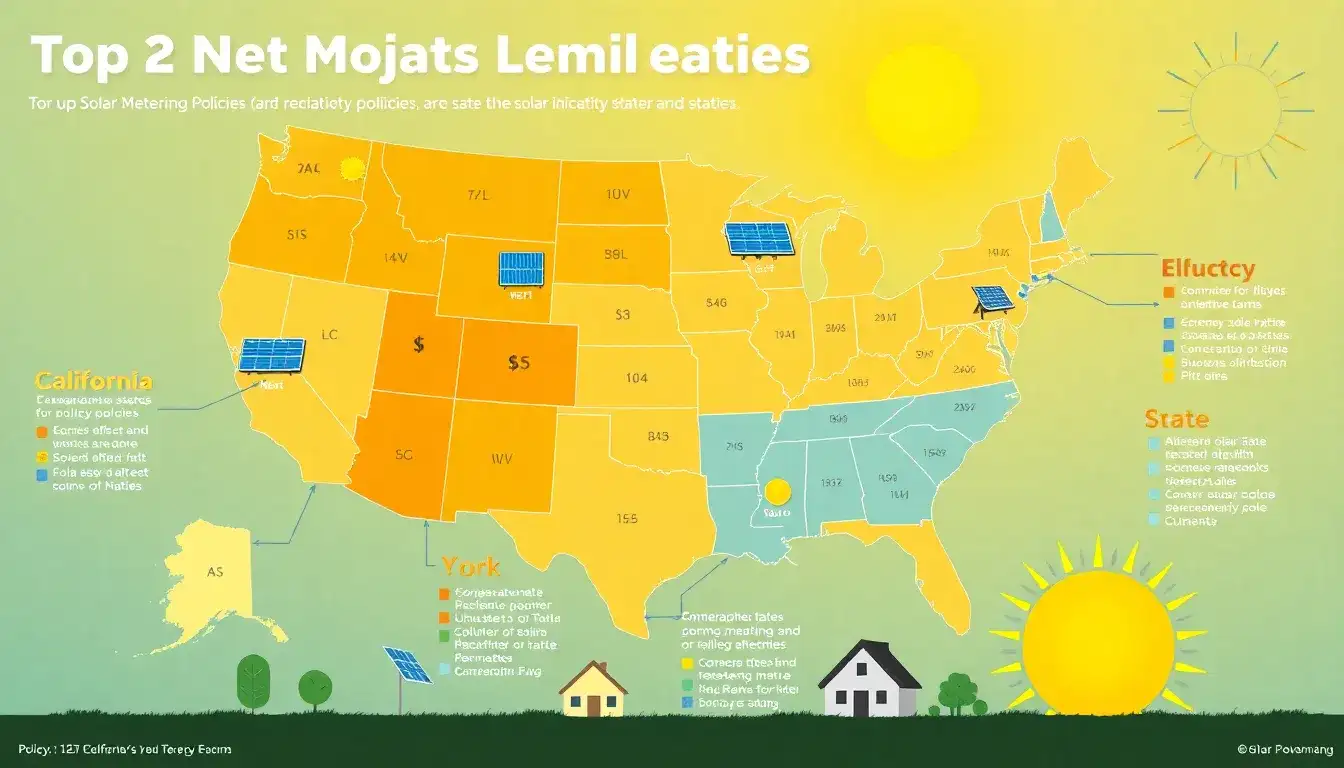
Net metering policies vary significantly among the top solar incentive states in the U.S., with differences in tariff structures, compensation rates, program caps, and applicability across utility types. Here is an overview of how these policies differ:
Types of Net Metering Policies
- Traditional Full Retail Net Metering: Many states offer traditional net metering where solar customers receive credits for the electricity they export to the grid at the full retail rate. This encourages higher solar adoption by providing strong economic incentives.
- Net Billing Tariffs: Some leading solar states, such as California, Arizona, and Utah, have moved away from traditional net metering to a net billing tariff system. Here, excess energy sent back to the grid is compensated at wholesale rates rather than retail rates. This hybrid model encourages solar self-consumption and better reflects grid costs and utility financial needs.
State-by-State Variations
| State | Net Metering Policy Type | Notable Features |
|---|---|---|
| California | Net Billing Tariff (NBT) | Excess energy compensated at wholesale rate, changing from full retail credits to encourage energy self-consumption. |
| Arizona | Net Billing | Similar to CA, wholesale rate compensation for excess solar. |
| Utah | Net Billing | Wholesale rate compensation, hybrid system. |
| Many Other States (e.g., Connecticut, Delaware, Florida, Georgia, Hawaii) | Traditional Full Net Metering | Credits at retail rate for exported power. |
| Alabama, South Dakota, Tennessee | No State-Mandated Policy | No statewide compensation policy but may have utility-specific programs. |
Caps and Limitations
- Many states impose caps on the total amount of net metering allowed, often expressed as a percentage of the total utility electricity sales (commonly around 3% to 4%). These caps limit how much solar energy can be credited, which can restrict solar growth in those states.
- States are increasingly considering raising these caps to support solar expansion.
Applicability Across Utility Types
- Net metering policies often differ by utility type within states:
- Investor-Owned Utilities (IOUs): Usually subject to state net metering mandates.
- Municipal Utilities and Rural Electric Cooperatives: Often exempt or have different, sometimes less favorable, net metering rules.
Summary
- Top solar incentive states vary between traditional full retail net metering and newer net billing tariffs that pay wholesale rates for excess solar.
- Caps on net metering and differences among utility types affect solar customers differently depending on location and provider.
- States like California, Arizona, and Utah have shifted to net billing to better align compensation with utility costs, while many others still offer full retail credit.
- Several states lack state-mandated net metering programs, leaving compensation to individual utilities.
This diversity reflects the balancing act between promoting solar adoption and maintaining grid stability and fairness in cost distribution.
Original article by NenPower, If reposted, please credit the source: https://nenpower.com/blog/how-do-net-metering-policies-vary-among-the-top-solar-incentive-states/

