

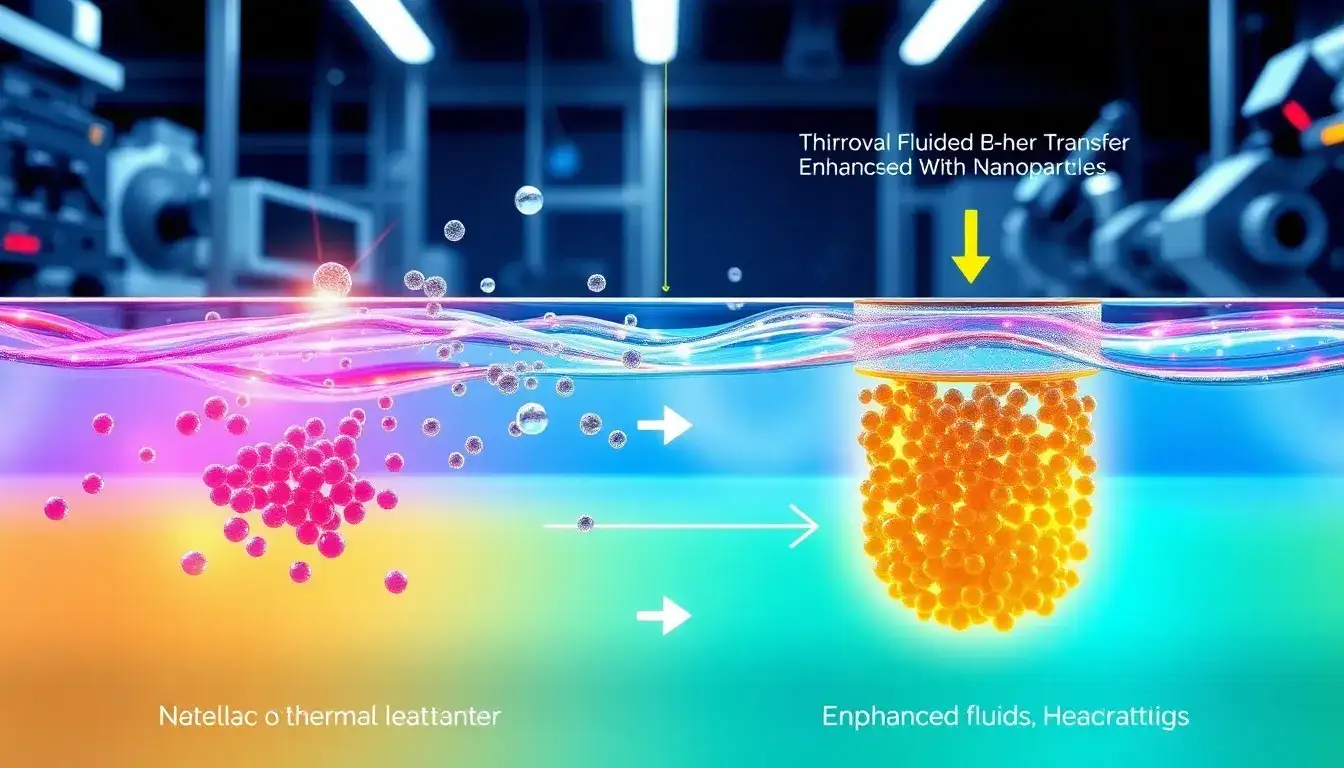
Nanoparticles improve the thermal conductivity of heat transfer fluids (HTFs) through several key mechanisms related to their tiny size and physical properties:
- Nano-scale Interaction: Nanoparticles, typically between 1 nm and 100 nm, interact with fluid molecules at the atomic level, creating enhanced pathways for heat transfer. This “nano” effect means the particles behave distinctly from larger particles, facilitating quicker energy movement and more evenly spreading heat throughout the liquid.
- Brownian Motion: The random movement of nanoparticles inside the fluid (Brownian motion) increases collisions and interactions between particles and fluid molecules. This dynamic activity enhances the overall heat transfer efficiency by enabling more frequent energy exchanges within the fluid.
- Thermal Bridges: Certain nanoparticles like carbon nanotubes (CNTs) serve as “thermal bridges” within the fluid. They form preferential paths for heat to travel, effectively increasing thermal conductivity beyond what the fluid alone can achieve. This effect is particularly strong with carbon-based nanomaterials, where interactions can also modify the liquid’s internal structure at the nanoscale, further improving heat conduction.
- High Thermal Conductivity of Nanoparticles: Many nanoparticles, such as metals (e.g., silver) and metal oxides, possess much higher thermal conductivities compared to base fluids like water or ethylene glycol. Incorporating these particles introduces highly conductive solid phases in the fluid, greatly enhancing the fluid’s ability to conduct heat.
- Improved Stability and Dispersion: Although early attempts with larger particles caused sedimentation and operational issues, nanoparticles—if well-dispersed and stabilized—avoid settling and maintain enhanced thermal properties without excessive drawbacks like increased pumping power.
Together, these factors create nanofluids that significantly enhance thermal conductivity compared to traditional heat transfer fluids, boosting the effectiveness of heating and cooling systems. For example, enhancements of up to 40–70% in thermal conductivity have been documented for fluids containing carbon-based nanoparticles like CNTs.
In summary, nanoparticles improve thermal conductivity by acting as highly conductive inclusions that enable faster heat transfer through atomic-level interactions, Brownian motion, and the formation of thermal pathways inside the fluid. This leads to more efficient heat dissipation in various thermal management applications.
Original article by NenPower, If reposted, please credit the source: https://nenpower.com/blog/how-do-nanoparticles-improve-the-thermal-conductivity-of-heat-transfer-fluids/

