

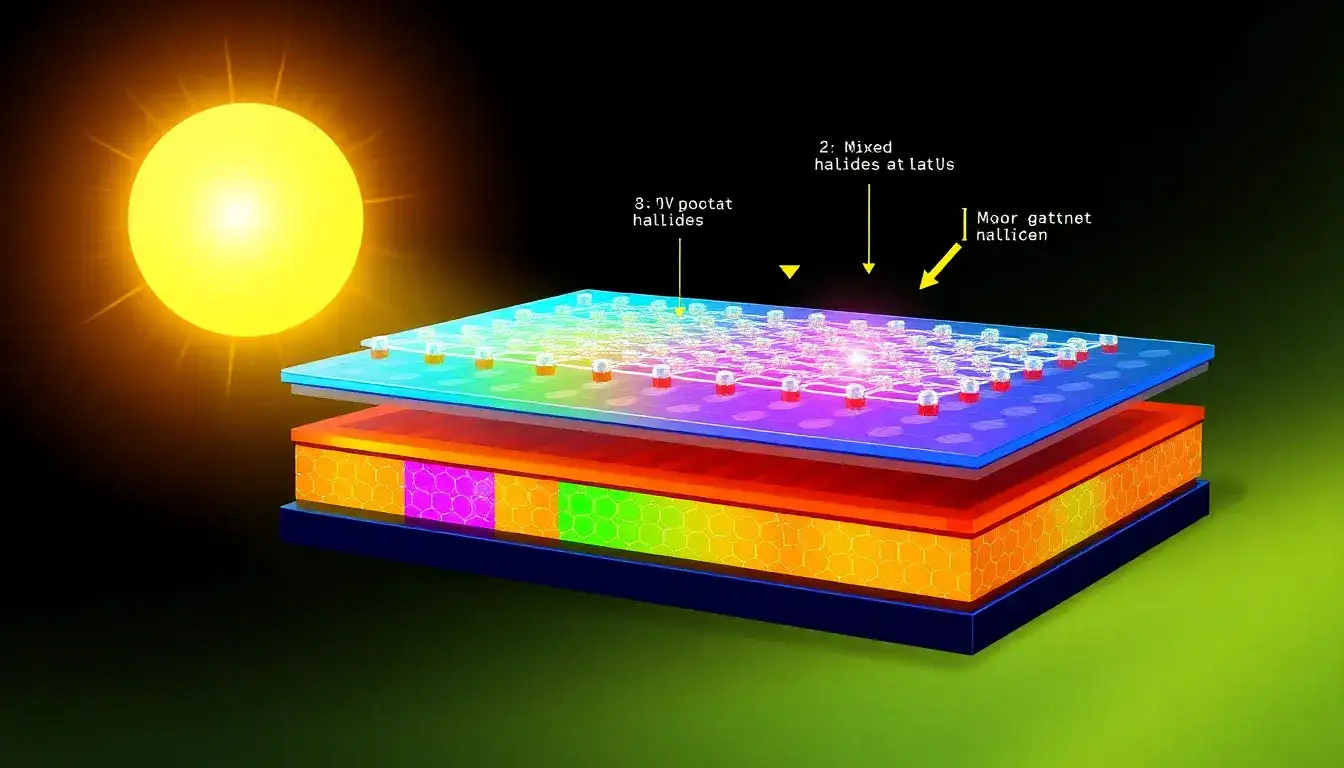
Mixed halides improve the stability of perovskite solar cells through several interrelated mechanisms involving compositional control, defect reduction, and mitigation of ion migration, which collectively enhance the structural and operational durability of the perovskite materials.
Key Mechanisms by which Mixed Halides Improve Stability
1. Controlled Crystallization and Reduced Defects
- Mixed halide perovskites (typically combining bromide and iodide ions) suffer from instability largely due to rapid and uneven crystallization that leads to structural defects such as halide vacancies. These defects facilitate halide migration, phase segregation, and poor device performance.
- A new fabrication method, such as the gas-quench technique, better controls crystallization rates, producing a bromide-rich surface layer and a graded structure that results in fewer bromide vacancies and a more ordered crystal lattice. This reduces halide migration and phase segregation, improving light absorption uniformity and overall stability under real-world operating conditions.
2. Halide Mixing Mitigates Phase Segregation
- Under continuous illumination, pure or unoptimized mixed halide perovskites tend to segregate into iodide-rich and bromide-rich domains, which disrupt their optical properties and degrade device performance.
- Properly mixed halide perovskites maintain a uniform distribution of halides, which stabilizes the crystal lattice and preserves the desired bandgap and light absorption characteristics. This uniformity diminishes the formation of distinct phases that could degrade solar cell efficiency and longevity.
3. Enhanced Bond Strength and Optimal Halide Ratios
- Incorporating smaller halide ions such as chlorine can strengthen Pb–halide bonds, increasing the material’s decomposition energy and thus its chemical stability. However, excessive substitution introduces lattice strain, which can lower stability.
- Research shows that there is an optimal ratio of chlorine or bromine substitution (typically below 25%) that balances enhanced bond strength and minimized lattice strain, leading to improved stability without significantly altering the bandgap or electronic properties.
4. Suppression of Ion Migration and Trap States
- Mixed halide compositions reduce halide ion migration, a key cause of device instability, by lowering vacancy density and lattice strain. This suppression also reduces the formation of trap states which cause charge recombination, improving both charge carrier lifetimes and photovoltaic performance.
- Additionally, interface and surface treatments combined with mixed halides further stabilize the material by passivating defects and improving charge transport layers, thus contributing to overall device durability.
Summary Table
| Mechanism | Description | Stability Benefit |
|---|---|---|
| Controlled crystallization | Slower, graded crystallization reduces bromide vacancies | Fewer defects, less halide migration |
| Avoids Br/I phase segregation under illumination | Maintains optical properties and bandgap | |
| Optimal halide substitution ratio | Balances Pb–halide bond strength with lattice strain | Increased decomposition energy, chemical stability |
| Reduced ion migration and traps | Lower vacancy density and trap states | Longer carrier lifetimes, less recombination |
| Surface/interface passivation | Coatings and additives stabilize the perovskite surface | Enhanced charge transport, device lifetime |
Conclusion
Mixed halides improve perovskite solar cell stability by enabling better control over crystallization, reducing defects and halide migration, maintaining uniform halide distribution to prevent phase segregation, and optimizing chemical bonding within the lattice. This results in solar cells that sustain performance under light and heat, with improved carrier dynamics and resistance to degradation—key steps toward commercial viability.
Original article by NenPower, If reposted, please credit the source: https://nenpower.com/blog/how-do-mixed-halides-improve-the-stability-of-perovskite-solar-cells/

