

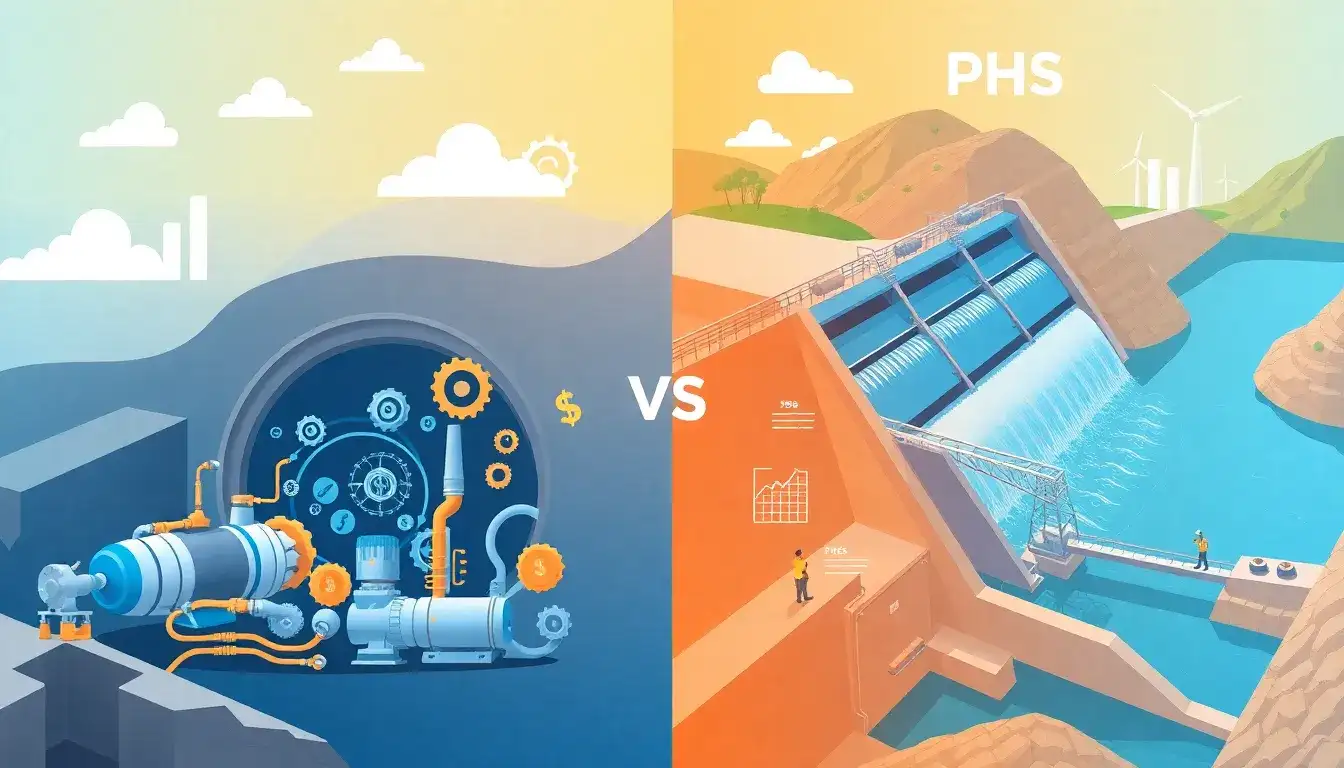
Comparing maintenance costs for Compressed Air Energy Storage (CAES) and Pumped Hydro Storage (PHS) systems requires an understanding of their operational mechanics and cost structures.
Compressed Air Energy Storage (CAES)
- Mechanism: CAES involves compressing air into underground reservoirs using excess energy. This compressed air is then expanded to generate electricity when needed.
- Maintenance Costs: The maintenance-related fixed O&M costs for CAES are estimated at around $10.30/kW-year, which includes long-term service contracts and equipment maintenance. Additionally, variable O&M costs are reported at approximately $1.78/MWh. The systems have moving parts, which generally result in higher maintenance costs compared to static storage systems like lithium-ion batteries.
- Efficiency and Costs: CAES systems typically have lower efficiencies (around 60-65%) compared to PHS, and while they can be cost-effective for long-duration storage, the costs associated with moving parts contribute to higher maintenance expenses.
Pumped Hydro Storage (PHS)
- Mechanism: PHS works by pumping water from a lower reservoir to an upper reservoir during off-peak hours. During peak hours, water is released back to the lower reservoir, generating electricity through turbines.
- Maintenance Costs: PHS systems generally have lower maintenance costs compared to CAES due to fewer moving parts and their closed-loop nature. However, the exact figures for PHS maintenance are not widely detailed in the provided sources.
- Efficiency and Costs: PHS is one of the oldest and most efficient forms of energy storage, with efficiencies often above 80%. The capital cost is significant due to the need for large reservoirs and terrain requirements.
Comparison
- Total Costs: While CAES can offer competitive long-duration storage costs, PHS typically requires less maintenance due to its simpler mechanical setup. However, PHS is often more expensive to set up initially.
- Operational Complexity: CAES involves more mechanical complexity with compressors and turbines, increasing maintenance needs. In contrast, PHS is a more straightforward mechanical system with fewer moving parts.
- Scalability and Location: Both CAES and PHS require specific geographical conditions for optimal performance. CAES needs underground reservoirs, while PHS requires suitable terrain for reservoirs.
In summary, while CAES maintenance costs are higher due to its mechanical complexity, PHS tends to be more efficient and has simpler operational requirements, which might reduce its maintenance needs. However, specific comparative data on maintenance costs for PHS is limited in the available sources.
Original article by NenPower, If reposted, please credit the source: https://nenpower.com/blog/how-do-maintenance-costs-for-caes-and-phs-systems-compare/

