

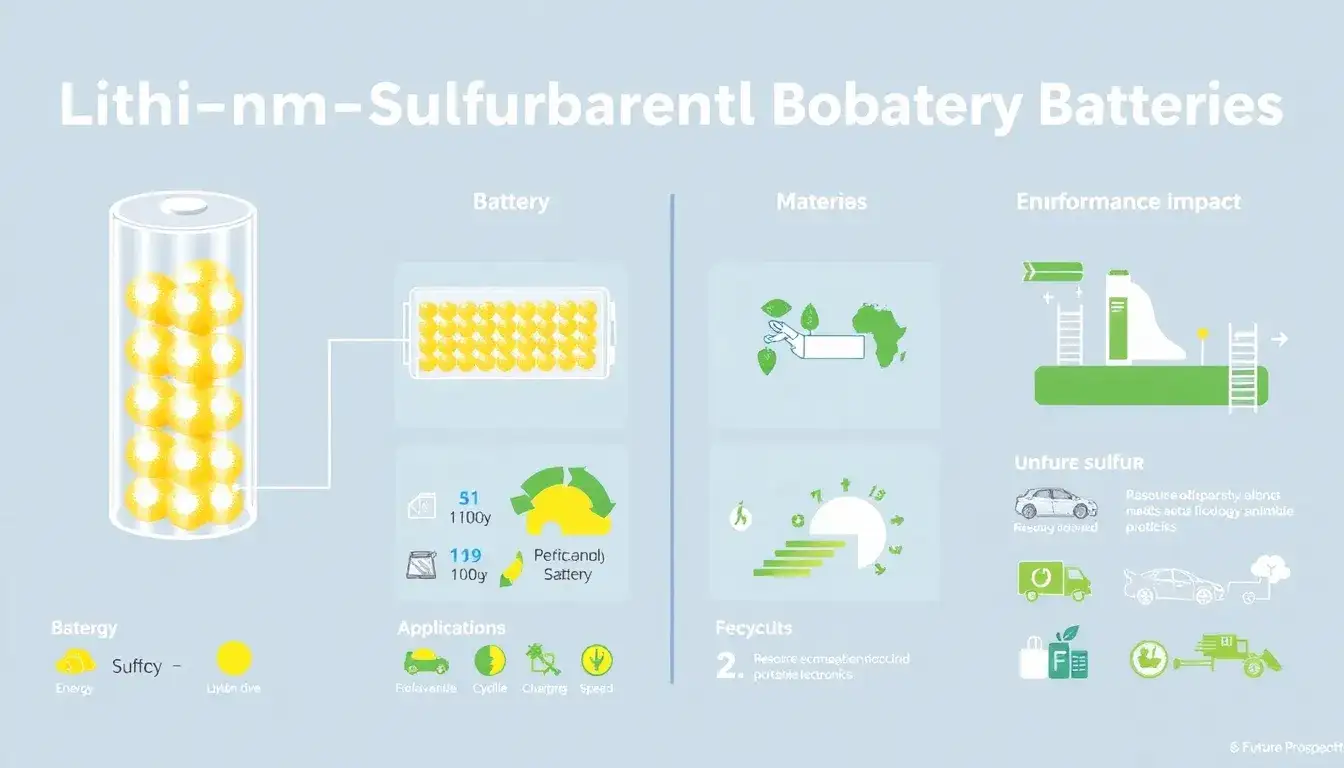
Key Differences Between Lithium-Sulfur and Lithium-Ion Batteries
| Feature | Lithium-Sulfur Battery | Lithium-Ion Battery |
|---|---|---|
| Energy Density | Much higher theoretical energy density, up to ~500 Wh/kg, about 2–3 times or more than Li-ion batteries (150-250 Wh/kg) | Established energy density around 150-250 Wh/kg |
| Weight | Lighter due to sulfur cathode and lithium metal anode; reduces overall device weight | Heavier because of heavier metal cathode materials (e.g., cobalt, nickel) |
| Cost | Potentially lower because sulfur is abundant and inexpensive; manufacturing costs are reduced | Higher cost due to expensive and supply-sensitive materials like cobalt and nickel |
| Cycle Life | Shorter cycle life (typically 300-500 cycles) due to sulfur cathode degradation and polysulfide shuttle effect | Longer cycle life (often >1000 cycles) with well-developed stability and longevity |
| Charging Speed | Promising rapid charging capabilities, benefiting from high conductivity | Generally slower charging relative to projected Li-S capabilities, mature technology with optimizations available |
| Safety | Challenges exist including lithium sulfide instability and polysulfide shuttle; research ongoing to improve safety | Proven safety record with extensive mitigation of fire and thermal runaway risks, though flammable electrolytes are used |
| Environmental Impact | More environmentally friendly with non-toxic, abundant sulfur and simpler recycling potential | Environmental concerns linked to mining and processing of lithium, cobalt, and nickel |
| Technical Challenges | Polysulfide dissolution causes capacity loss (shuttle effect); volume expansion (~80%) during cycling leads to mechanical stress; poor conductivity of sulfur requires additives | More mature technology with fewer unresolved chemical stability issues, but still reliant on critical raw materials |
How They Work
- Li-ion batteries operate by lithium ions moving between cathode and anode materials intercalated in solid structures.
- Li-S batteries involve chemical conversion between elemental sulfur cathode and lithium metal anode, forming lithium polysulfides and lithium sulfide during discharge, with complex chemical reactions that can cause polysulfide migration and capacity fade.
Advantages of Lithium-Sulfur Batteries
- Higher energy density and lighter weight, enabling longer range electric vehicles and lighter portable electronics.
- Lower material costs and reduced reliance on scarce metals, potentially leading to cheaper batteries.
- Environmentally benign materials and simpler recycling possibilities.
- Faster charging capabilities are possible due to high conductivity of components.
Disadvantages and Challenges of Lithium-Sulfur Batteries
- Shorter operational life due to polysulfide shuttle effect causing active material loss and electrode degradation.
- Safety concerns related to lithium dendrite formation and lithium sulfide instability.
- Mechanical degradation from volume expansion during charge/discharge cycles.
- Need for advanced electrolyte formulations and additives to mitigate capacity loss and improve stability — recent research shows promise using Lewis acid additives to form protective films reducing polysulfide dissolution.
Advantages of Lithium-Ion Batteries
- Long cycle life and proven reliability in a wide range of applications, including electric vehicles, consumer electronics, and grid storage.
- Mature technology with extensive manufacturing and recycling infrastructure.
- Well-established safety protocols and engineering mitigations.
Outlook and Future
Research in lithium-sulfur batteries is rapidly advancing to overcome their limitations, particularly cycle life and safety issues. Innovations like electrolyte additives that suppress the polysulfide shuttle and promote stable interfaces are showing significant progress and could enable Li-S batteries to become competitive alternatives to Li-ion for electric vehicles and other high-energy applications.
In summary, lithium-sulfur batteries offer compelling advantages over traditional lithium-ion batteries—higher energy density, lighter weight, and cheaper, more environmentally friendly materials. However, they currently face challenges with cycle life and safety that lithium-ion batteries have largely addressed. The choice between them depends on the application’s priorities: Li-ion for reliable, long-lasting performance now, and Li-S as a promising next-generation technology that may revolutionize energy storage with further development.
Original article by NenPower, If reposted, please credit the source: https://nenpower.com/blog/how-do-lithium-sulfur-batteries-compare-to-traditional-lithium-ion-batteries/

