

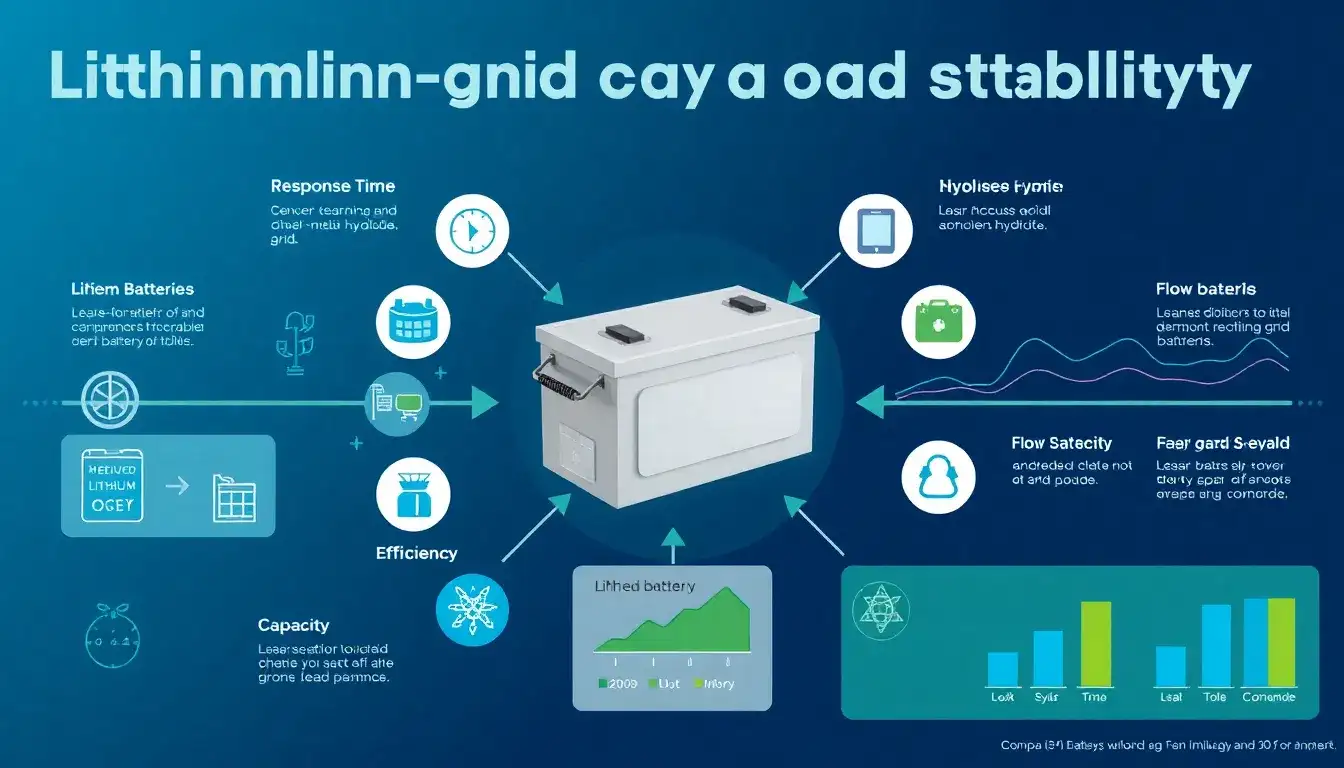
Lithium-ion batteries compare favorably to other battery types in terms of grid stability due to several key performance characteristics:
- Round-Trip Efficiency (RTE): Lithium-ion batteries have a very high round-trip efficiency, typically above 90%, which means less energy is lost during storage and retrieval. In contrast, lead-acid batteries have about 70% efficiency, flow batteries range between 50-75%, and metal-air batteries can be as low as 40% efficiency. This high efficiency contributes directly to grid stability by providing more reliable energy output.
- Energy and Power Density: Lithium-ion batteries offer superior energy density (around 200 Wh/kg) and power density (approximately 500 W/kg), allowing them to store more energy and deliver higher power output per unit mass compared to flow batteries, which have 100 Wh/kg and 300 W/kg respectively. This makes lithium-ion better suited for fast response and high power demands in grid stabilization.
- Duration and Cycle Life: Although flow batteries typically have a longer cycle life (about 1000 cycles) compared to lithium-ion batteries (around 500 cycles), the high efficiency and power density of lithium-ion cells make them highly effective for applications requiring frequent charging and discharging, such as frequency regulation and short-term grid balancing. However, lithium-ion’s shorter cycle life can affect long-term cost and sustainability.
- Deployment and Reliability: Lithium-ion technology is currently the dominant choice for new grid-scale battery installations due to their mature technology, high efficiency, and declining costs. They are widely used to help avoid grid disturbances like rolling blackouts by enabling rapid energy dispatch and recharge cycles, particularly in regions with high solar penetration where energy storage needs to bridge generation gaps effectively.
- Environmental and Safety Considerations: While lithium-ion batteries excel in performance, they have higher environmental impacts and toxicity compared to some alternatives like flow batteries, which exhibit lower CO2 emissions and toxicity ratings. Solid-state batteries are an emerging alternative with potential advantages, but lithium-ion remains dominant given current commercial readiness.
In summary, lithium-ion batteries offer superior efficiency, energy and power density, and are the most widely used technology for enhancing grid stability, especially for short to medium-duration storage. Their ability to rapidly charge and discharge makes them well suited to manage fluctuations and support grid reliability amidst increasing renewable energy integration. However, they face challenges in cycle life and environmental impact compared to some other battery chemistries, which could influence future developments in grid storage technologies.
Original article by NenPower, If reposted, please credit the source: https://nenpower.com/blog/how-do-lithium-ion-batteries-compare-to-other-battery-types-in-terms-of-grid-stability/

