

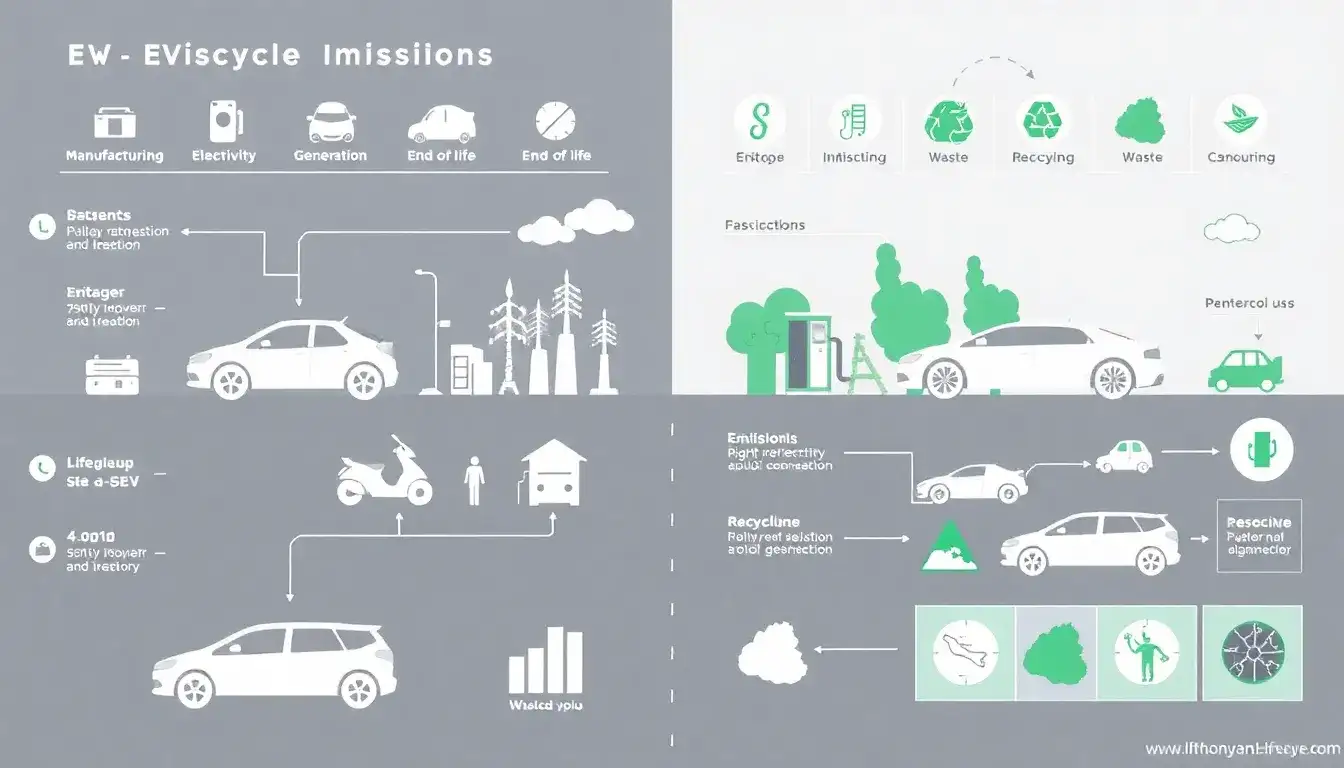
The lifecycle emissions of electric vehicles (EVs), including battery electric vehicles (BEVs), are significantly lower than those of gasoline-powered internal combustion engine vehicles (ICEVs) when considering the full cradle-to-grave analysis. This includes emissions from production (vehicle and battery manufacturing), fuel or electricity production, vehicle use, and end-of-life processes.
Key Comparisons of Lifecycle Emissions: EVs vs Gasoline Cars
- Zero Tailpipe Emissions vs High Tailpipe Emissions
EVs have zero tailpipe emissions when running solely on electricity, whereas gasoline cars emit CO2 and pollutants directly through combustion. However, EVs’ total emissions also include those from electricity generation, which varies by energy source. - Fuel Cycle Emissions
Gasoline vehicles’ lifecycle emissions include extraction, refining, and transport of fuel, contributing significantly upstream. EV emissions depend on the carbon intensity of the electricity grid used to charge them—grids with cleaner energy sources provide the greatest emissions advantages for EVs. - Manufacturing Emissions
EVs generally have higher manufacturing emissions, largely due to battery production. The emissions intensity depends on where and how batteries are manufactured and the energy mix of that region. For instance, battery production in China tends to have 60%-85% higher CO2 emissions than in Europe or the U.S. - Break-even Distance and Use-Phase Emissions
The emissions break-even point—the distance an EV must be driven before its lifecycle emissions fall below those of a gasoline car—varies widely by country due to grid carbon intensity. For example, in France (with a low-carbon grid), EVs break even as early as 25,000 km, while in China (higher grid emissions), it’s up to 153,000 km. Over typical vehicle lifespans (~200,000 km), EVs produce substantially lower lifecycle emissions. - Quantitative Emissions Savings
Lifecycle CO2 emissions of medium-sized BEVs can be 18% to 87% lower than comparable gasoline cars depending on the country and grid mix. In the U.S., lifecycle emissions of BEVs are roughly 45% lower than plug-in hybrids (PHEVs) and 65% lower than traditional gasoline cars. Globally, a medium battery electric car has about half the lifecycle emissions of an equivalent ICE vehicle running on oil-based fuels over 15 years. - Future Outlook
As electricity grids become cleaner and battery production improves, the lifecycle emissions advantage of EVs will grow. By 2035, gasoline cars may produce over two to three times the emissions of BEVs over their lifetimes.
Summary
| Aspect | Electric Vehicles (EVs) | Gasoline Cars (ICEVs) |
|---|---|---|
| Tailpipe Emissions | Zero when running on electricity | High CO2 and pollutant emissions |
| Fuel Production Emissions | Variable; depends on electricity grid carbon mix | High from extraction, refining, and transport |
| Manufacturing Emissions | Higher due to batteries; varies by production location | Lower, but includes complex engine manufacturing |
| Emissions Break-even Distance | 25,000 km to 153,000 km (depends on grid carbon intensity) | N/A |
| Lifecycle Emissions Savings | 18%-87% lower CO2 emissions over vehicle lifetime | Baseline |
| Future Trends | Grid decarbonization improves EV advantage | Limited improvements expected |
In conclusion, lifecycle emissions for EVs are generally substantially lower than those for gasoline vehicles, especially as the electricity they use becomes cleaner and manufacturing emissions decrease with technological progress.
Original article by NenPower, If reposted, please credit the source: https://nenpower.com/blog/how-do-lifecycle-emissions-of-evs-compare-to-those-of-gasoline-cars/

