

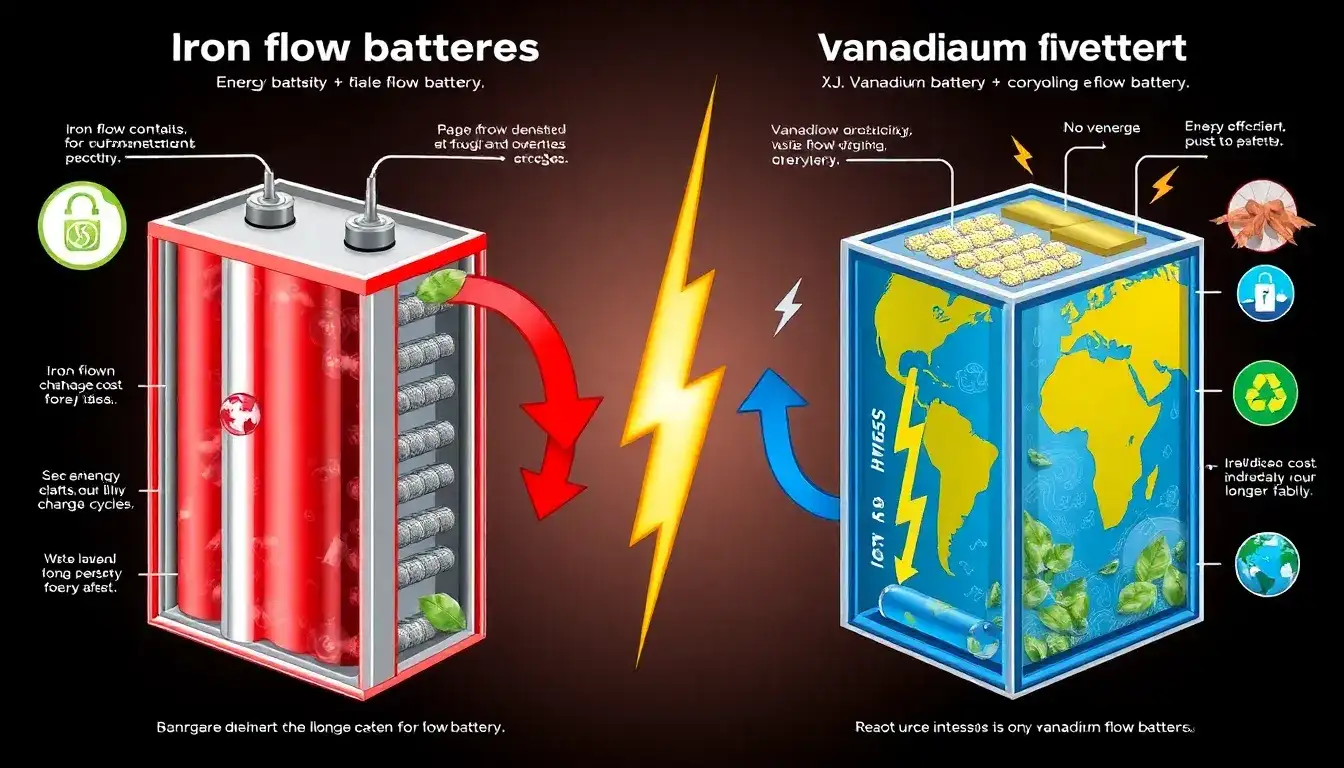
Iron Flow Batteries vs. Vanadium Flow Batteries
Iron flow batteries and vanadium flow batteries differ notably in performance and sustainability, with iron flow batteries showing distinct advantages in several key areas.
Performance Differences
- Cycle Life and Durability: Iron flow batteries have a longer operational lifespan, with about 20 years of life, compared to vanadium flow batteries which typically have shorter life spans. This means iron flow batteries require less frequent replacement and maintenance over time.
- Safety and Thermal Management: Iron flow batteries pose no risk of thermal runaway and can maintain peak efficiency without the need for active cooling systems. This reduces complexity and cost in operation and increases safety compared to vanadium flow batteries, which typically require more rigorous thermal management to prevent degradation.
- Cycling Capability: Iron flow batteries support unlimited cycling with zero capacity fade over their life, enabling consistent performance during frequent charge and discharge cycles. Vanadium flow batteries generally also offer good cycling but may exhibit capacity fade after extensive use, potentially requiring electrolyte rebalancing and maintenance.
Sustainability Differences
- Material Abundance and Environmental Impact: Iron is earth-abundant, non-toxic, and ethically sourced, making iron flow batteries more sustainable in terms of raw material availability and extraction impact. Vanadium is less abundant and mining it can have higher environmental and ethical concerns.
- Global Warming Potential (GWP) and Lifecycle Emissions: Lifecycle analyses have demonstrated that iron flow batteries have significantly lower embodied CO2 emissions and global warming potential compared to vanadium redox flow batteries and lithium-ion technologies. Iron flow batteries thus have the lowest environmental impact across manufacturing, use, and end-of-life stages among major flow battery chemistries.
- Recycling and End-of-Life: Iron flow batteries are substantially recyclable or reusable at end-of-life, contributing to sustainability by minimizing waste and resource depletion. Vanadium batteries are also recyclable but involve more complex processes and the handling of more toxic vanadium compounds, potentially increasing environmental and health risks.
Summary Comparison
| Feature | Iron Flow Batteries | Vanadium Flow Batteries |
|---|---|---|
| Lifespan | ~20 years | Typically less; often ~7-10 years |
| Safety | No thermal runaway risk; simpler cooling | Requires thermal management for safety |
| Cycling Performance | Unlimited cycles, zero capacity fade | Good cycling but may require maintenance |
| Material Abundance | Earth-abundant, non-toxic iron | Less abundant, more environmentally intensive |
| Environmental Impact | Lowest global warming potential in lifecycle | Higher GWP compared to iron batteries |
| End-of-Life Recycling | Substantially recyclable, simpler processes | Recyclable but more complex due to vanadium |
In conclusion, iron flow batteries outperform vanadium flow batteries in sustainability metrics such as environmental impact, material abundance, and lifecycle emissions, while also providing long cycle life and superior safety features. This makes iron flow batteries a cleaner, safer, and more sustainable choice for long-duration energy storage applications.
Original article by NenPower, If reposted, please credit the source: https://nenpower.com/blog/how-do-iron-flow-batteries-differ-from-vanadium-flow-batteries-in-terms-of-performance-and-sustainability/

