

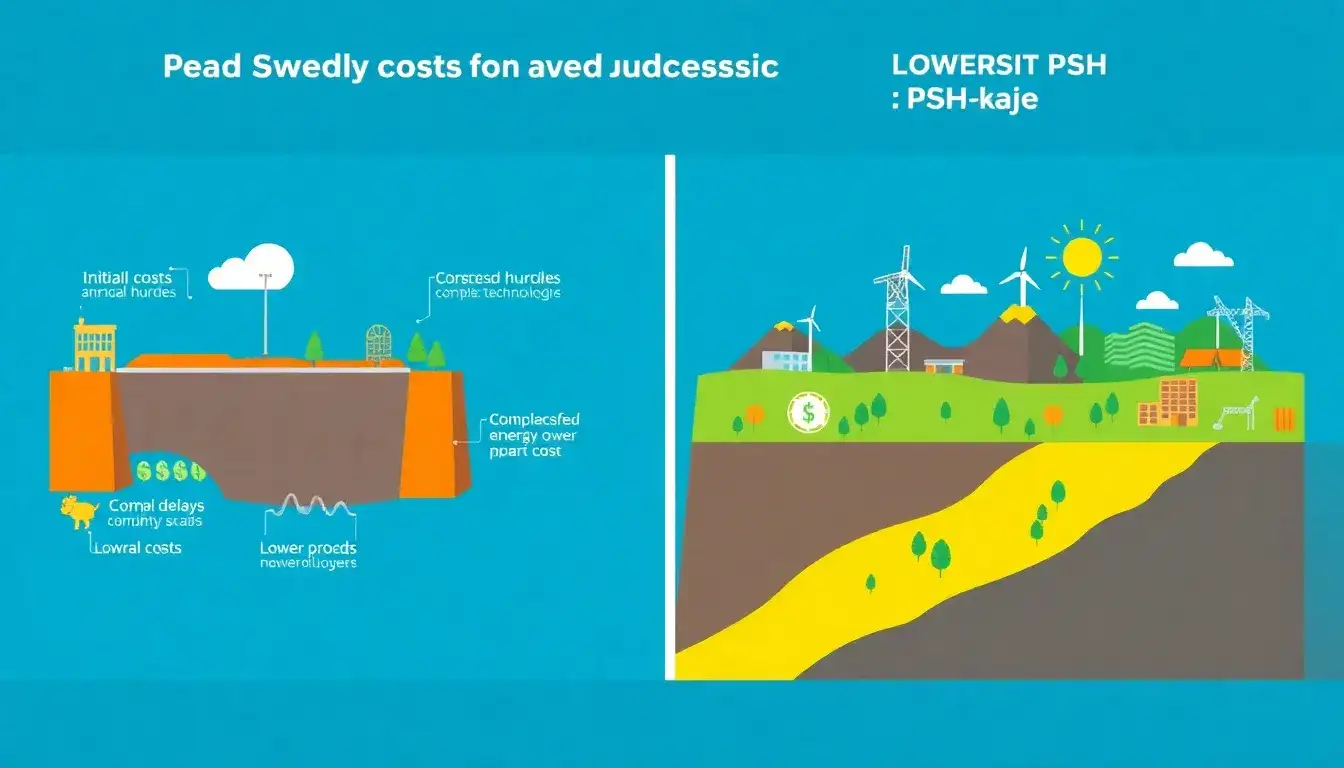
Initial costs significantly affect the feasibility of new Pumped Storage Hydropower (PSH) projects by impacting their economic viability. Here are some key ways initial costs influence the feasibility of PSH projects:
Impact of Initial Costs on PSH Feasibility
- Economic Viability:
- Capital Costs: High initial capital costs are a major barrier to the deployment of new PSH projects, especially for smaller or innovative designs like modular PSH (m-PSH). High costs can make these projects uncompetitive compared to other forms of energy storage.
- Cost Components: The cost of components such as turbines, generators, and storage tanks is crucial. For instance, the cost of pressure vessels or storage tanks can be a significant cost driver for hybrid or modular systems.
- Design and Configuration:
- Site-Specific Costs: Factors like geological conditions, terrain, and existing infrastructure can greatly influence costs. Sites with challenging conditions, such as difficult excavation or poor tunneling conditions, increase initial costs.
- Project Scale: Larger projects might have economies of scale, but smaller modular projects face challenges due to higher cost per unit of power.
- Market and Regulatory Factors:
- Market Revenue Potential: Even with lower costs, if the market revenue potential is low, projects may not be viable. Regulatory uncertainties and regional economic indicators can further discourage investment.
- Comparison with Alternatives: The cost per kilowatt-hour (kWh) of PSH must be competitive with other energy storage technologies to ensure feasibility.
- Innovative Solutions:
- Cost Reduction Strategies: Improving the cost of storage through innovations or utilizing existing infrastructure can significantly enhance the feasibility of m-PSH projects.
- Hybrid Systems: Exploring hybrid configurations, like integrating solar power with m-PSH, can offer new paths to viability by optimizing resource utilization.
Tools and Models for Cost Assessment
- Cost Modeling Tools: Both NREL and ORNL have developed cost models to help assess and predict the costs of PSH projects. These tools calculate costs based on specific site conditions, technology configurations, and market factors.
- Validation and Adjustment: These models are validated against real projects and continuously updated to improve accuracy and accommodate changing market conditions.
Overall, initial costs are critical in determining the feasibility of new PSH projects. Reducing these costs through innovative designs, efficient use of resources, and favorable regulatory environments is essential for making PSH a viable option in the energy market.
Original article by NenPower, If reposted, please credit the source: https://nenpower.com/blog/how-do-initial-costs-affect-the-feasibility-of-new-psh-projects/

