

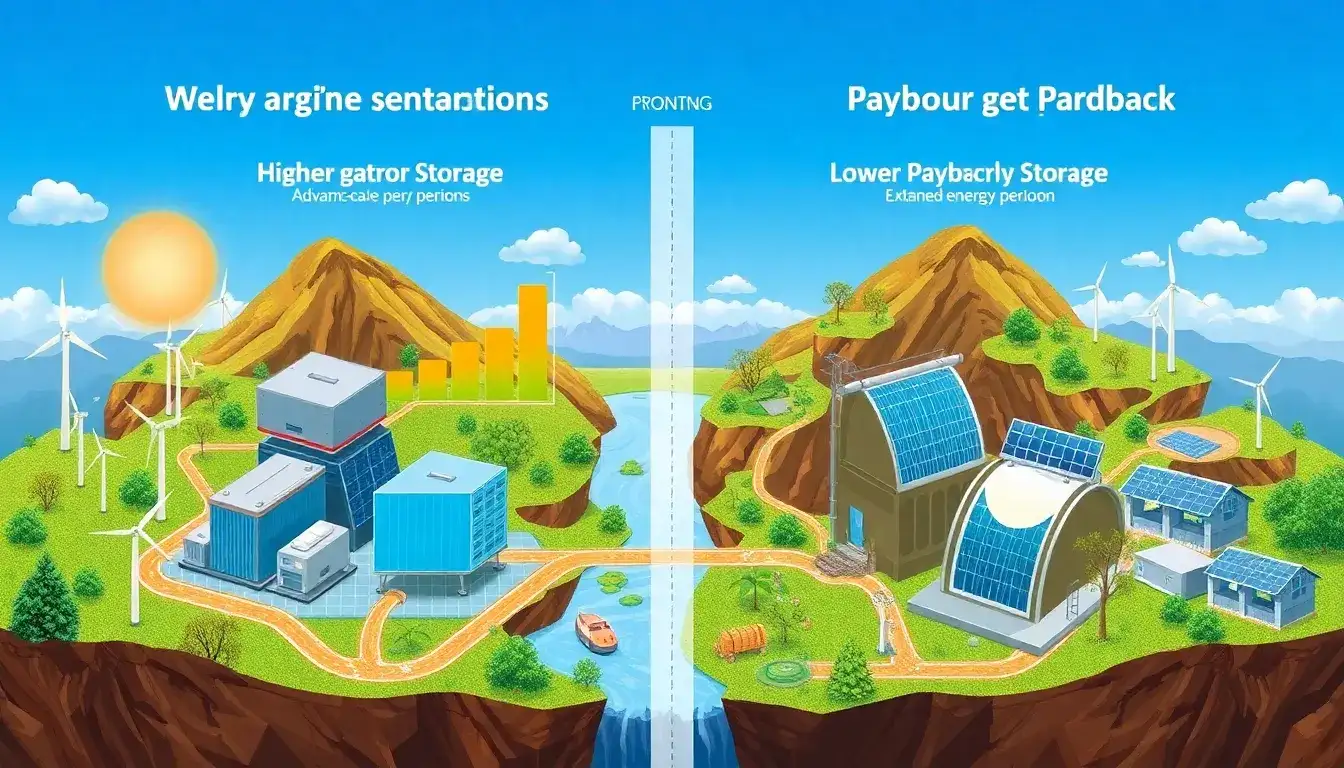
Incentives play a crucial role in reducing the payback period for long-duration energy storage investments by lowering the upfront costs and increasing the financial returns from these systems.
How Incentives Impact Payback Periods for Energy Storage
- Reduction of upfront costs: Incentives such as federal and state tax credits, rebates, and utility programs directly reduce the initial capital required for installing energy storage. For example, the federal Investment Tax Credit (ITC) offers a tax credit of 26% of the system cost for storage systems charged by renewable energy, significantly lowering net investment costs. In California, the ITC can cover 30% of combined solar and battery costs, immediately reducing the upfront financial burden.
- Direct rebates: State and utility rebates target battery capacity, sometimes offering significant cash back per kilowatt-hour. California’s Self-Generation Incentive Program (SGIP), for example, provides rebates ranging from $200 to $1,000 per kWh depending on household income and risk factors, which can reduce a 10 kWh battery cost by thousands of dollars.
- Improved financial returns: Incentives improve the overall economics by increasing the amount saved or offset through reduced electricity bills and resilience benefits. Although longer than solar alone, energy storage payback periods can shrink from more than 10 years to around 5 years with robust incentives.
- Eligibility conditions: To qualify for the ITC, energy storage systems typically need to be paired with renewable energy sources (like solar panels) to be eligible, linking storage incentives to renewable generation adoption.
Summary
With strong incentives like federal tax credits (26%-30%), and state/utility rebates (e.g., up to $1,000/kWh in CA), the payback period for long-duration energy storage can be shortened significantly—often to about five years in the best cases—making the investments more financially attractive and accelerating adoption. Without these incentives, payback periods are generally longer due to the high upfront costs of storage systems.
Thus, incentives are a key factor in improving the financial viability and reducing the payback timeframe for long-duration energy storage investments.
Original article by NenPower, If reposted, please credit the source: https://nenpower.com/blog/how-do-incentives-impact-the-payback-period-for-long-duration-energy-storage-investments/

