

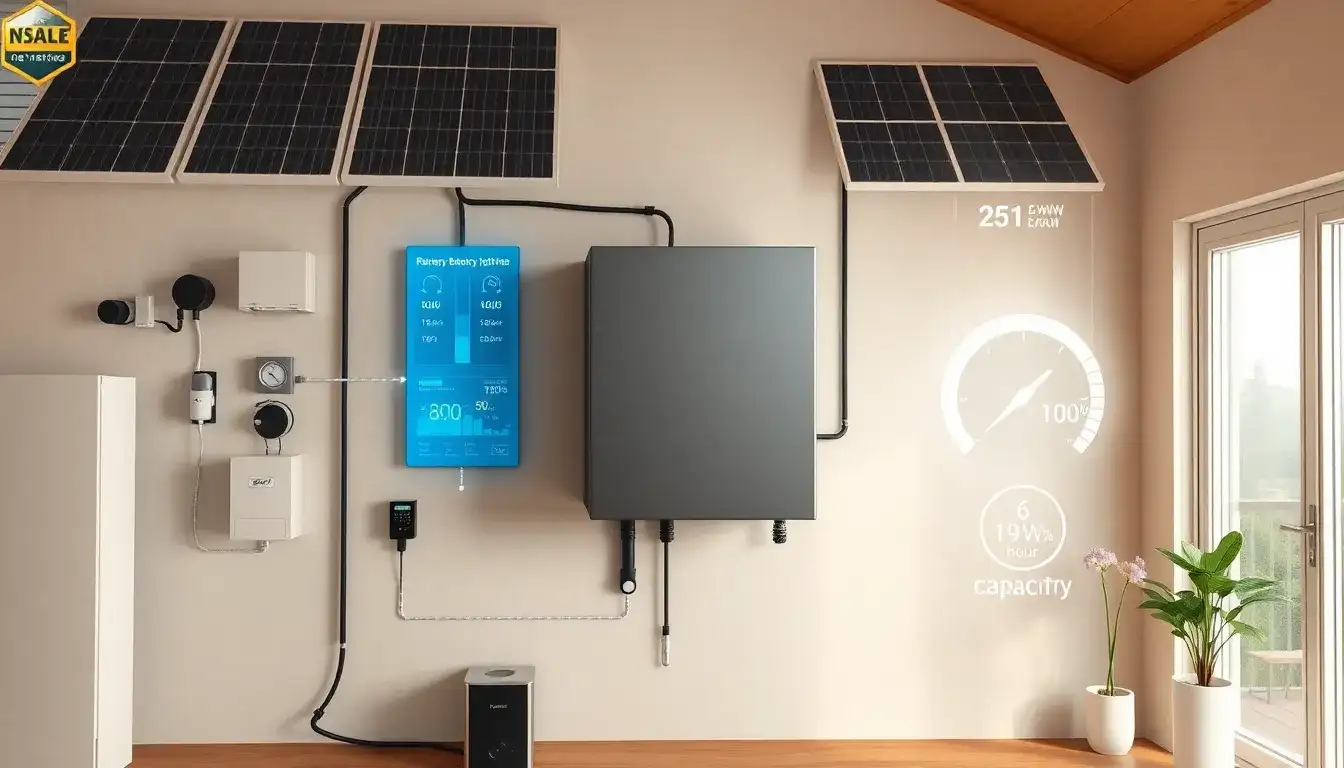
To determine if your battery storage system meets a 3 kilowatt-hour (kWh) capacity requirement, follow these steps:
Check Specifications Directly
Review the manufacturer’s specifications for your battery system. Look explicitly for energy storage capacity listed in kWh (most straightforward method). For example, a system labeled “5 kWh” exceeds the requirement, while a “2.5 kWh” unit does not.
Calculate Using Voltage and Amp-Hours
If capacity is listed in amp-hours (Ah) instead of kWh:
- Identify the battery’s nominal voltage (e.g., 12V, 24V).
- Multiply voltage by Ah using the formula:
kWh = (Voltage (V) × Amp-Hours (Ah)) / 1000
For a 12V, 250Ah battery:
(12 × 250) / 1000 = 3 kWh (exact requirement met).
Measure Capacity Experimentally
For smaller or unlabeled batteries:
- Use a constant current load (e.g., a 500mA load for a 5000mAh battery).
- Discharge fully while tracking time until cutoff voltage.
- Calculate:
Capacity (Wh) = Load Power (W) × Discharge Time (hours)
Convert Wh to kWh (divide by 1000). A result ≥3000Wh = 3 kWh.
Key Considerations
- Depth of Discharge (DoD): If your battery has a 80% DoD, a 3.75 kWh gross capacity (3 kWh usable) still meets the requirement.
- Efficiency losses: Factor in ~90% efficiency (common for lithium-ion) to ensure sufficient usable capacity.
- Professional testing: For grid-scale systems, consult experts to verify capacity using specialized equipment.
Example: A 48V, 62.5Ah battery provides (48 × 62.5) / 1000 = 3 kWh.
Original article by NenPower, If reposted, please credit the source: https://nenpower.com/blog/how-do-i-determine-if-my-battery-storage-system-meets-the-3-kilowatt-hour-capacity-requirement/

