

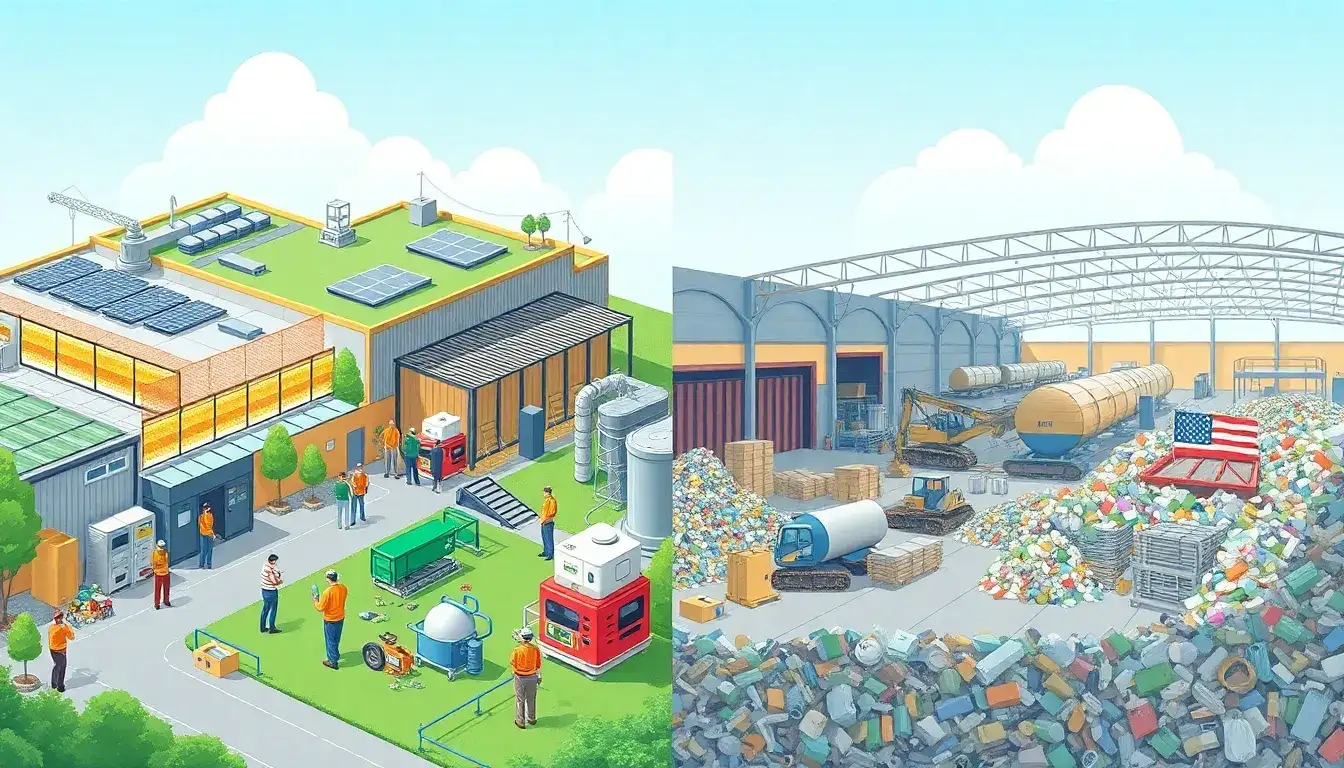
High-value recycling facilities in the EU vs. US
High-value recycling facilities in the EU differ from those in the US primarily in technological approaches, policy frameworks, operational scale, and regulatory environment.
Technological and Operational Differences
- EU Facilities: European high-value recycling facilities tend to have advanced specialization, such as handling both crystalline silicon (c-Si) and thin-film photovoltaic (PV) panels, as seen in German facilities like FLAXRES GmbH which also explores mobile recycling units in shipping containers for flexibility and scale. This reflects a broader trend of innovation and versatility in EU recycling tech.
- US Facilities: The US has fewer such advanced facilities, with notable ones located in Ohio, Arizona, and Texas. Major players like First Solar, Inc. conduct high-value recycling but the number of such commercial facilities is limited in comparison to the EU.
Policy and Regulatory Framework
- EU: The European Union employs stringent and comprehensive policies for e-waste and recycling. This includes mandatory collection points, retailer’s obligation to accept e-waste, and a strong push toward a circular economy model where electronics manufacturers have extended producer responsibility (EPR). Such policies enforce high recycling rates and promote reuse of valuable components.
- US: US recycling laws vary by state and are generally less stringent. Most states base regulations on extended producer responsibility, but there is less uniformity and fewer mandates for free consumer returns or retailer take-back, resulting in lower recycling rates for e-waste compared to Europe.
Recycling Rates and Landfill Context
- EU: European cities face disposal crises due to limited landfill capacity, which drives the urgency for high-value recycling and waste diversion strategies. This scarcity of landfill space encourages more rigorous recycling programs and innovations to recover valuable materials from waste streams.
- US: The US often has abundant landfill availability, reducing economic pressure for recycling. This has led to a slower adoption of extensive high-value recycling programs at the commercial level.
Summary Table
| Aspect | European Union | United States |
|---|---|---|
| Facility Technology | Handles diverse panel types; innovative units | Fewer facilities; focus on key players like First Solar |
| Policy Approach | Strict, uniform EU-wide mandates; circular economy model; free e-waste returns | State-dependent laws; less uniform; EPR-based but less comprehensive |
| Recycling Rates | Higher, driven by policy and landfill scarcity | Lower overall, due to less regulation and available landfill space |
| Landfill Availability | Limited, disposal crises in cities | More abundant, less pressure to recycle |
In essence, EU high-value recycling facilities operate within a more cohesive, stringent regulatory framework with a clear emphasis on circular economy principles, fostering advanced technological solutions and higher recycling rates. The US, by contrast, exhibits greater variability in facility availability and recycling policies, often resulting in lower recycling efficiency and fewer commercial high-value recycling operations.
Original article by NenPower, If reposted, please credit the source: https://nenpower.com/blog/how-do-high-value-recycling-facilities-in-the-eu-differ-from-those-in-the-us/

