

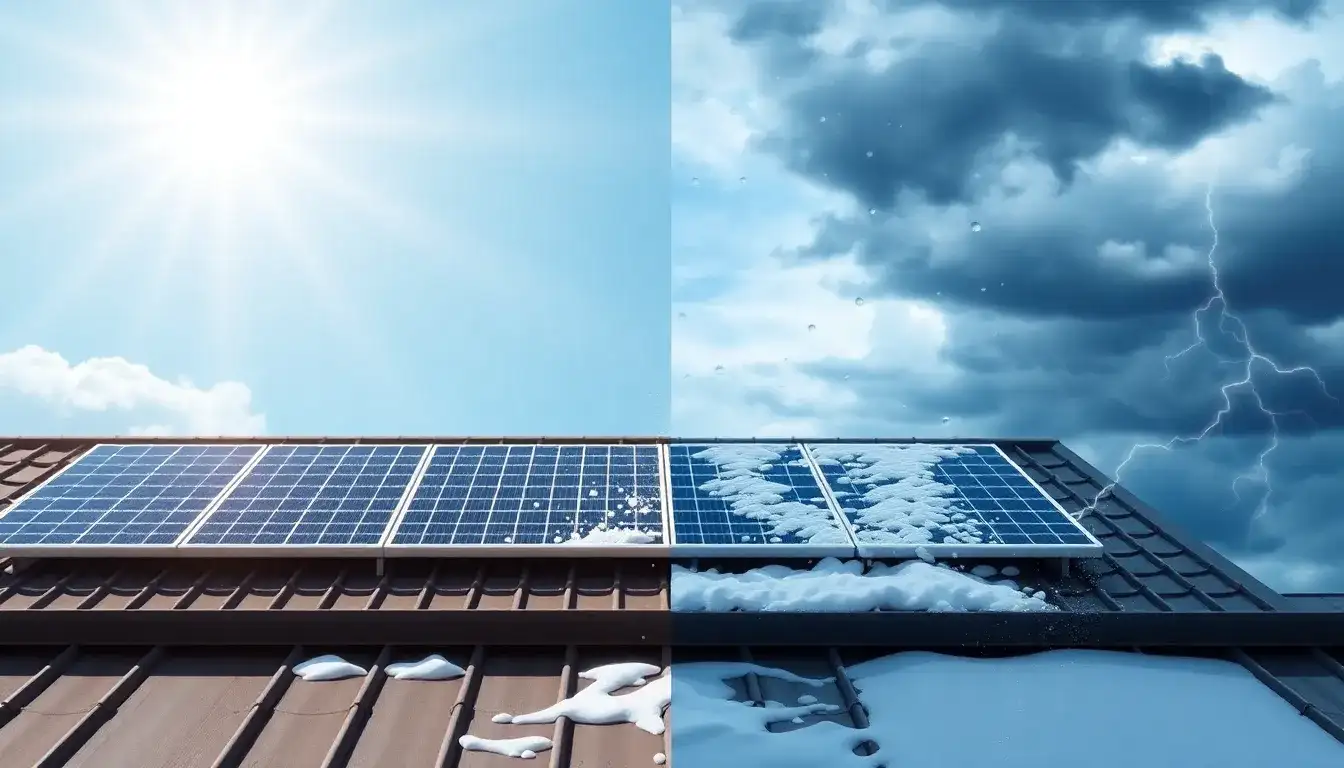
High-efficiency Solar Panels
High-efficiency solar panels maintain good performance across various weather conditions, though their output varies depending on sunlight intensity, temperature, and environmental factors.
Performance in Different Weather Conditions
Sunny and Clear Days
Sunny and Clear Days
Solar panels achieve peak efficiency under clear, sunny skies with direct sunlight. Optimal panel temperatures range between 70°F and 90°F (21°C to 32°C), as moderate temperatures help maintain efficiency. Light breezes aid in cooling panels to prevent efficiency loss due to overheating.
Cloudy and Overcast Weather
Cloudy and Overcast Weather
Solar panels still generate electricity during cloudy conditions due to their ability to capture diffuse sunlight—scattered light not coming directly from the sun. Efficiency typically decreases by about 20% to 60% depending on cloud density, with energy production dropping to roughly 10-25% of peak capacity on heavily overcast days. However, panels remain functional and can even experience temporary boosts (the “Edge-of-Cloud Effect”) when sunlight refracts around cloud edges.
Rainy Weather
Rainy Weather
While rain reduces direct sunlight and thus temporarily lowers output, it provides important benefits. Rain naturally cleans panels by washing away dust, dirt, and debris, improving long-term efficiency. Additionally, rain cools the panels, mitigating the negative impact of heat on solar cell efficiency. High temperatures increase electrical resistance and reduce output, so rain’s cooling helps maintain better performance.
Snow and Ice
Snow and Ice
Despite common misconceptions, snow does not necessarily impair solar panel functioning severely. Light snow can allow some light to penetrate, and modern panels have smooth surfaces enabling snow to slide off more easily. Snow’s high reflectivity can increase sunlight concentration on panels during sunny winter days, enhancing output. Cold temperatures improve solar cell efficiency by reducing electrical resistance compared to hot conditions. However, heavy snow accumulation can block sunlight and add structural weight risk, necessitating maintenance to clear panels.
Hot Weather
Hot Weather
Solar panel efficiency declines slightly as temperatures rise above 77°F (25°C) due to increased electrical resistance within the cells. The typical efficiency loss is around 0.38% per degree Celsius above this temperature. Despite this, high-quality panels use materials and design features to mitigate heat effects, and hot, sunny climates remain favorable due to strong solar irradiance.
Shade and Fog
Shade and Fog
Shade from trees or structures significantly reduces output—often halving it—since panels rely on sunlight exposure. Fog reduces direct sunlight but still allows about 50% efficiency due to diffuse light capture.
Summary Table of Performance Factors
| Weather Condition | Typical Efficiency Impact | Notes |
|---|---|---|
| Sunny, moderate temp | Peak efficiency | Best sunlight, optimal temp 70-90°F, light breeze beneficial |
| Cloudy/Overcast | 20%-60% reduction | Diffuse light captured; panels remain functional |
| Rainy | Temporary reduction; cleaning benefit | Cooling effect; natural cleaning improves long-term output |
| Snowy | Potential blockage; efficiency boost from reflectivity | Cold improves efficiency; snow slide-off important |
| Hot (above 77°F) | Slight efficiency decline (~0.38% per °C) | Cooling design helps offset heat losses |
| Shade | ~50% reduction or more | Shade from trees or objects reduces output |
| Fog | ~50% efficiency | Diffuse light capture allows continued operation |
Maximizing Solar Panel Efficiency in All Weather
- Install panels facing south (in Northern Hemisphere) with optimal tilt (30-45 degrees).
- Avoid shading from trees, buildings, or roof components.
- Maintain cleanliness through regular washing or relying on natural rain.
- Use solar tracking systems or battery storage to optimize energy capture and availability.
- Choose high-efficiency panels designed to perform well in low-light and varying temperature conditions.
Modern high-efficiency solar panels are engineered for resilience and adaptability to diverse weather conditions, making them effective energy sources year-round in most climates.
Original article by NenPower, If reposted, please credit the source: https://nenpower.com/blog/how-do-high-efficiency-solar-panels-perform-in-different-weather-conditions/

