

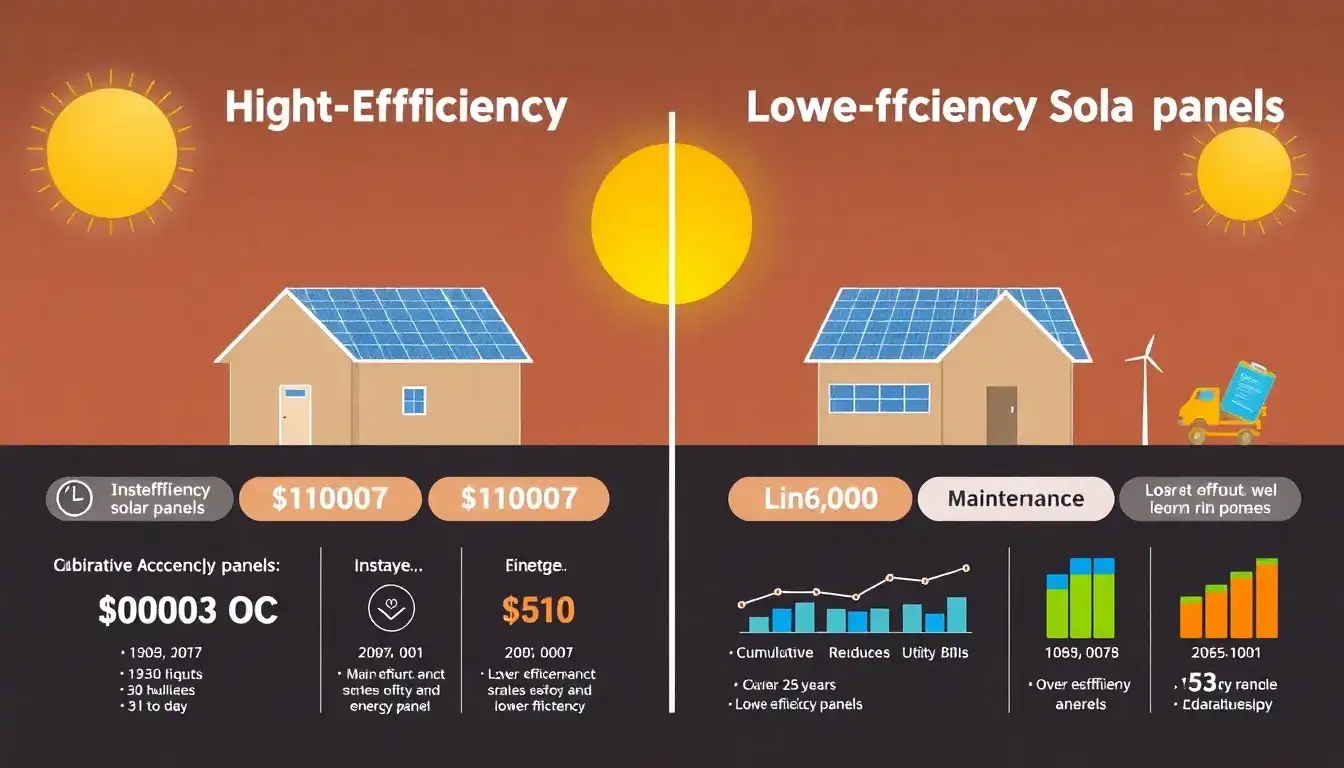
High-Efficiency vs. Lower-Efficiency Solar Panels: Cost Savings Over Their Lifespan
When comparing high-efficiency solar panels to lower-efficiency ones, several factors influence the overall cost savings over their lifespan. Here are some key considerations:
Efficiency and Energy Production
- Higher Efficiency, More Energy Output: High-efficiency panels, typically above 22% efficient, produce more electricity per square foot compared to standard panels (usually 15-18% efficient) under the same conditions. This higher output can lead to greater savings on electricity bills.
- Reduced Installation Needs: High-efficiency panels require fewer units to achieve the same power output, reducing roof space usage and potentially lowering installation costs.
Cost and Upfront Expenses
- Higher Initial Costs: High-efficiency panels are more expensive upfront compared to standard panels. However, they often provide better long-term savings due to increased energy production.
- Payback Period: High-efficiency panels typically have a shorter payback period (5 to 9 years) compared to standard panels (6 to 10 years) due to their increased efficiency and energy output.
Long-Term Savings and ROI
- Increased Lifespan Savings: Over a 25-year period, high-efficiency panels can yield greater total savings by generating more electricity and reducing electricity bills further.
- Warranty and Performance: Most high-efficiency panels come with warranties of 25 years or more and experience minimal performance degradation (less than 0.5% annually), ensuring sustained energy production over their lifespan.
Scenario Comparison
Consider two systems in Massachusetts:
- System 1 (High-Efficiency): Uses Maxeon’s 440-watt panels at 22.8% efficiency. With a system size of 8.8 kW, it can produce 9,680 kWh annually and offers a 25-year net savings of $80,915 after costs.
- System 2 (Lower-Efficiency): Uses panels with a 21% efficiency. The system size is slightly smaller at 8.1 kW, producing 8,910 kWh annually with a 25-year net savings of $77,257.
High-efficiency panels, like those from Maxeon, Qcells, and Panasonic, offer increased energy production and potentially more savings over their lifespan due to higher efficiency, despite higher upfront costs.
Conclusion
High-efficiency solar panels provide better long-term cost savings and a faster payback period compared to lower-efficiency options, thanks to increased energy production and reduced installation requirements. While they are more expensive initially, high-efficiency panels can be more cost-effective over their lifespan, particularly for installations with space constraints or high electricity rates.
Original article by NenPower, If reposted, please credit the source: https://nenpower.com/blog/how-do-high-efficiency-solar-panels-compare-to-lower-efficiency-ones-in-terms-of-overall-cost-savings-over-their-lifespan/

