

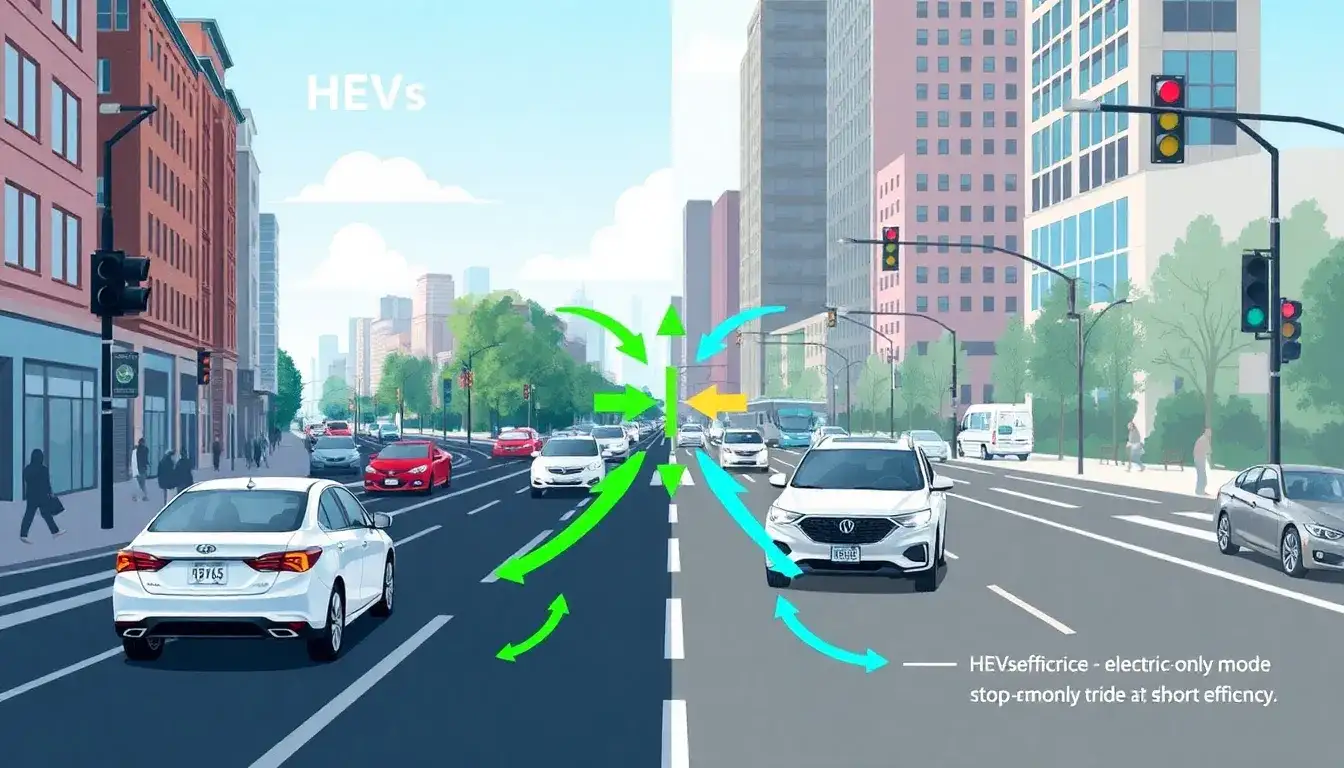
Hybrid electric vehicles (HEVs) and plug-in hybrids (PHEVs) show distinct fuel efficiency patterns in urban driving due to their differing powertrain designs:
HEVs in urban driving
HEVs excel in stop-and-go city conditions due to frequent regenerative braking, which recaptures energy during deceleration to power their small (1+ kWh) battery. This energy is reused for electric-only propulsion at low speeds, resulting in higher city MPG compared to highway driving.
PHEVs in urban driving
PHEVs typically achieve greater efficiency in urban settings when operating in electric-only mode (20-50 miles/charge), using no gasoline for short commutes. Once the larger battery (10-20 kWh) depletes, PHEVs revert to hybrid operation but often get slightly lower MPG than HEVs due to added battery weight – though still better than gas-only vehicles.
Key comparison
- Electric advantage: PHEVs avoid fuel use entirely for initial 20-50 miles (ideal for urban errands).
- Hybrid efficiency: HEVs maintain consistent fuel economy without need for charging.
- MPG after depletion: PHEVs like the Chrysler Pacifica Hybrid achieve ~40 MPG in hybrid mode, comparable to HEVs in similar size classes but often 2-5 MPG lower than the most efficient hybrids.
PHEVs deliver superior urban efficiency only when regularly charged, while HEVs provide consistently optimized fuel economy without charging requirements.
Original article by NenPower, If reposted, please credit the source: https://nenpower.com/blog/how-do-fuel-efficiencies-of-hevs-and-phevs-compare-in-urban-driving/

