

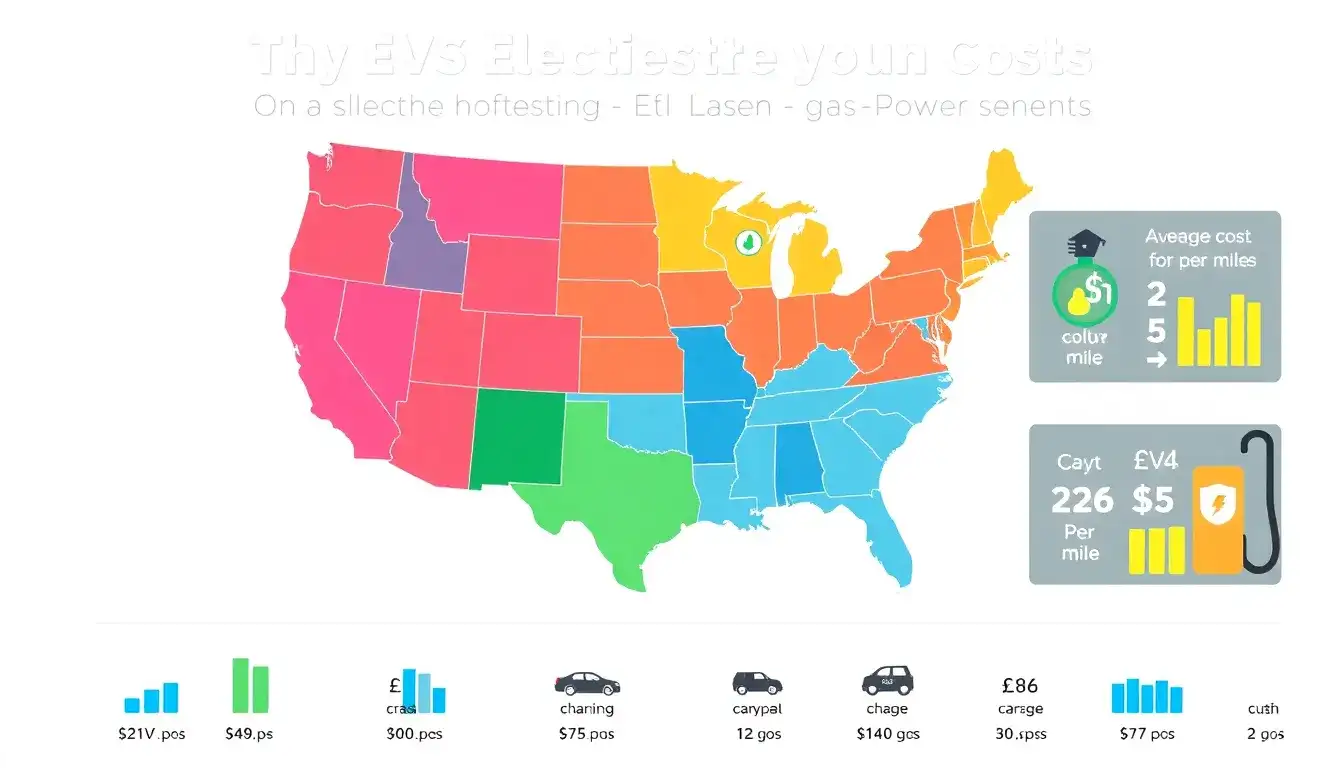
Electric vehicle fuel costs show significant regional variations compared to gasoline-powered cars, primarily influenced by local electricity and gasoline prices:
Cost comparisons
- Home charging advantages: EVs charged at home are cheaper to operate than gasoline cars in all 50 US states. For example, Washington shows 5x higher costs for gasoline per 100 miles due to cheap electricity and expensive gas, while Oregon and Montana offer over $1,000/year savings for EV drivers.
- Public charging impact: Fast-charging use erodes cost benefits, with public stations making EVs 2-3x more expensive per charge session than home charging. In California, recent data shows nearly identical fueling costs ($16.88 ICE vs $16.92 EV with home charging), demonstrating how high electricity prices narrow the gap.
Regional price factors
| Factor | Impact on EV vs. Gas Cost | Examples |
|---|---|---|
| Electricity prices | Lower = Greater EV savings | Washington (9.5¢/kWh) vs New Jersey (15.4¢/kWh) |
| Gas prices | Higher = Wider EV advantage | California’s high gas prices partially offset expensive electricity |
| Infrastructure | Public charger availability affects practical costs | Rural areas often lack affordable Level 2 chargers |
State-level extremes
- Greatest savings: Oregon ($1,238/year) and Washington ($1,187/year) demonstrate maximum benefits from low electricity rates.
- Smallest margins: California shows narrow margins due to both high electricity and gasoline prices, while Michigan and Florida have lower absolute savings due to reduced driving distances.
Original article by NenPower, If reposted, please credit the source: https://nenpower.com/blog/how-do-fuel-costs-for-evs-vary-by-region-compared-to-gas-powered-cars/

