

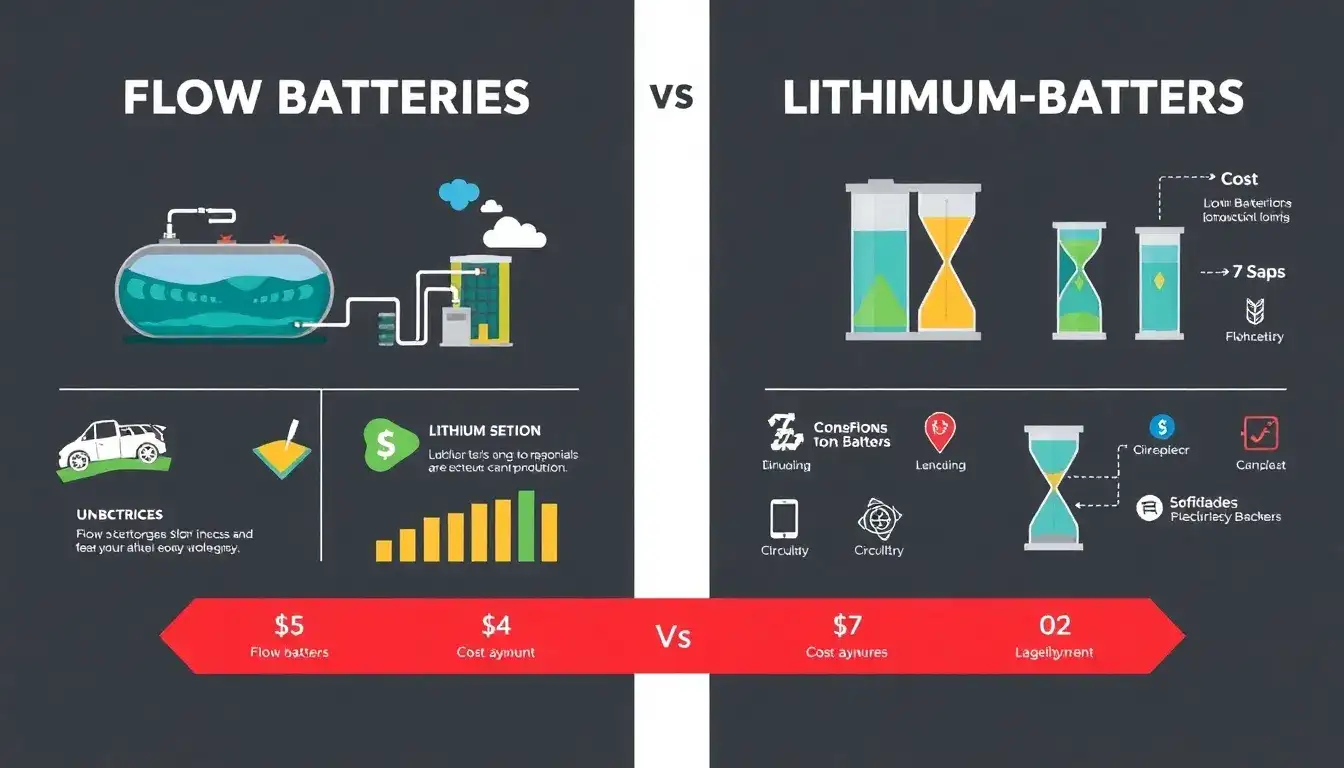
Flow batteries and lithium-ion batteries differ significantly in cost structures and lifespan characteristics:
1. Cost
Flow batteries become more cost-effective at scale due to inexpensive electrolyte tank expansion, while lithium-ion costs rise linearly with size due to expensive cathode materials. Flow batteries are price-competitive only for long-duration storage (typically >4 hours discharge time), whereas lithium-ion dominates shorter-duration applications.
2. Lifespan
Flow batteries offer 20,000+ cycles (15-25 years) with minimal degradation, while lithium-ion typically lasts 10,000 cycles (~15 years) in stationary storage. Heavy daily cycling further widens the gap: flow batteries maintain performance for 20-30 years, whereas lithium-ion degrades faster under frequent use (8-year lifespan under daily cycling).
Key Comparison Table
| Feature | Flow Batteries | Lithium-Ion Batteries |
|---|---|---|
| Cost at Scale | More economical | Less economical |
| Lifespan | 15-25 years | 8-15 years |
| Cycles | 20,000+ | 10,000 |
| Cost Driver | Electrolyte volume | Cathode materials |
Flow batteries excel in large-scale, long-duration storage where lifespan outweighs space constraints, while lithium-ion remains dominant for high-power, compact applications.
Original article by NenPower, If reposted, please credit the source: https://nenpower.com/blog/how-do-flow-batteries-compare-to-lithium-ion-batteries-in-terms-of-cost-and-lifespan/

