

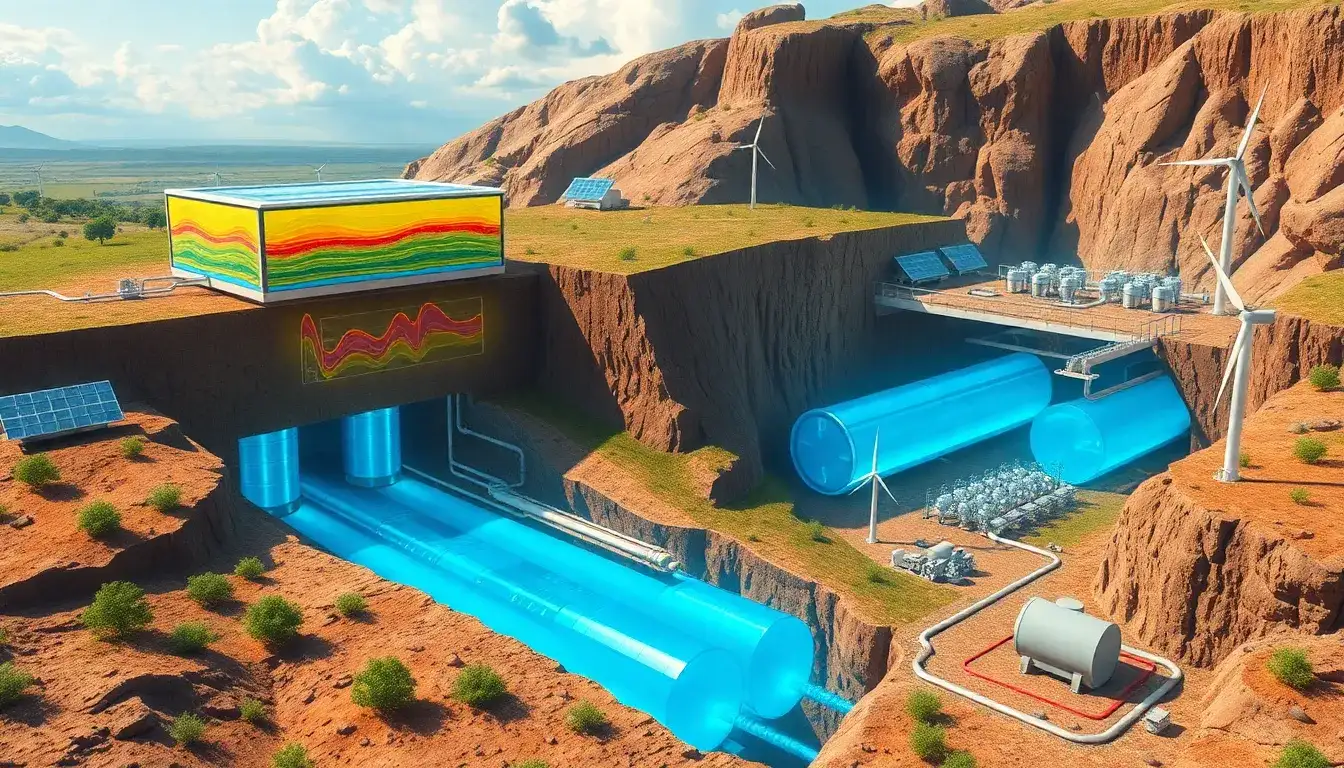
Flow Batteries
Advantages:
- Long Lifetimes and Flexibility: Flow batteries, particularly vanadium and iron flow batteries, offer extended lifetimes and over 20,000 charge-discharge cycles, making them suitable for long-duration storage.
- Scalability: They can store hundreds of megawatt-hours of energy, making them viable for grid-scale applications.
- Efficiency: While their efficiency ranges from 50–80%, which is less than lithium-ion batteries, it is sufficient for bridging long periods of low renewable energy generation.
Challenges:
- Complexity: The systems are inherently complex compared to lithium-ion batteries, lacking the technological advancements driven by the automotive industry.
- Innovation Gap: Despite their potential, flow batteries have not experienced the same level of innovation as lithium-ion batteries.
Compressed Air Energy Storage (CAES)
Advantages:
- Large-Scale Capacity: CAES systems can store energy on a massive scale, making them suitable for long-duration storage needs.
- Cost-Effectiveness: The cost of energy stored per unit is often lower compared to battery technologies, though initial infrastructure costs can be high.
- Efficiency Improvements: Modern CAES systems aim to improve efficiency by incorporating advanced heat management and other technologies.
Challenges:
- Geographical Limitations: CAES requires specific geological formations to store compressed air, limiting its deployment to suitable areas.
- Energy Loss: The process involves energy loss due to heat dissipation during compression and expansion.
Contribution to Feasibility
Both technologies contribute by offering solutions for storing energy over extended periods:
- Flow Batteries: Provide scalable and flexible storage solutions suitable for grid integration with renewables.
- Compressed Air Systems: Offer large-scale storage capacities with cost advantages, though they are geographically constrained.
Together, these technologies help address the intermittency issues of renewable energy sources, supporting the transition to more sustainable energy systems.
Original article by NenPower, If reposted, please credit the source: https://nenpower.com/blog/how-do-flow-batteries-and-compressed-air-systems-contribute-to-the-feasibility-of-long-duration-energy-storage/

