

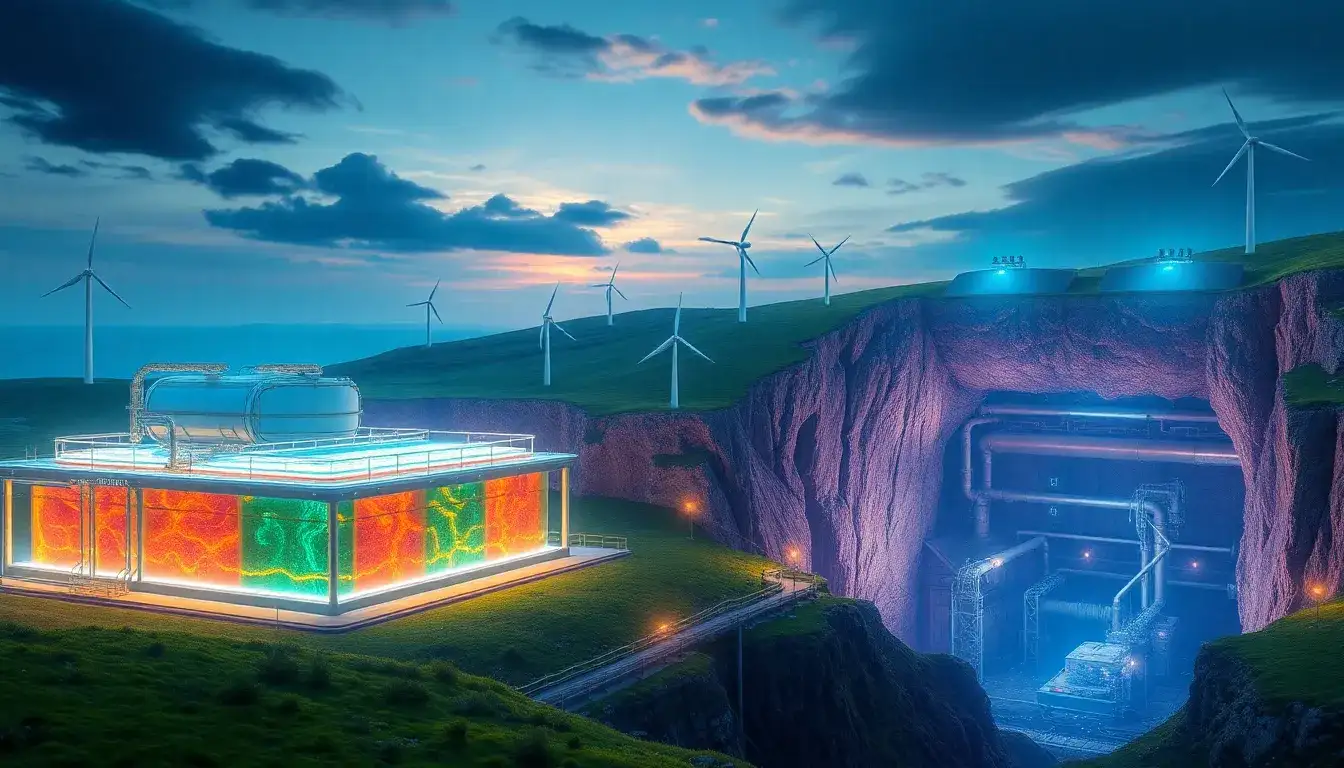
Flow batteries and compressed air energy storage (CAES) are two distinct technologies addressing long-duration energy storage needs for renewable energy grids, though available search results focus primarily on flow batteries. Below is a synthesis of their roles:
Flow batteries
- Design principle: Store energy in liquid electrolytes pumped through electrochemical cells during charge/discharge cycles.
- Scalability: Cost per kWh decreases with size, as larger tanks for electrolytes are relatively inexpensive.
- Longevity: Vanadium-based systems achieve 20,000+ cycles (15–25 years) with minimal degradation, compared to lithium-ion’s ~10,000 cycles.
- Applications: Excel in 4+ hour discharge scenarios, becoming cost-competitive over longer durations. Efficiency ranges between 50–80%.
- Challenges: Complexity and lack of cross-industry innovation (e.g., unlike lithium-ion’s automotive synergy).
Compressed air energy storage (CAES)
(Note: Specific CAES data is absent in provided results; general knowledge is summarized.)
- Design principle: Compress air into underground reservoirs (e.g., salt caverns) during surplus energy periods, later expanding it to drive turbines.
- Scalability: Suitable for multi-day storage due to low cost per kWh at large scales.
- Efficiency: ~40–70%, depending on heat recovery systems (diabatic vs. adiabatic designs).
- Applications: Grid-scale balancing for wind/solar over days or weeks.
Comparison
| Feature | Flow Batteries | CAES |
|---|---|---|
| Efficiency | 50–80% | 40–70% |
| Cycle Life | 20,000+ cycles | Decades |
| Duration | Hours to days | Hours to weeks |
| Cost Advantage | Longer discharge = lower cost | Scale-dependent |
While flow batteries are advancing in longevity and scalability for daily cycling, CAES remains critical for multi-day storage, though technological maturity varies. Both face challenges in competing with lithium-ion for shorter durations or higher round-trip efficiency demands.
Original article by NenPower, If reposted, please credit the source: https://nenpower.com/blog/how-do-flow-batteries-and-compressed-air-systems-contribute-to-long-duration-energy-storage/

