

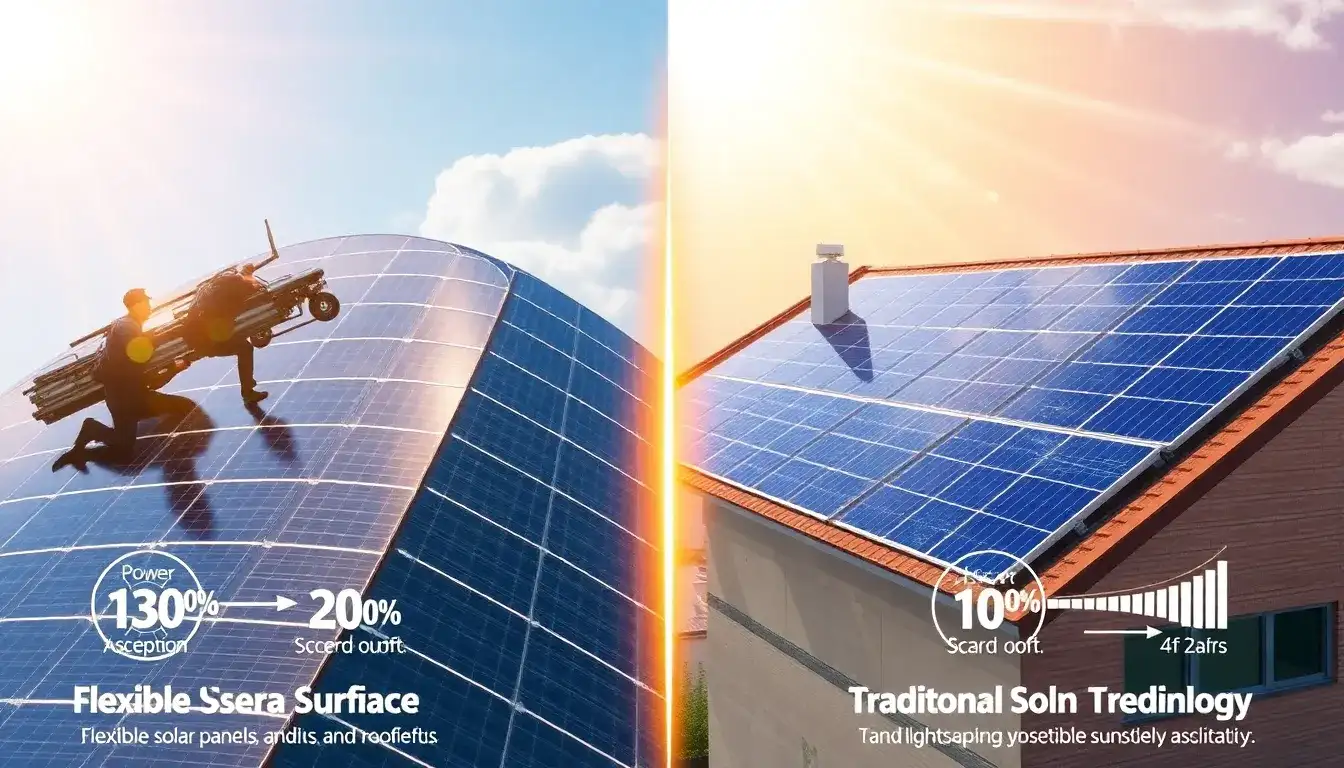
Flexible solar panels generally have lower efficiency compared to traditional rigid solar panels. Typical efficiency ratings for flexible panels range from about 10-18%, whereas traditional rigid panels usually achieve efficiencies around 20-23% or even up to 23% for high-quality monocrystalline panels.
The lower efficiency of flexible panels is mainly due to their thinner, less conductive semiconductor material and their polymer protective layer, which is less efficient at converting sunlight to electricity compared to the glass and aluminum used in traditional panels. Traditional panels use crystalline silicon cells with more material to absorb light, which contributes to their higher efficiency.
More specifically:
- Flexible solar panels often have efficiencies from 10% to 17% or up to 18% under ideal conditions.
- Rigid solar panels generally reach about 20-23% efficiency, with some average values around 19-20% or higher depending on the type and quality.
- Some advanced flexible solar film technologies are working towards increasing flexible panel efficiency closer to traditional levels; for example, recent printed flexible solar cells have achieved about 11% efficiency at larger scale and continue improving through research.
In practical terms, the lower efficiency means flexible panels generate less power per unit area and are typically used for portable or specialized applications (e.g., on RVs, boats, camping) rather than whole-home solar solutions. Flexible panels’ lightweight and adaptability are major advantages but come with tradeoffs in power output and lifespan, as their efficiency and durability are inferior to traditional rigid panels.
Summary Comparison
| Feature | Flexible Solar Panels | Traditional Rigid Solar Panels |
|---|---|---|
| Efficiency | ~10-18% (sometimes 7-15%) | ~20-23% (average ~19-23%) |
| Power output per area | Lower, generally ≤ 100-300 watts | Higher, typically 300-370 watts |
| Materials/protection | Thin semiconductor, polymer coating (e.g., ETFE) | Crystalline silicon, glass & aluminum |
| Flexibility | High | Rigid |
| Lifespan/warranty | Shorter (about 5 years) | Longer (about 25 years) |
| Best use case | Portable, flexible mounting, boats, RVs | Residential and commercial rooftop systems |
In conclusion, flexible solar panels are less efficient than traditional rigid panels, which limits their use mostly to lower power and portable applications rather than as a replacement for home solar systems. However, ongoing research into flexible solar technology is improving their efficiency and may narrow this gap in the future.
Original article by NenPower, If reposted, please credit the source: https://nenpower.com/blog/how-do-flexible-solar-panels-compare-to-traditional-solar-panels-in-terms-of-efficiency/

