

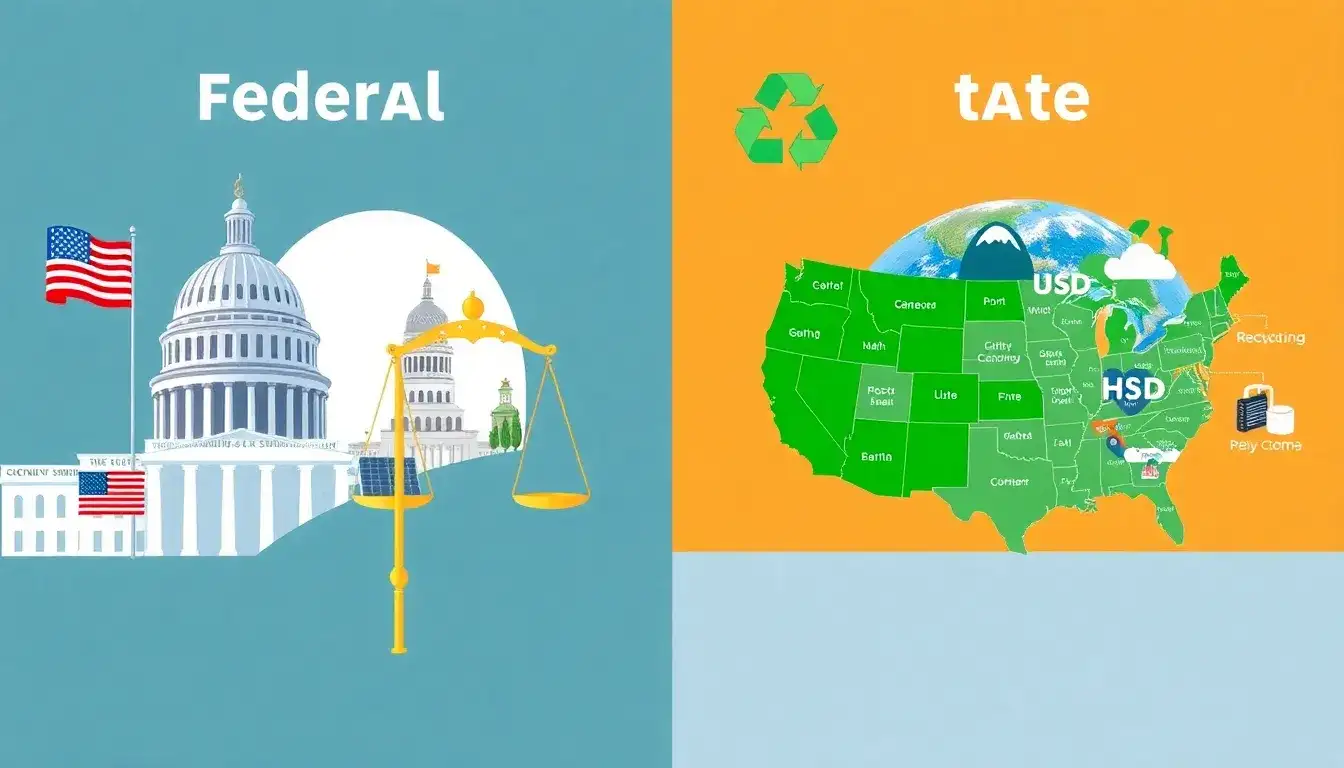
Federal Regulations
- At the federal level, there are currently no specific regulations mandating the recycling of solar panels. PV modules are primarily managed under the Resource Conservation and Recovery Act (RCRA) as either solid waste or hazardous waste, depending on their characteristics.
- Under the RCRA, generators of PV waste must determine whether their solar panels are hazardous by using the toxicity characteristic leaching procedure (TCLP) or by applying generator knowledge. Panels that pass TCLP are classified as solid waste and regulated under Subtitle D, while those that fail are considered hazardous waste under Subtitle C.
- The U.S. Environmental Protection Agency (EPA) is working on proposed rules to improve management and recycling of end-of-life solar panels, including potentially adding them to universal waste regulations, but these proposals are still in progress as of early 2025.
- Homeowners and businesses are generally advised to contact state or local recycling agencies for guidance on disposal and recycling of solar panels since the federal framework does not provide detailed instructions.
State Regulations
- Several states have taken the initiative to impose more specific regulations on PV module recycling. For example, California’s Department of Toxic Substances Control (DTSC) has adopted regulations designating end-of-life PV modules identified as hazardous waste as universal waste, streamlining their management and encouraging recycling.
- State regulations can mandate recycling, impose collection or take-back programs, and establish stricter hazardous waste classification and handling procedures, thus creating stronger incentives and enforcement mechanisms for PV recycling at the state level.
- These state-level regulations often fill the gaps left by the federal framework by providing clearer mandates and infrastructure for PV panel recycling, contributing to greater recycling rates and better environmental outcomes within those states.
| Aspect | Federal Regulations | State Regulations |
|---|---|---|
| Specificity for PV recycling | No mandatory solar panel recycling rules; regulated as solid or hazardous waste under RCRA | Some states mandate recycling and have established universal waste rules specifically for PV modules |
| Waste classification | Determined by TCLP or generator knowledge; panels classified as solid or hazardous waste | States might have more stringent classification and management requirements |
| Enforcement and Incentives | Mainly oversight and guidance through EPA; no uniform take-back or recycling mandates | Can include mandatory recycling programs, take-back requirements, and streamlined waste handling |
| Impact on PV recycling | Limited impact; mainly classification and disposal rules | Stronger impact with mandatory recycling and better infrastructure |
In summary, federal regulations primarily provide a broad hazardous waste management framework without explicit requirements for PV recycling, relying on general solid and hazardous waste rules. In contrast, state regulations can be more detailed and proactive, often imposing specific mandates for recycling PV modules and facilitating their proper management, which leads to a stronger influence on actual PV recycling practices. This divergence means that the effectiveness of PV recycling initiatives varies significantly by state.
Original article by NenPower, If reposted, please credit the source: https://nenpower.com/blog/how-do-federal-and-state-regulations-differ-in-their-impact-on-pv-recycling/

