

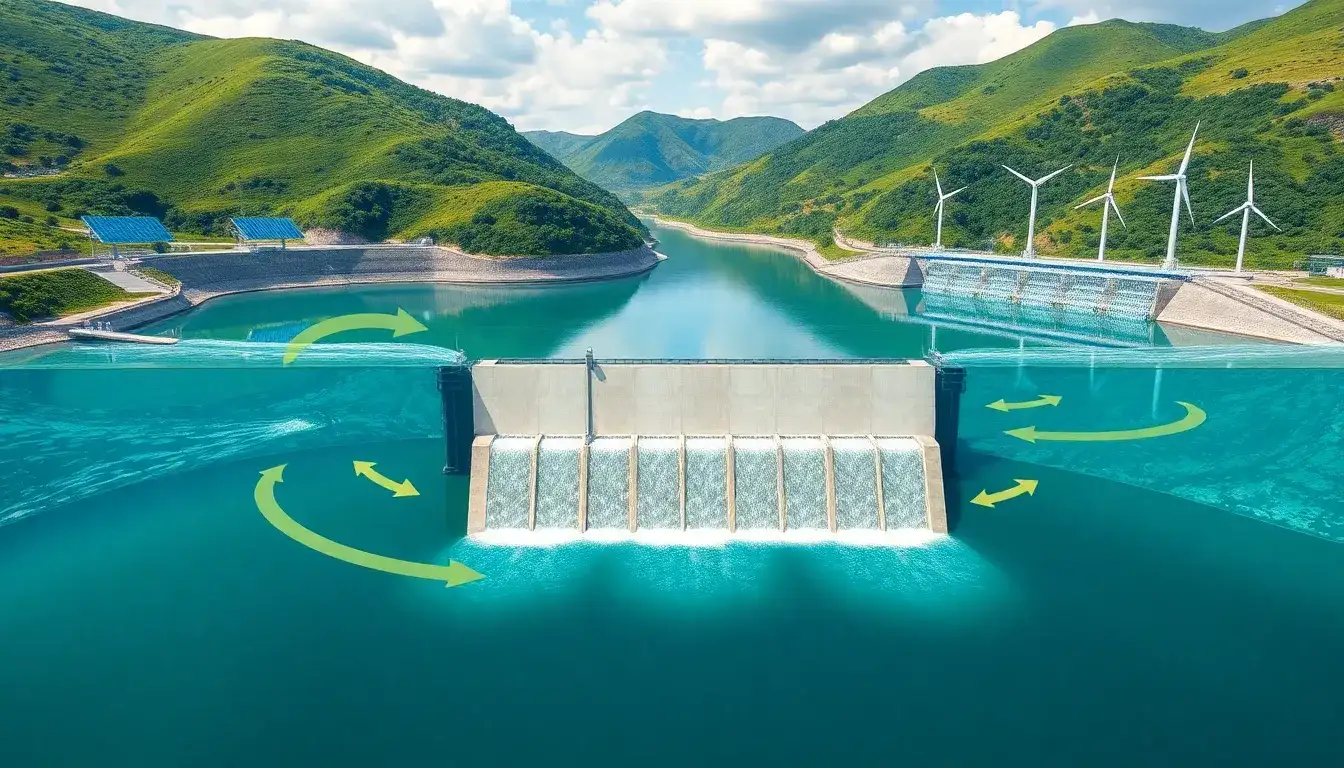
Contribution of Existing Reservoirs to Pumped Hydro Storage Efficiency
- Utilizing Existing Infrastructure Reduces Capital Costs and Construction Time: When a pumped hydro project adds an upper reservoir to an existing hydropower system or reservoir, it leverages pre-existing dams and reservoirs. This integration reduces the need for new large-scale construction, which lowers upfront capital costs and environmental disruption while enabling faster project deployment.
- Optimized Site Characteristics: The energy stored in pumped hydro depends on the volume of water and the height difference between two reservoirs. Existing reservoirs often provide optimal conditions, such as a large body of water at a suitable elevation difference, which is crucial for maximizing energy storage capacity and round-trip efficiency.
- High Round-Trip Efficiency: Pumped hydro storage typically achieves round-trip efficiencies between 70% and 80%, with some reports ranging up to 87%. Systems that integrate existing reservoirs tend to benefit from proven, reliable infrastructure, helping maintain or even improve these efficiency levels due to stable water management and reduced losses.
- Long-Term Operational Experience: Existing hydropower reservoirs come with long operational histories, sometimes spanning decades, which helps operators optimize water management and minimize losses from evaporation or inefficiencies in pumping and generating cycles. This operational knowledge translates into improved overall efficiency and reliability of the pumped hydro storage system.
- Economic and Grid Stability Benefits: Existing reservoirs integrated into pumped hydro projects facilitate load balancing by storing excess energy during low demand and generating power during peak demand. This reduces reliance on less efficient peaking power plants and stabilizes grid operations, contributing indirectly to system-level efficiency and cost-effectiveness over time.
Summary Table
| Aspect | Contribution of Existing Reservoirs |
|---|---|
| Capital cost | Reduced by using existing dams and infrastructure |
| Site optimization | Provides ideal elevation difference and water volume |
| Round-trip efficiency | Supports maintaining high efficiency (~70-80%) |
| Operational experience | Enhances water management and reduces losses |
| Economic/grid benefits | Enables efficient load balancing and reduces peaking plant use |
In essence, existing reservoirs improve pumped hydro storage efficiency by providing ready-made, well-suited infrastructure that minimizes construction costs and losses, supports high round-trip efficiency, and leverages decades of operational experience to optimize performance. This makes pumped hydro storage one of the most efficient and cost-effective large-scale energy storage solutions available today.
Original article by NenPower, If reposted, please credit the source: https://nenpower.com/blog/how-do-existing-reservoirs-contribute-to-the-efficiency-of-pumped-hydro-storage/

