

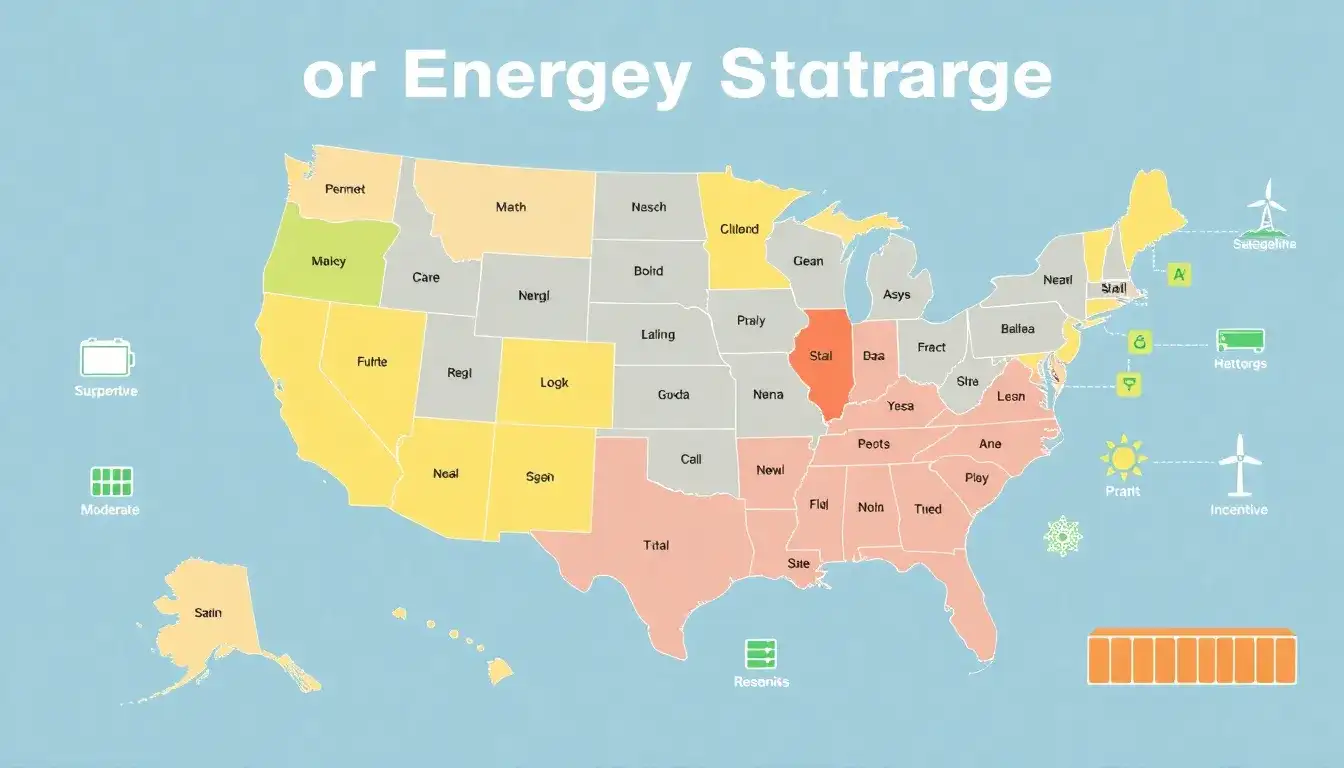
Energy storage regulations in the United States vary significantly across states, primarily in the types of policies adopted, procurement targets set, regulatory adaptations, financial incentives, and consumer protections.
Key Differences in State Energy Storage Regulations
1. Procurement Targets
Many states have established energy storage procurement targets, requiring utilities to acquire specific amounts of energy storage capacity by certain deadlines. However, the size and timelines of these targets differ notably:
- California was the pioneer with a mandate for 1,325 MW by 2020, later adding 500 MW of behind-the-meter (BTM) storage for a total of 1,825 MW by 2020. The state has installed around 2,500 MW by 2021 and is now focusing on long-duration storage solutions.
- New York initially required 3,000 MW by 2030, which was doubled to 6,000 MW by 2030 in 2022.
- New Jersey set a 2,000 MW target by 2030.
- Virginia mandates 3,100 MW by 2035, with a specific 10% carve-out for BTM storage.
- States like Oregon have smaller mandates, e.g., utilities were directed to procure 5 MWh each by 2020 but have not increased targets since.
- Connecticut and Maine have progressively increasing targets aiming for 1,000 MW and 400 MW by 2030, respectively.
- Illinois is working towards utility targets to be established by 2032.
2. Regulatory Adaptations and Customer Protections
Some states have enacted laws to facilitate energy storage integration and protect consumers:
- Nevada prohibits utilities from placing customers with energy storage in separate rate classes solely due to owning storage and requires utilities to offer optional Time-of-Use (TOU) rates to promote cost savings.
- Colorado grants customers the right to install energy storage and mandates streamlined interconnection rules to reduce barriers to storage deployment.
3. Incentives and Demonstration Programs
Several states include financial incentives and demonstration projects to encourage storage development, though the specific programs and their scope vary by state.
4. Behind-the-Meter (BTM) Storage Policies
Only a few states explicitly include mandates or incentives for BTM energy storage:
- California and Virginia have specific BTM storage requirements or carve-outs within their mandates, which is relatively uncommon.
- Other states focus mainly on utility-scale procurement without explicit BTM targets.
Summary Table of Select States’ Energy Storage Policies
| State | Procurement Target | BTM Storage Inclusion | Key Regulatory Features |
|---|---|---|---|
| California | 1,825 MW by 2020 | Mandated 500 MW BTM storage | Leading market, focus on long-duration storage |
| New York | 6,000 MW by 2030 | Not specified | Aggressive doubling of target in 2022 |
| New Jersey | 2,000 MW by 2030 | Not specified | Clean Energy Act mandates procurement targets |
| Virginia | 3,100 MW by 2035 (with 10% BTM carve-out) | 10% BTM storage requirement | Includes specific BTM carve-out |
| Oregon | 5 MWh each for two major utilities by 2020 | No increased targets yet | Smaller scale mandates, no recent increases |
| Connecticut | 1,000 MW by 2030 (progressive targets by 2027) | Not specified | Incremental goal-setting |
| Nevada | 1,000 MW by 2030 | Not specified | Customer protections; no separate rate classes |
| Colorado | No specific procurement target, but supportive | Supportive of customer installations | Streamlined interconnection rules |
In conclusion, state-level energy storage regulations in the U.S. differ by the scale and nature of procurement mandates, the focus on behind-the-meter storage, regulatory support mechanisms, and consumer protections. These differences reflect varying state policy priorities, utility market structures, and energy transition goals.
Original article by NenPower, If reposted, please credit the source: https://nenpower.com/blog/how-do-existing-regulations-differ-between-states-regarding-energy-storage/

