

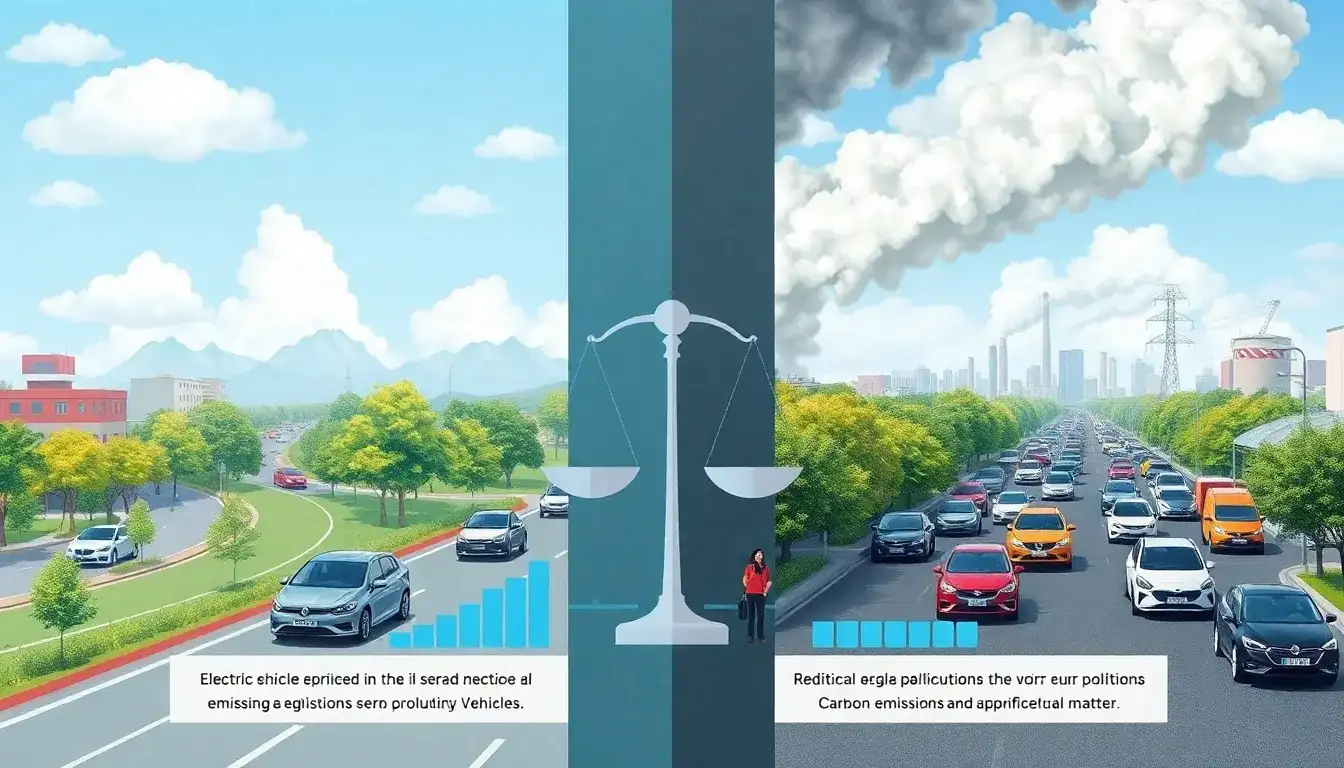
Electric vehicles (EVs) reduce air pollution compared to traditional petrol and diesel vehicles, but the extent and nature of this reduction depend on multiple factors.
Key Points on Air Pollution Reduction by EVs Compared to Traditional Vehicles
- Tailpipe Emissions: EVs produce zero tailpipe emissions because they have no internal combustion engine. This means they eliminate emissions of nitrogen oxides (NOx), carbon monoxide (CO), hydrocarbons (HC), and particulate matter (PM) directly from the vehicle exhaust that are typical of conventional petrol and diesel cars.
- Particulate Matter (PM) Emissions: While EVs do not emit exhaust particulates, concerns have been raised about increased non-exhaust particulate emissions (from brake wear, tire wear, and road wear) due to the generally heavier weight of EVs. However, studies indicate that, even with heavier weight, EVs emit fewer PM2.5 particles overall compared to petrol and especially diesel cars. The use of regenerative braking in EVs further reduces brake wear emissions, lowering PM pollution.
- Overall Impact on Air Quality: Research supports that switching from internal combustion engine (ICE) vehicles to EVs leads to significant reductions in harmful air pollutants. One study links the increased adoption of EVs with improved urban air quality and better public health outcomes. EVs reduce PM2.5 and PM10 by 6-42% depending on vehicle type and replacement scenario, even for heavier, longer-range EV models.
- Secondary Particulate Formation: Accounting for all particle sources associated with cars, including secondary particles formed in the atmosphere, EVs still contribute substantially less particulate pollution compared to petrol and diesel cars.
Summary Table Comparing EVs and Traditional Vehicles on Air Pollution
| Emission Type | Petrol/Diesel Vehicles | Electric Vehicles (EVs) |
|---|---|---|
| Tailpipe NOx, CO, HC | Significant emissions | Zero emissions |
| Tailpipe PM2.5/PM10 | Present, especially from diesel cars | Zero tailpipe emissions |
| Brake/Tire/Road Wear PM | Lower (lighter vehicles) | Higher due to heavier weight but reduced with regenerative braking |
| Overall PM Emissions | Higher | Lower by 6-42% compared to ICE vehicles |
| Impact on Air Quality | Contributes to urban air pollution | Improves urban air quality and health |
In conclusion, EVs offer a clear advantage over traditional petrol and diesel vehicles in reducing air pollution, particularly by eliminating toxic exhaust emissions. Although EVs are heavier and produce somewhat more non-exhaust particulate pollution, their overall contribution to air quality improvement remains positive across urban, rural, and motorway environments.
Original article by NenPower, If reposted, please credit the source: https://nenpower.com/blog/how-do-evs-compare-to-traditional-vehicles-in-terms-of-air-pollution-reduction/

