

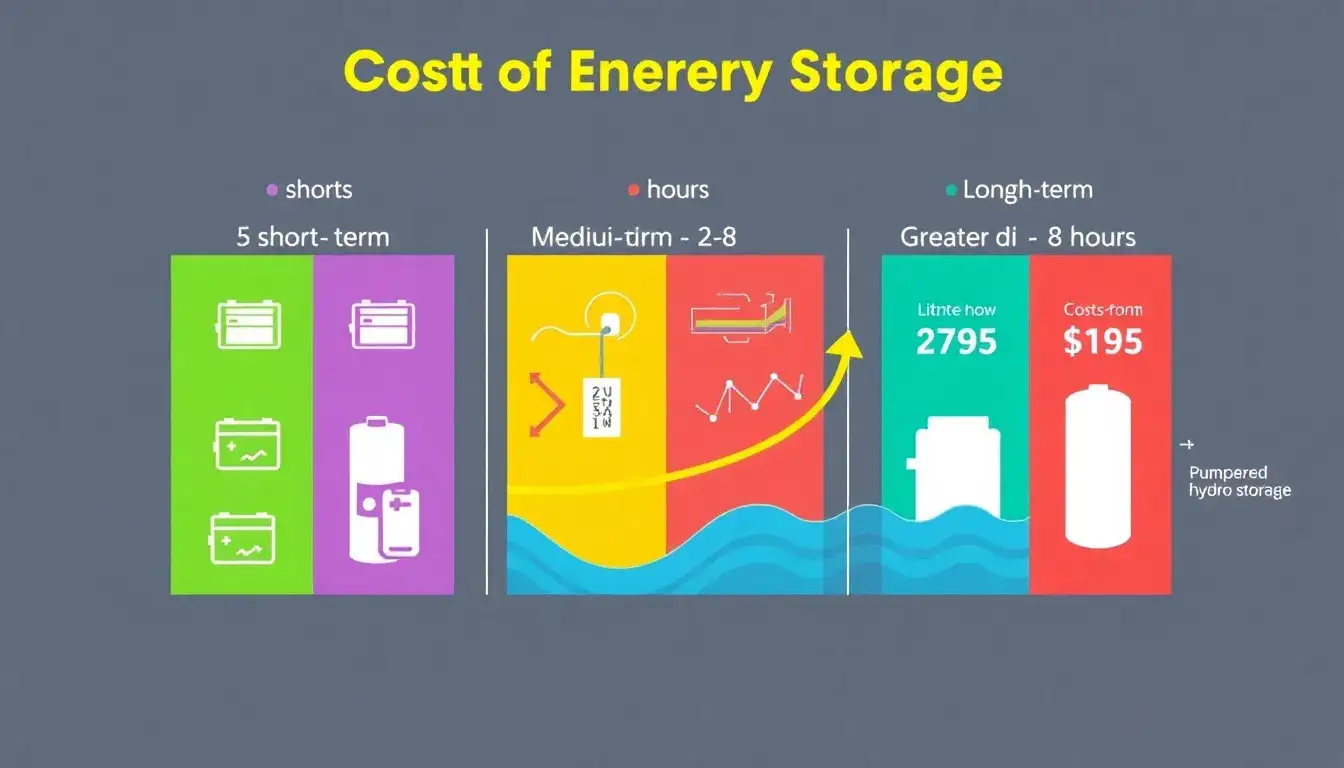
Energy storage costs vary significantly depending on the duration of battery storage due to differences in technology design, capital expenditure (capex) structure, and scalability of power and energy components. Below is a detailed overview of how costs vary across different durations and storage technologies:
Cost Variation by Duration for Lithium-Ion Batteries
- Shorter Durations (1–4 hours): Lithium-ion batteries (Li-ion) are currently the most common and cost-effective technology for short-duration storage, especially around 4 hours. For example, a 4-hour Li-ion battery system has an average capital cost around $304/kWh globally, with lower costs reported in China (~$198/kWh).
- Longer Durations (6–8 hours and beyond): As duration increases, Li-ion costs decrease per kilowatt-hour of capacity but not as sharply as for some long-duration technologies. This is because extending duration in Li-ion requires proportionally more battery cells and power conversion equipment, leading to nearly linear cost increases with capacity.
- NREL projections show Li-ion costs decreasing more quickly for longer durations over time due to reductions in battery pack prices, but capital costs still include substantial power-related expenses that do not scale with energy capacity.
- Example from NREL 2024 data shows the ex-factory price per kWh for Li-ion batteries dropping from $211/kWh at 1-hour duration to about $164/kWh at 8-hour duration, indicating cost savings with extended duration but still significant costs remain.
Long-Duration Energy Storage (LDES) Technologies Compared to Li-ion
- Thermal Energy Storage and Compressed Air Energy Storage (CAES): These technologies tend to have lower capital costs for longer durations, especially 8 hours or more. For instance, thermal energy storage averages $232/kWh and compressed air about $293/kWh for 8-hour durations, both cheaper than 4-hour Li-ion at $304/kWh.
- These LDES technologies benefit from cost structures where increasing duration mainly involves inexpensive scaling of the storage medium (e.g., larger salt caverns for CAES, bigger thermal reservoirs) rather than expensive active components.
- Flow batteries, suitable for mid-duration (up to about 12 hours), have higher capital costs on average (~$444/kWh), but their energy and power components can be scaled more flexibly, potentially lowering costs at longer durations compared to Li-ion.
Cost Components and Scaling Implications
- Li-ion batteries have significant costs tied to power capacity (inverters, battery stacks) that do not scale down significantly with longer durations, making incremental energy capacity additions expensive.
- LDES such as thermal and compressed air have decoupled power and energy costs, where adding energy storage duration mainly increases cheaper energy storage components rather than power equipment, leading to better cost efficiencies at longer durations.
Summary Table: Approximate Capital Costs by Technology and Duration (USD/kWh)
| Technology | Duration (hours) | Approximate Capex ($/kWh) | Notes |
|---|---|---|---|
| Lithium-ion battery (Li-ion) | 1 | ~$211 | Higher cost per kWh at very short durations |
| Lithium-ion battery (Li-ion) | 4 | ~$304 (global avg.) | Standard commercial duration |
| Lithium-ion battery (Li-ion) | 8 | ~$164 (ex-factory gate) | Cost declines but requires more cells |
| Thermal energy storage | 8+ | ~$232 | Cheapest among LDES for 8-hour+ |
| Compressed air energy storage | 8+ | ~$293 | Competitive with thermal, cheaper than Li-ion at 8h |
| Flow batteries | Up to 12 | ~$444 | Higher capex but scalable energy capacity |
Conclusion
- For shorter durations (around 4 hours), Li-ion batteries remain the most cost-effective and prevalent solution, although costs vary by region.
- For longer durations (8 hours and beyond), thermal energy storage and compressed air energy storage often offer cheaper capital costs per kWh than Li-ion batteries because of their cost structure that decouples energy capacity from power equipment.
- Technologies like flow batteries fill a niche in mid-duration storage but currently have higher capital costs.
- Cost declines are expected across technologies, but Li-ion benefits from economies of scale driven by EV and electronics demand, possibly limiting how competitive LDES can become globally despite advantages at longer durations.
This cost variation reflects the fundamental differences in how storage technologies scale for power and energy, affecting economic viability depending on storage duration needs.
Original article by NenPower, If reposted, please credit the source: https://nenpower.com/blog/how-do-energy-storage-costs-vary-between-different-durations-of-battery-storage/

