

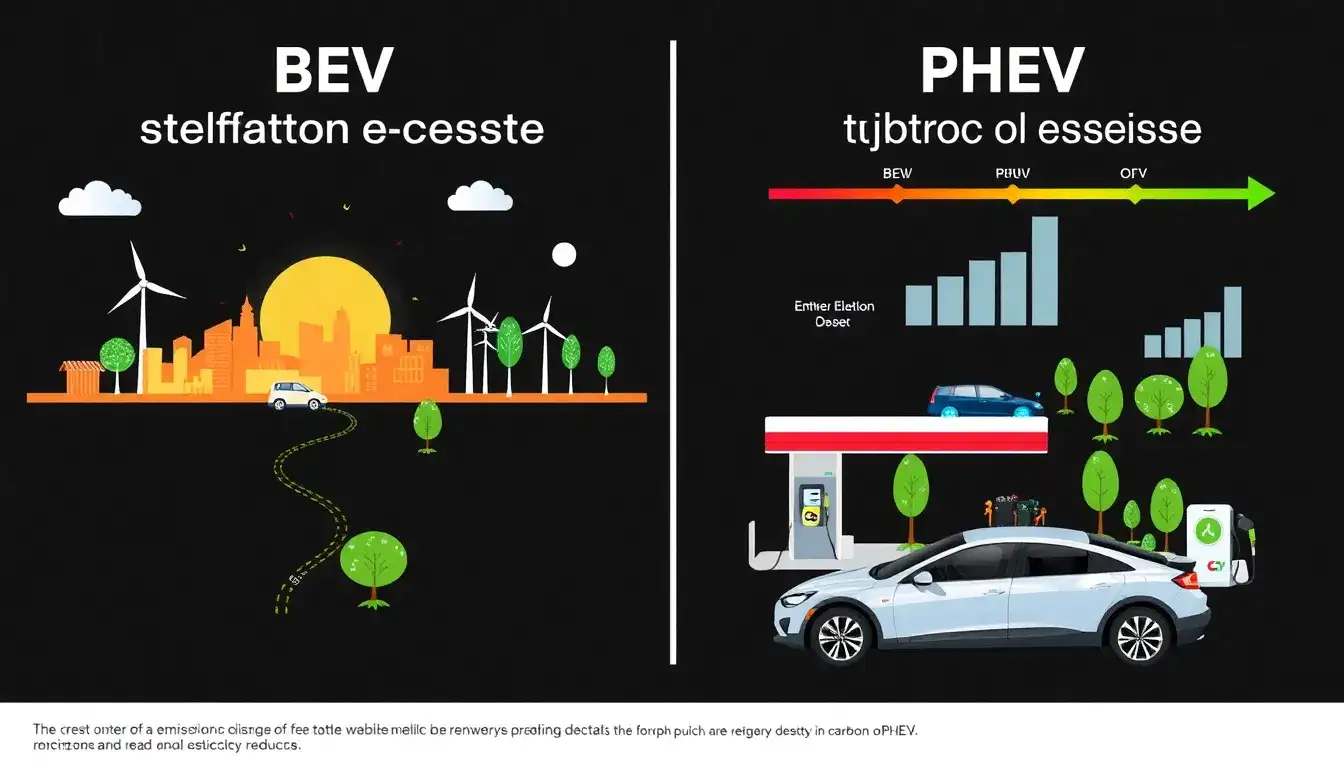
Emissions offset times for Battery Electric Vehicles (BEVs) and Plug-in Hybrid Electric Vehicles (PHEVs) differ significantly due to their operational and emission characteristics.
BEVs
- Emissions during production: BEVs emit a significant portion of their lifecycle emissions during production, often cited around 56%.
- Lifetime emissions: Overall, BEVs have lower lifecycle greenhouse gas (GHG) emissions compared to PHEVs. When powered by the average grid mix, BEVs generally have around 50% to 65% lower emissions than equivalent ICEVs over their lifetime, and they are notably cleaner than PHEVs.
- Emissions offset time: Since BEVs produce zero tailpipe emissions, the emissions offset time is largely determined by how quickly the grid decarbonizes. As the grid becomes cleaner, BEVs become increasingly environmentally friendly.
PHEVs
- Emissions during operation: PHEVs reduce emissions by using electricity but still have a gasoline engine, leading to higher emissions when the engine is used. Their utility factor (the share of kilometers traveled on electricity) significantly affects emissions. Real-world utility factors are often lower than rated values, leading to higher emissions.
- Lifetime emissions: PHEVs emit about 30% less over their lifetime compared to ICEVs under current conditions, but they emit roughly twice as much as BEVs when considering lifecycle emissions.
- Emissions offset time: For PHEVs, the emissions offset time depends on how much they operate on electricity versus the gasoline engine. With a higher utility factor, PHEVs can offset more emissions, but this is generally less efficient compared to BEVs due to their dual powertrains.
In summary, BEVs offer a cleaner profile with lower lifecycle emissions and a potential for increased environmental benefits as the grid decarbonizes. In contrast, PHEVs provide a balance between electric and gasoline power, which can be more suitable for certain driving conditions but generally result in higher lifecycle emissions compared to BEVs. The emissions offset time for PHEVs varies based on usage patterns, whereas BEVs rely on grid improvements for further reductions.
Original article by NenPower, If reposted, please credit the source: https://nenpower.com/blog/how-do-emissions-offset-times-differ-between-bevs-and-phevs/

