

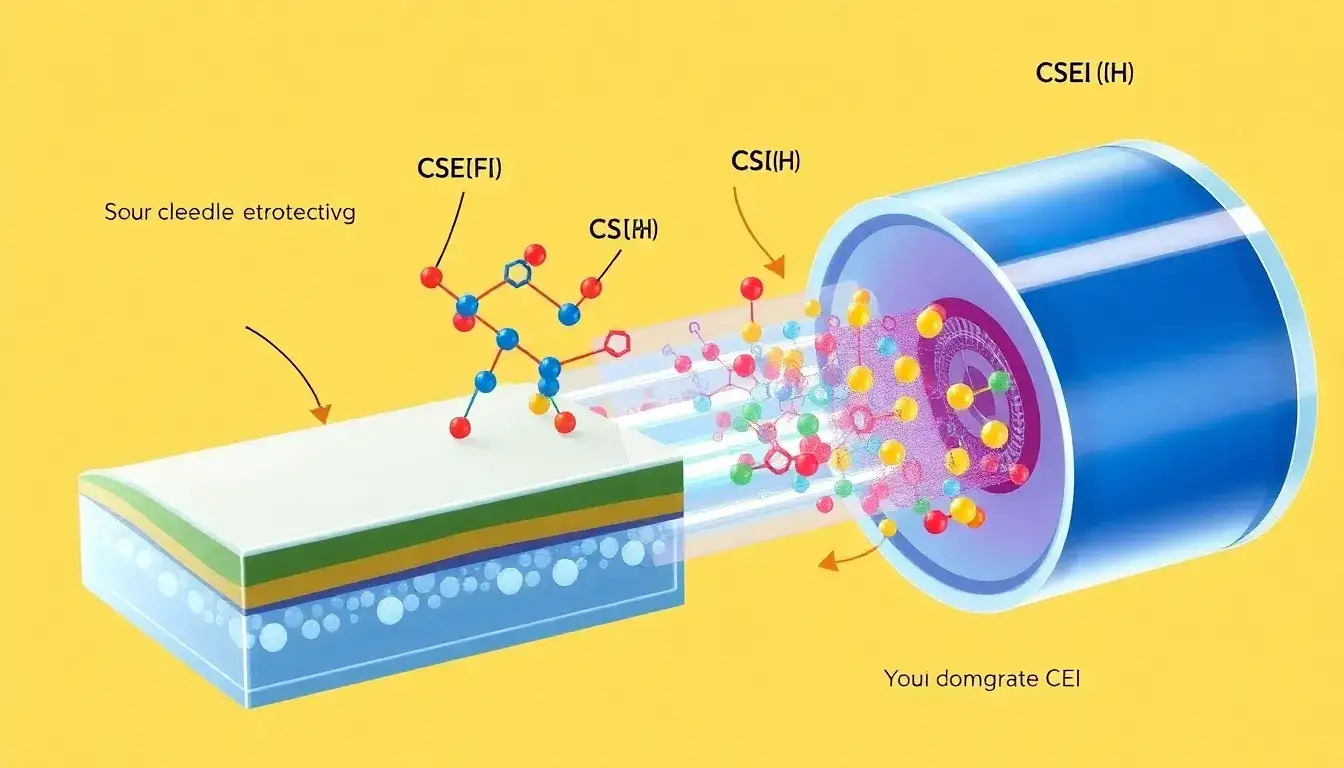
Electrolyte additives like VSF (Vinylene Carbonate Sulfone) are crucial for stabilizing both the Solid-Electrolyte Interphase (SEI) and the Cathode-Electrolyte Interphase (CEI) in lithium-ion batteries. Here’s how they work:
Stabilizing the SEI
- Formation of a Stable Layer: Additives like VSF help form a dense and stable SEI on the anode surface. This layer prevents direct contact between the anode and the electrolyte, inhibiting reactions that consume electrolyte components and reducing lithium dendrite growth.
- Oxidative Stability: By enhancing the SEI, these additives improve the oxidative stability of the electrolyte. This stability ensures that the electrolyte remains intact even at high voltages.
Stabilizing the CEI
- Kinetic Stabilization: The CEI, formed with the help of additives, provides kinetic stabilization. This means the additives decompose at the cathode surface, forming a protective layer that improves the cathode’s resistance to oxidation at high voltages.
- Thermodynamic Stability: New electrolyte designs, including additives like VSF, aim to enhance thermodynamic stability at the cathode/electrolyte interphase. This stability prevents excessive solvent decomposition and maintains the structural integrity of the cathode.
- Prevention of Degradation: Additives help prevent the formation of unwanted structures on the cathode, such as rock-salt structures, which can degrade battery performance over time.
Overall, additives like VSF play a critical role in improving both SEI and CEI stability, which is essential for enhancing battery performance, longevity, and safety.
Original article by NenPower, If reposted, please credit the source: https://nenpower.com/blog/how-do-electrolyte-additives-like-vsf-stabilize-the-sei-and-cei/

