

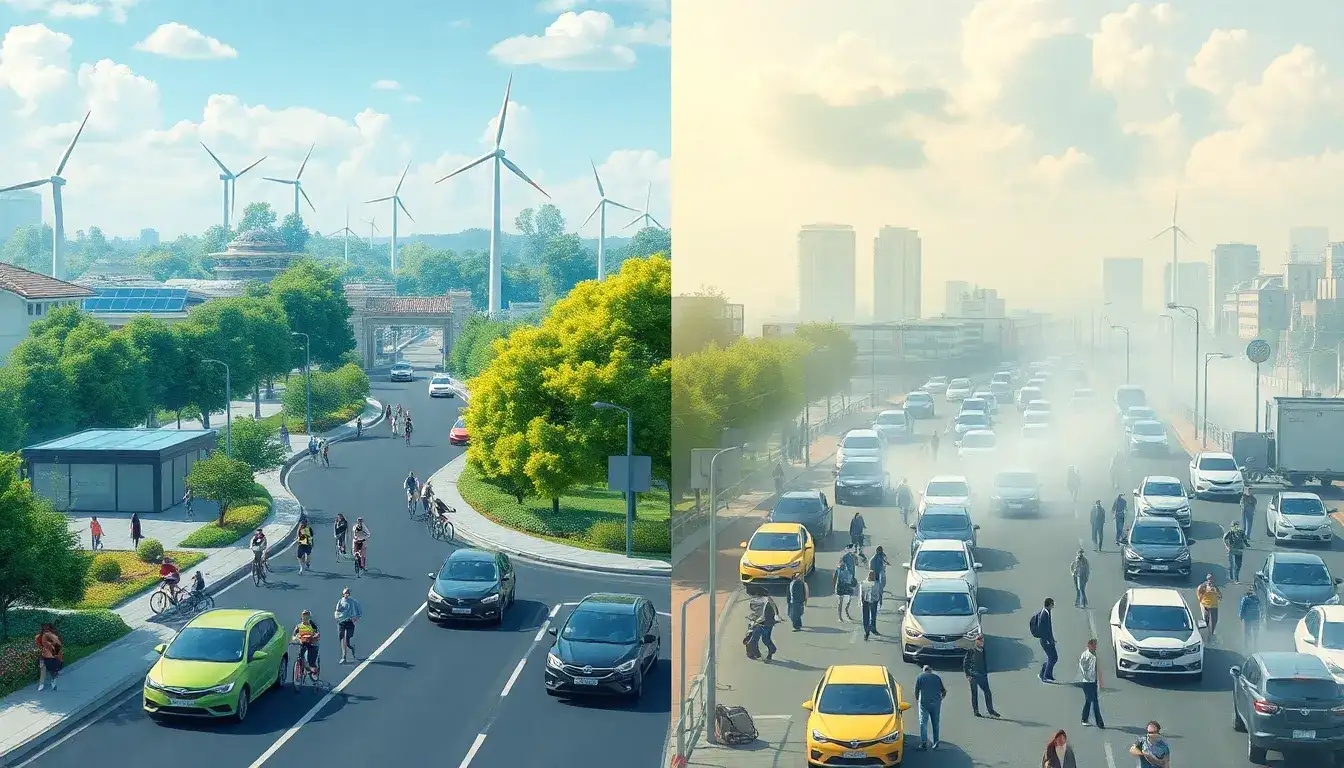
Electric vehicles (EVs) impact public health positively compared to gasoline-powered cars primarily through reductions in air pollution and associated health risks, though the overall effects depend on factors like electricity generation sources and broader systemic considerations.
Key Public Health Benefits of Electric Vehicles Compared to Gasoline Cars
- Reduced Air Pollutants and Mortality: EV adoption significantly reduces emissions of fine particulate matter (PM2.5) and ground-level ozone, both of which are harmful to human health. For instance, a scenario with 25% EV adoption in the U.S. reduces CO₂ emissions by about 242 million tons annually and avoids approximately 437 deaths due to lower PM2.5 exposure, along with 98 deaths avoided from lesser ozone formation. Studies in major U.S. cities like New York, Chicago, and Houston show that transitioning to EVs could prevent hundreds of premature deaths monthly by improving air quality.
- Climate and Health Co-Benefits: EVs contribute to climate change mitigation by lowering CO₂ emissions. This, in turn, yields co-benefits for public health because mitigating climate change reduces risks such as heat-related illnesses and respiratory problems.
- Economic Benefits from Health Improvements: The reduction in pollution-related deaths and diseases results in large economic savings; for example, a 25% EV adoption could avoid around $16.8 billion in health damages annually in the U.S., with benefits increasing substantially if the electricity used is generated from low- or zero-emission sources.
- Improved Urban Air Quality: EVs help reduce pollution in densely populated urban areas where traffic congestion and air pollution are most severe, thus potentially improving respiratory and cardiovascular health outcomes for urban residents.
Important Considerations and Trade-Offs
- Electricity Generation Source Matters: The health benefits of EVs depend heavily on how the electricity used to charge them is produced. If charging relies on fossil fuel combustion (e.g., coal or natural gas power plants), the air quality and health benefits are reduced, and in some cases, adverse health outcomes may increase. Therefore, coupling EV adoption with cleaner energy sources maximizes public health gains.
- Complex Public Health Impacts Beyond Air Quality: While EVs reduce air pollution, they also introduce other public health considerations. These include potential increases in road injuries if EVs encourage more driving, health risks linked to the production and disposal of batteries, and exposure to hazardous materials from battery manufacturing. Also, socioeconomic disparities affect how different communities experience EV-related health outcomes, emphasizing the need for thoughtful policy to ensure equitable benefits.
- Localized Variations: Some studies highlight that in specific scenarios or regions (e.g., Los Angeles), a partial EV transition could improve health, but full electrification under current pollution conditions might occasionally increase mortality due to complex atmospheric chemistry influencing PM2.5 and ozone levels.
Summary
Electric vehicles offer substantial public health improvements over gasoline-powered cars by reducing air pollution, lowering premature deaths, and mitigating climate change impacts. These gains are most significant when EV charging is powered by clean energy sources. However, EV adoption also involves nuanced trade-offs, including environmental and health risks related to battery production and disposal, and variation in outcomes across regions and socioeconomic groups. Policymaking that integrates EV adoption with clean energy transition and equity considerations is essential to maximizing public health benefits.
This comprehensive view is supported by recent research analyzing air quality, mortality data, and health-economic impacts associated with EVs in the United States.
Original article by NenPower, If reposted, please credit the source: https://nenpower.com/blog/how-do-electric-vehicles-impact-public-health-compared-to-gasoline-powered-cars/

