

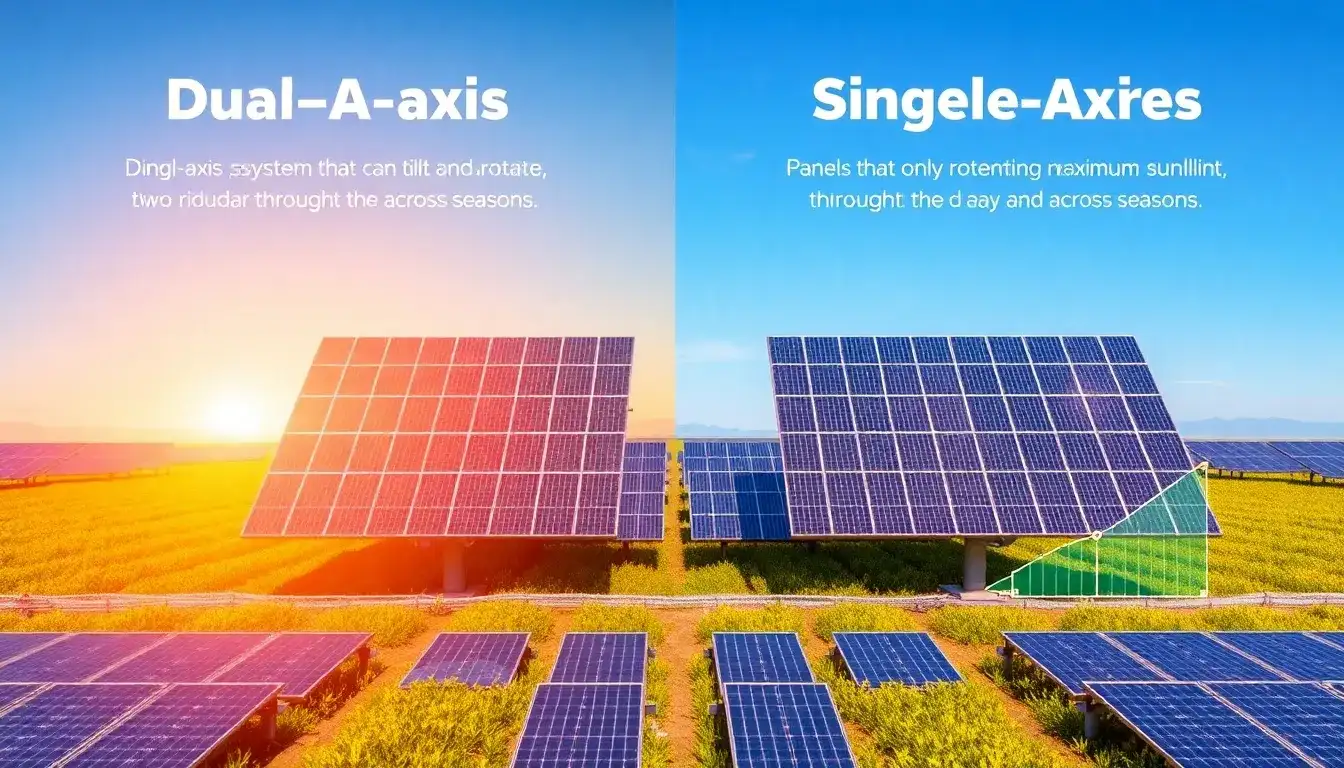
Dual-axis solar tracking systems differ from single-axis systems in efficiency primarily through their ability to more precisely follow the sun’s position, resulting in greater energy capture.
Efficiency Comparison:
- Single-axis trackers typically increase photovoltaic panel efficiency by about 25% to 30% compared to fixed mounts. They track the sun’s movement primarily from east to west during the day.
- Dual-axis trackers improve efficiency further by an additional 5% to 10% beyond single-axis systems, translating to roughly 30% to 40% efficiency gain over fixed systems. This is because dual-axis trackers adjust both azimuth and elevation angles, continuously orienting the panels directly towards the sun throughout the day and across seasons.
Additional Details:
- Dual-axis trackers provide more accurate solar alignment since they track the sun’s path across two axes, making them especially beneficial in locations with high solar direct beam radiation and complex sun angles.
- This enhanced tracking results in a more consistent and higher energy output, with dual-axis systems generating approximately 45-50% more power annually compared to static systems, and outperforming single-axis trackers as well.
- However, the increased efficiency comes with trade-offs: dual-axis trackers are more mechanically complex, leading to higher maintenance and potentially lower reliability than single-axis trackers, which are simpler and more robust over long lifetimes.
- Geographic factors influence the choice—dual-axis tracking is more advantageous in regions with clear skies and high direct sunlight, such as deserts or equatorial areas, where precise sun tracking yields greater returns.
In summary, dual-axis solar tracking systems provide superior efficiency—roughly an additional 5% to 10% improvement over single-axis systems—by continuously orienting panels directly at the sun in two dimensions, resulting in up to 40% greater energy generation compared to fixed mounts. This efficiency gain is balanced against higher system complexity and maintenance requirements.
Original article by NenPower, If reposted, please credit the source: https://nenpower.com/blog/how-do-dual-axis-solar-tracking-systems-differ-from-single-axis-systems-in-terms-of-efficiency/

