

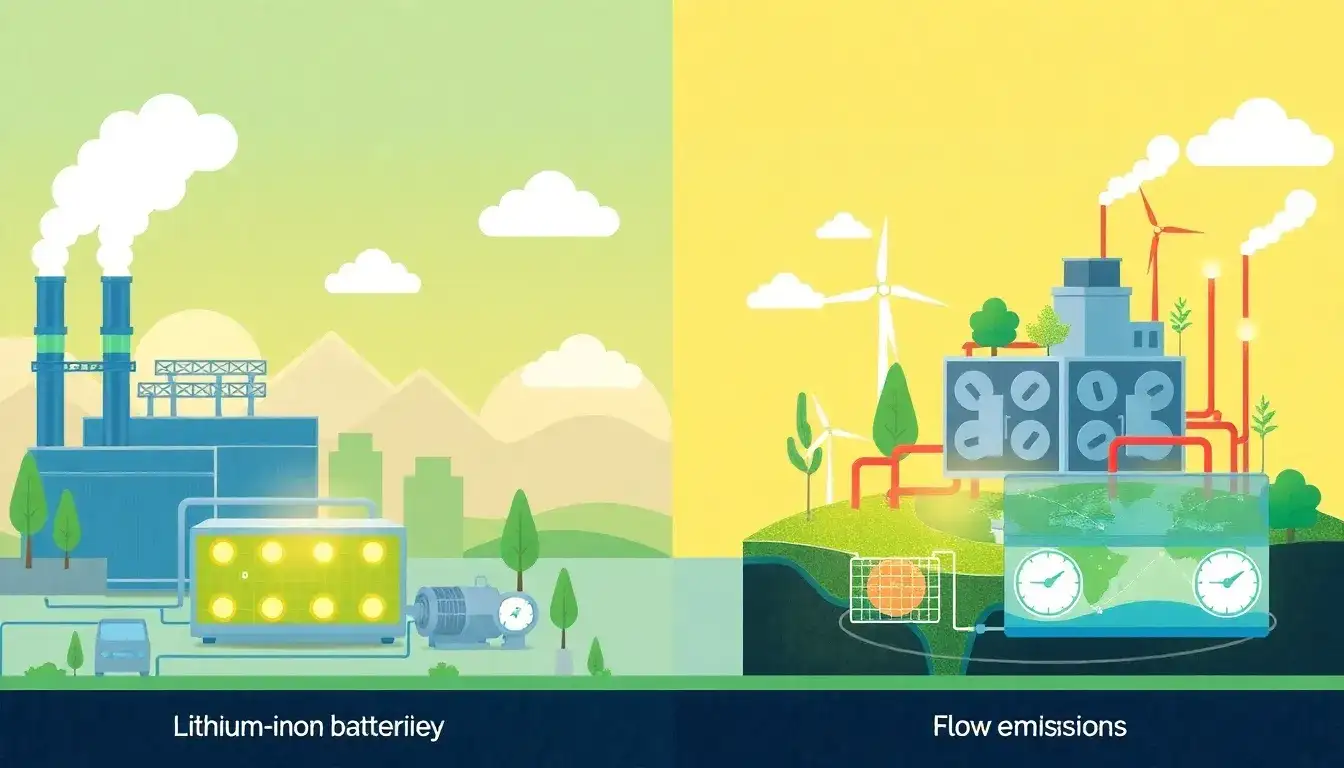
Comparison of Utility-Scale Battery Types by Emissions
Different types of utility-scale batteries have varying environmental impacts, primarily due to their manufacturing, operation, and material usage. Here’s a summary comparing some key types:
1. Lithium-Ion (Li-ion) Batteries
- Emissions: The production of lithium-ion batteries involves significant greenhouse gas emissions, estimated at about 254.6 kg CO2e per kW installed for utility-scale systems. Operations themselves are generally emission-free but require energy-intensive manufacturing.
- Environmental Impact: Moderate due to mining impacts and energy usage during production. However, they offer high energy density and a relatively fast charge/discharge speed.
2. Flow Batteries
- Emissions: Unlike lithium-ion, flow batteries have a lower environmental impact during operation and can offer longer cycle lives, reducing waste generation. Their production emissions are less well-documented, but they generally require less energy-intensive materials compared to Li-ion.
- Environmental Impact: Low, as they have a lower environmental footprint and don’t use toxic materials like some other types.
3. Lead-Acid Batteries
- Emissions: Lead-acid batteries have higher emissions in terms of pollution due to lead content and lower energy density compared to other types. Their production also contributes to environmental degradation.
- Environmental Impact: High, mainly due to lead contamination and lower cycle life, which leads to more frequent replacements.
4. Sodium-Based and Nickel-Based Batteries
- Emissions: These alternatives are being explored for reduced environmental impact compared to lithium-ion. Sodium-based batteries have a moderate environmental impact, while nickel-based batteries face challenges due to toxic metals.
- Environmental Impact: Moderate for sodium-based due to medium risk factors; high for nickel-based due to toxic metal usage.
5. Hydrogen Fuel Cells
- Emissions: Hydrogen fuel cells are emission-free during operation if powered by renewable hydrogen. However, they are not typically classified under battery technologies but are used for energy storage.
- Environmental Impact: Low, as they offer emission-free operation when using renewable hydrogen.
Key Points
- Lithium-ion batteries have significant production emissions but are widely used due to their high energy density.
- Flow batteries offer a lower environmental impact with fewer toxic materials.
- Hydrogen fuel cells are emission-free during operation but depend on renewable hydrogen for their environmental benefits.
Conclusion
The choice of utility-scale battery type depends on balancing emissions, operational efficiency, and material sustainability. While lithium-ion is common due to its performance, flow batteries and alternatives like sodium-based or hydrogen fuel cells may offer better environmental profiles.
Original article by NenPower, If reposted, please credit the source: https://nenpower.com/blog/how-do-different-types-of-utility-scale-batteries-e-g-lithium-ion-flow-batteries-compare-in-terms-of-emissions/

