

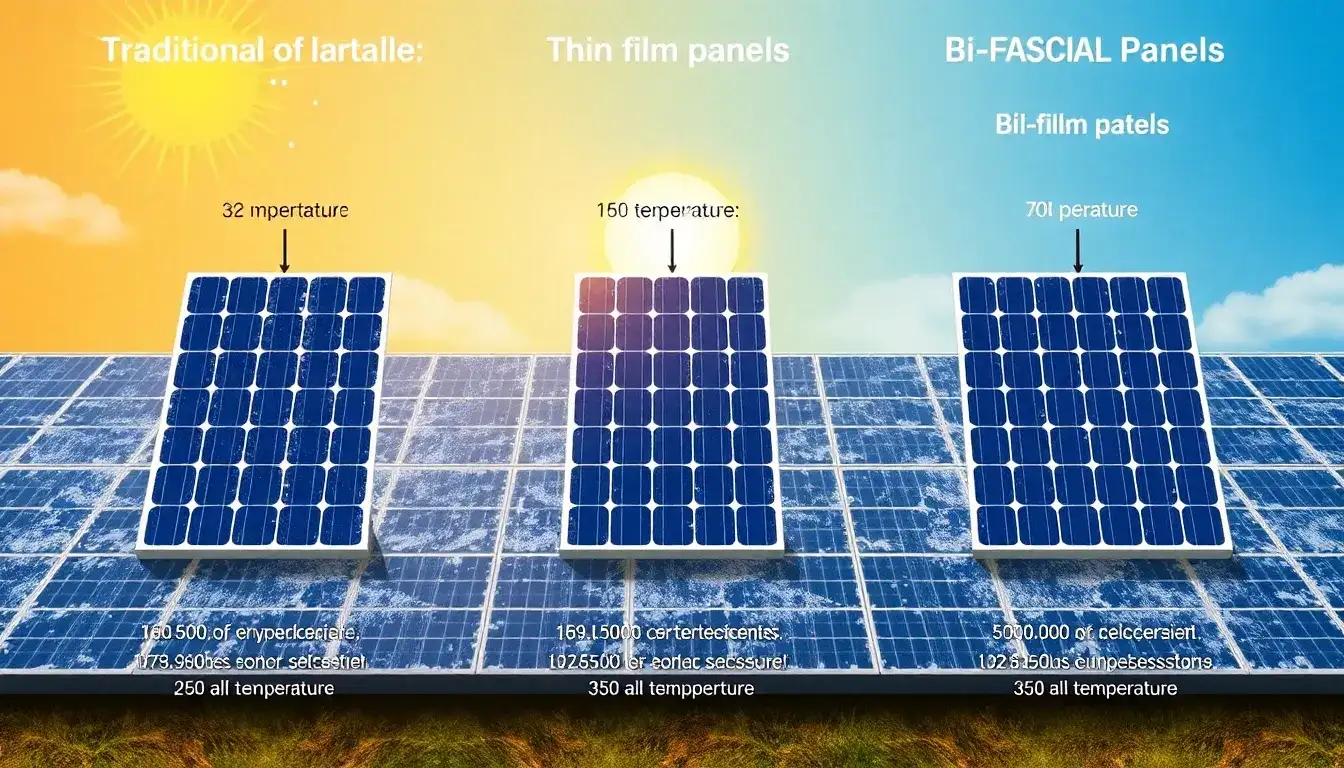
Different types of solar panels handle temperature variations in ways that affect their efficiency and power output due to their specific materials and construction. Here is a detailed explanation based on the characteristics of solar panels and how temperature influences their performance:
Temperature Effects on Solar Panel Efficiency in General
- Solar panels are typically tested and rated at a “standard test condition” temperature of 25°C (77°F). This is considered the optimal temperature for their peak efficiency.
- As temperature rises above 25°C, the efficiency of solar panels decreases. This is because higher temperatures cause the semiconductor material in the cells to have a reduced bandgap, lowering the voltage output and thus the power generated.
- Conversely, cooler temperatures below 25°C generally improve efficiency by increasing voltage, which can boost output by 5-7% at temperatures around 0°C compared to the rated efficiency.
- The efficiency loss due to temperature rise is quantified by the temperature coefficient, usually expressed as a percentage of power loss per degree Celsius above 25°C. Typical values for crystalline silicon panels are between -0.3% to -0.5% per °C. For example, a coefficient of -0.38% means for every 1°C increase above 25°C, power output drops 0.38%.
- In real-world conditions, solar panel surface temperatures can reach 60°C to 70°C (140°F to 158°F) on hot summer days, leading to a 10-15% reduction in power compared to rated output at 25°C.
How Different Types of Solar Panels Handle Temperature Variations
Solar panels come mainly in three types: Monocrystalline, Polycrystalline, and Thin-film. Each type responds differently to temperature due to their material properties.
| Solar Panel Type | Handling of Temperature Variations | Typical Temperature Coefficient | Notes on Performance |
|---|---|---|---|
| Monocrystalline | Highest efficiency but typically has a moderate negative temperature coefficient (~ -0.35%/°C). Efficiency decreases as temperature rises but performs well in moderate climates. | Around -0.35% to -0.40%/°C | Durable with good overall temperature tolerance; performance drops with heat but benefits from cooler conditions. |
| Polycrystalline | Slightly lower efficiency than mono but similar temperature sensitivity. Often with a slightly higher temperature coefficient, meaning somewhat greater efficiency losses in heat. | Around -0.40% to -0.45%/°C | Performance drops more in heat compared to monocrystalline; still reliable for various climates. |
| Thin-film (e.g., CdTe, CIGS) | Generally lower efficiency at standard conditions, but better performance at higher temperatures due to a lower temperature coefficient. | Around -0.20% to -0.25%/°C | Better suited to hot environments; less efficiency loss with temperature rise but lower absolute efficiency overall. |
Thin-film panels perform comparatively better in high temperatures due to their lower temperature coefficient, making them advantageous in very hot climates, though they may produce less power overall than crystalline panels.
Additional Factors Related to Temperature Management
- Solar panels can get hotter than ambient temperature, influenced by factors such as geographic location, installation methods, ventilation, and roofing materials.
- Some panels have specialized coatings that reflect non-useful wavelengths of light, reducing heat absorption and panel temperature by 5-10°C, thereby improving performance in heat.
- Cooling techniques such as evaporative cooling or automated cleaning systems have been shown to reduce panel temperatures and improve output in hot environments.
- Micro-inverters and power optimizers can help mitigate the impact of temperature gradients across arrays by optimizing performance panel-by-panel.
- Inverters with temperature-compensated maximum power point tracking (MPPT) algorithms adjust operation based on panel temperature to maintain efficiency.
Summary
- All solar panels show decreased efficiency as temperature rises above their optimal 25°C (77°F) rating.
- Monocrystalline and polycrystalline panels have moderate negative temperature coefficients, typically losing 0.3-0.5% efficiency per degree Celsius increase.
- Thin-film panels tend to have lower temperature coefficients, losing less efficiency in heat but start with lower base efficiency.
- Cooler temperatures improve solar panel efficiency, sometimes boosting output noticeably versus standard rating conditions.
- Proper installation, ventilation, specialized coatings, and advanced electronics can help mitigate temperature-related efficiency losses.
This nuanced thermal behavior means choosing the right solar panel type for your climate and ensuring good system design are key to optimizing performance in temperature-variable environments.
Original article by NenPower, If reposted, please credit the source: https://nenpower.com/blog/how-do-different-types-of-solar-panels-handle-temperature-variations/

