

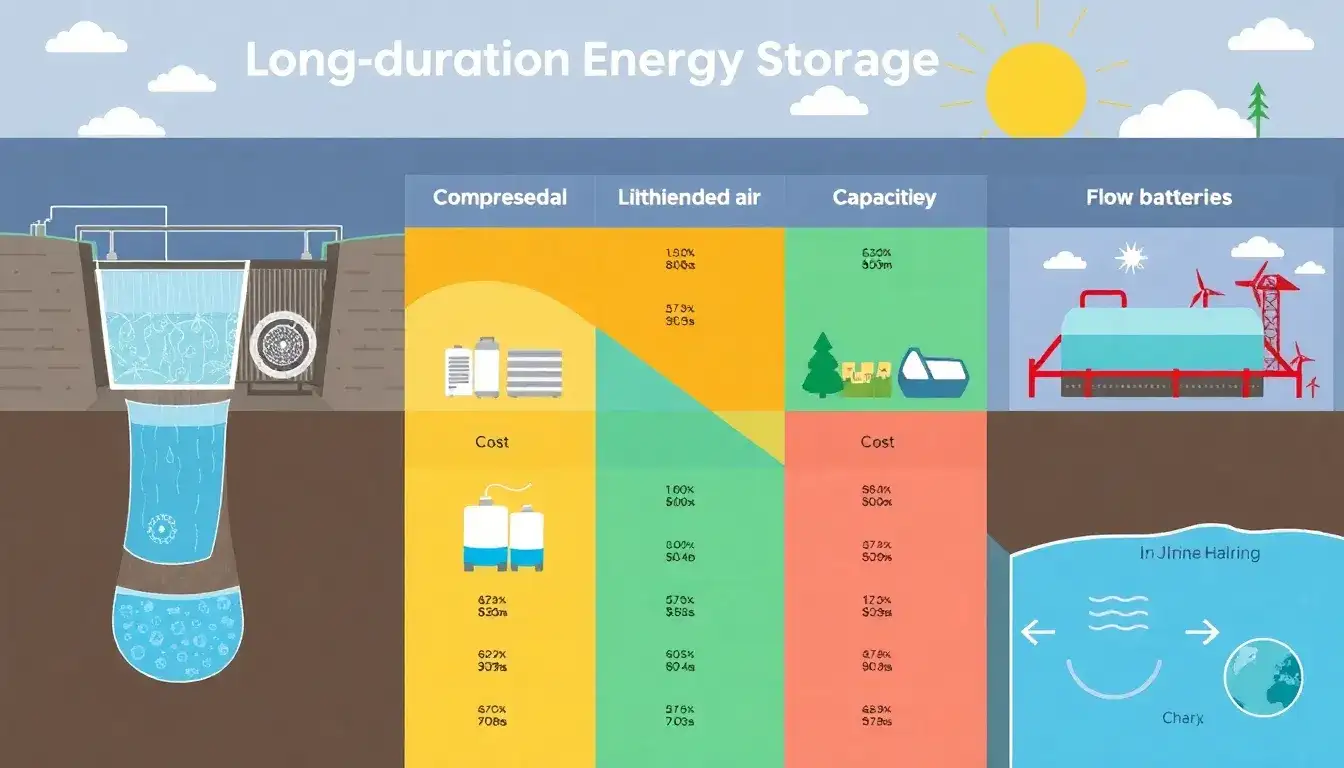
Long-duration energy storage (LDES) technologies
technologies are critical for integrating renewable energy and enhancing grid stability. Below is a comparison of the primary types, focusing on storage duration, efficiency, and deployment trends.
Technology Categories
LDES systems are broadly classified into four types:
- Mechanical: Stores energy via position or tension (e.g., pumped hydro, compressed air)
- Thermal: Stores energy as heat (e.g., molten salt, phase-change materials)
- Chemical: Utilizes chemical bonds (e.g., hydrogen, synthetic fuels)
- Electrochemical: Reversible chemical reactions (e.g., flow batteries, metal-air batteries)
Key Comparisons
| Category | Example Technologies | Storage Duration | Round-Trip Efficiency | Current Deployment |
|---|---|---|---|---|
| Mechanical | Pumped hydro, compressed air | 10–24+ hours | 70–85% | Dominant (96% of U.S. utility-scale storage) |
| Thermal | Molten salt storage | 6–10+ hours | 40–70% | Limited, mostly experimental |
| Chemical | Hydrogen storage | 48–96+ hours | 25–50% | Emerging (pilot projects, e.g., PG&E microgrids) |
| Electrochemical | Flow batteries, zinc-air | 6–100+ hours | 60–80% | Rapidly scaling (dominated by Li-ion, but new chemistries emerging) |
Market Dynamics
- Pumped Hydro: Established but stagnant; no new U.S. plants in 40 years. Costs are location-dependent and face permitting hurdles.
- Flow Batteries: Competitive for 6–12 hours, with vanadium and iron-based systems leading. Costs must drop 45–55% by 2030 to compete against alternatives.
- Hydrogen: Offers ultra-long duration (days) but suffers from low efficiency. Paired with fuel cells, it is being tested for multi-day grid support.
- BESS (Battery Energy Storage Systems): 6–8 hour Li-ion dominates, but lithium-free alternatives (e.g., iron-air) aim for 100-hour storage at lower costs.
Future Outlook
By 2030, 6–8 hour BESS are projected to lead new deployments due to falling costs ($200–300/kWh by 2030). While pumped hydro remains relevant for >10-hour storage, policy support for newer technologies (e.g., compressed air, metal-air batteries) will determine their market share. Hydrogen’s role hinges on efficiency improvements and infrastructure development.
Original article by NenPower, If reposted, please credit the source: https://nenpower.com/blog/how-do-different-types-of-long-duration-energy-storage-technologies-compare/

