

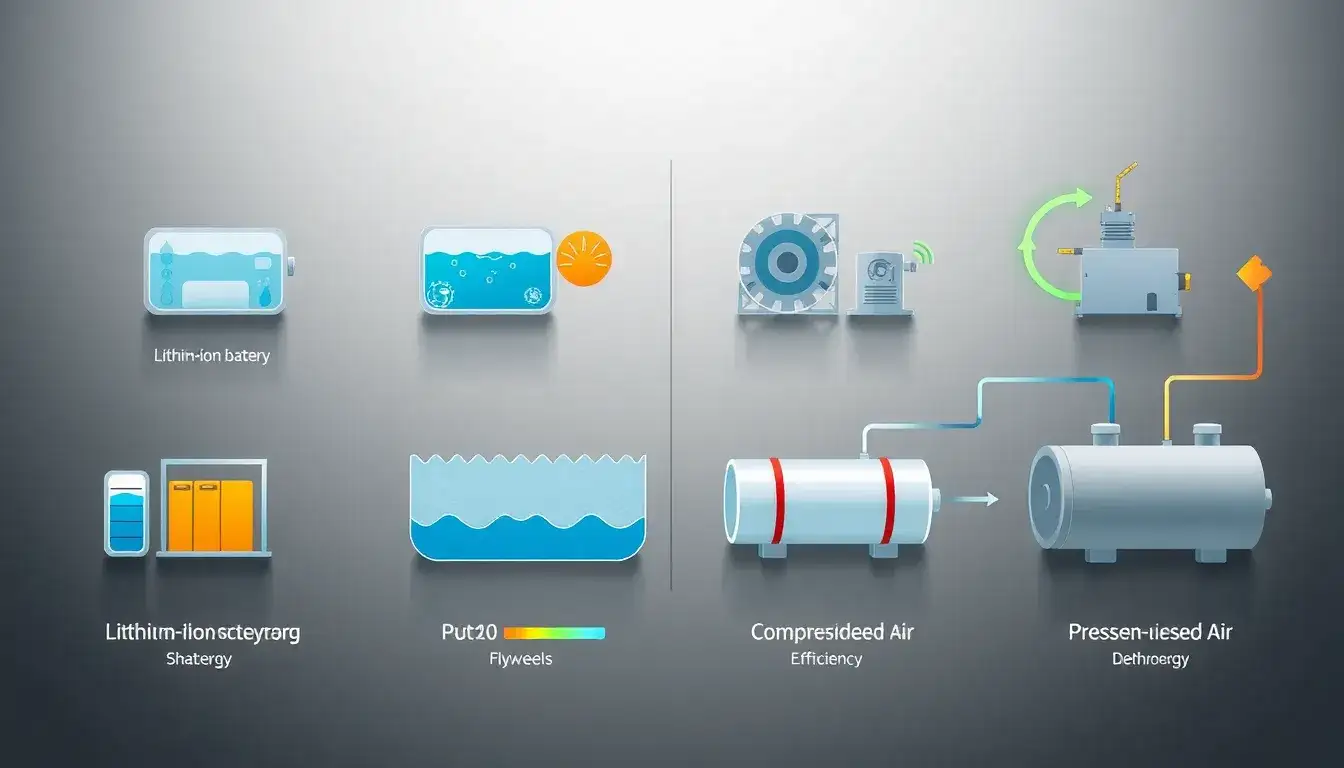
Comparing Different Energy Storage Technologies
Comparing different energy storage technologies involves assessing their efficiency, which can be measured by round-trip efficiency (RTE) or system efficiency. Here’s a breakdown of some common energy storage types and their efficiencies:
Types of Energy Storage Technologies and Their Efficiencies
1. Lithium-Ion Batteries
- Efficiency: High, often exceeding 90%.
- Characteristics: They have a high energy density, making them suitable for applications requiring compact energy storage, such as electric vehicles and portable electronics. They also have a low self-discharge rate.
2. Compressed Air Energy Storage (CAES)
- Efficiency:
- Diabatic CAES: Less than 55%.
- Adiabatic CAES: Potentially up to 70% when heat is recovered.
- Characteristics: CAES involves compressing air in underground caverns, which is then expanded to generate electricity. Adiabatic systems are more efficient as they retain heat generated during compression.
3. Pumped Hydro Storage (PHS)
- Efficiency: Typically around 75% to 80%.
- Characteristics: PHS is one of the oldest and most common forms of energy storage, involving pumping water to an elevated reservoir during off-peak hours and releasing it to generate electricity during peak hours.
4. Thermal Energy Storage
- Efficiency: Varies by type, but can be high for certain systems like the ThermalBattery™, which claims an efficiency over 98%.
- Characteristics: Thermal systems store energy as heat or cooling. The ThermalBattery™ technology uses high-performance concrete to store thermal energy efficiently.
5. Supercapacitors and Hybrid Systems
- Efficiency: Generally high power density but lower energy density compared to batteries. Hybrid systems combining batteries and supercapacitors can enhance overall performance by leveraging the strengths of each technology.
- Characteristics: Supercapacitors offer rapid charging and discharging capabilities, making them ideal for applications needing high power bursts.
Comparison Table
| Technology | Efficiency Range | Key Characteristics |
|---|---|---|
| Lithium-Ion Batteries | 90% – 98% | High energy density, low self-discharge |
| CAES (Diabatic) | <55% | Low efficiency, underground storage |
| CAES (Adiabatic) | Up to 70% | Higher efficiency with heat recovery |
| Pumped Hydro Storage | 75% – 80% | Traditional, high capacity |
| ThermalBattery™ | >98% | High efficiency, long service life |
| Supercapacitors | High power density | Rapid charge/discharge, hybrid potential |
Each technology has its advantages and is suited to different applications. Lithium-ion batteries are efficient and compact, while CAES and PHS are more suited for large-scale energy storage. Thermal energy storage systems like ThermalBattery™ are highly efficient, and supercapacitors offer rapid power delivery.
Original article by NenPower, If reposted, please credit the source: https://nenpower.com/blog/how-do-different-types-of-energy-storage-technologies-compare-in-terms-of-efficiency/

